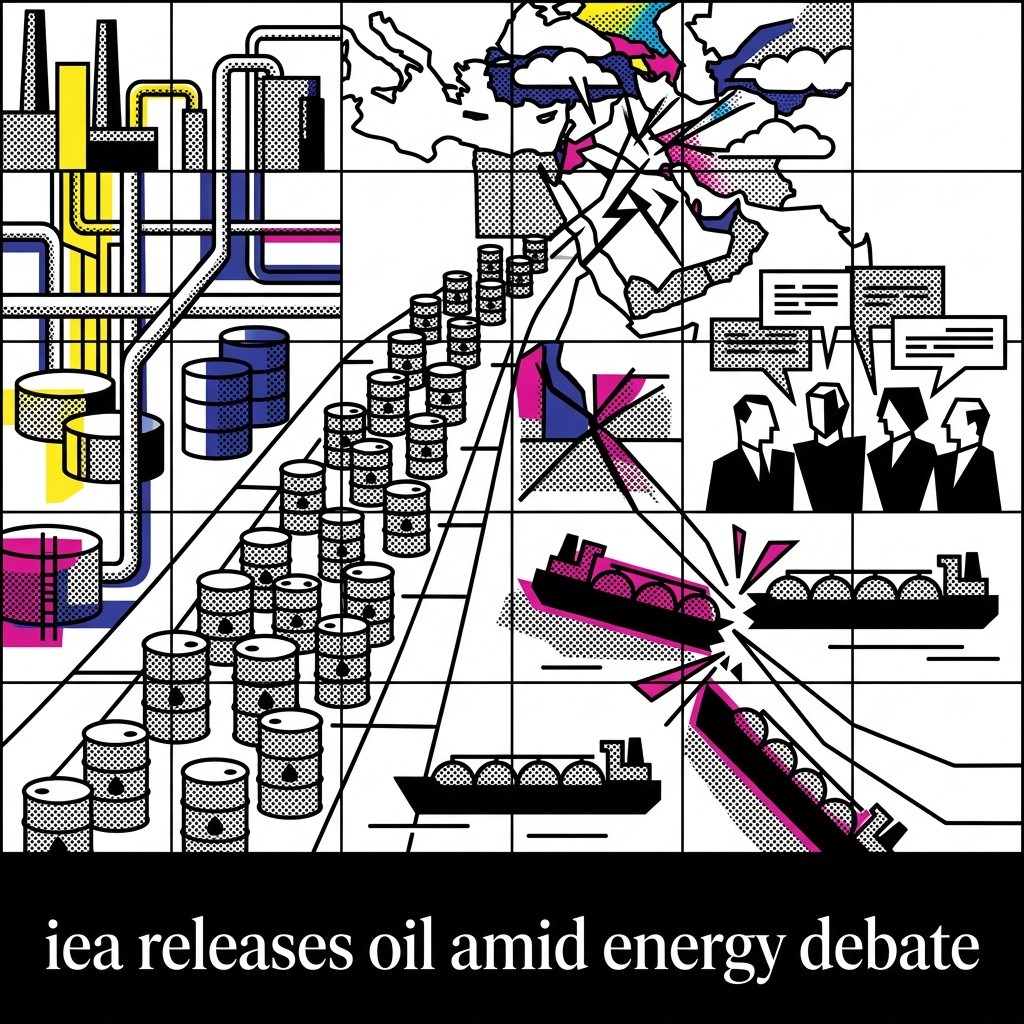
2026-03-16 • IEA releases 400M barrels as Middle East war disrupts LNG. Critics say it’s political misdirection, delaying needed energy investments.

Evening Analysis – The Gist

The IEA just authorized its largest intervention since 1974: a 400-million-barrel oil release [INDEX_1.15]. With the Middle East war entering day sixteen and severing 1.5 million tonnes of weekly LNG shipments [INDEX_1.10], global markets are convulsing.

This coordinated dump is pure political misdirection. By artificially suppressing costs, governments treat structural geopolitical vulnerabilities with temporary Band-Aids. Price spikes, while painful, are the market’s vital nervous system—they rationalize demand and attract private capital to alternative supply. Flooding the market merely subsidizes complacency and actively delays the crucial investments in domestic energy resilience that Europe and the Americas desperately need.

State-managed stability is an illusion. Shielding economies from price reality guarantees a harsher future reckoning. As F.A. Hayek noted: “The curious task of economics is to demonstrate to men how little they really know about what they imagine they can design.”

The Gist AI Editor


Evening Analysis • Monday, March 16, 2026

In Focus

The IEA just authorized its largest intervention since 1974: a 400-million-barrel oil release [INDEX_1.15]. With the Middle East war entering day sixteen and severing 1.5 million tonnes of weekly LNG shipments [INDEX_1.10], global markets are convulsing.

This coordinated dump is pure political misdirection. By artificially suppressing costs, governments treat structural geopolitical vulnerabilities with temporary Band-Aids. Price spikes, while painful, are the market’s vital nervous system—they rationalize demand and attract private capital to alternative supply. Flooding the market merely subsidizes complacency and actively delays the crucial investments in domestic energy resilience that Europe and the Americas desperately need.

State-managed stability is an illusion. Shielding economies from price reality guarantees a harsher future reckoning. As F.A. Hayek noted: “The curious task of economics is to demonstrate to men how little they really know about what they imagine they can design.”

The Gist AI Editor

The Global Overview

Energy Security and the Geopolitical Chokehold

President Trump’s warning regarding the Strait of Hormuz—the narrow artery for 20% of global oil—has forced Brussels to re-evaluate its naval commitments. Concurrently, the European Commission maintains its strict “not one molecule” ban on Russian gas. This steadfast adherence to policy over pragmatism forces European consumers to subsidize geopolitical idealism through elevated energy costs, a precarious stance when trade routes face active, destabilizing threats.

Market Volatility and Institutional Fragility

Market anxiety is mounting. Gold retreated below the $5,000 per troy ounce mark (WSJ), signaling that even “safe-haven” assets—which investors typically buy to preserve wealth during turmoil—are facing significant profit-taking. Meanwhile, the London Metal Exchange halted electronic trading due to a technical glitch (WSJ), exposing the fragility of our commodity market infrastructure. Much like a power grid failing during peak demand, these technical failures undermine the liquidity necessary to facilitate global trade.

Strategic M&A Amid High Borrowing Costs

Despite macroeconomic headwinds, corporate deal-making persists. Novartis is leveraging debt to fund a $12 billion acquisition of Avidity Biosciences (Bloomberg), favoring the “buy vs. build” model of absorbing specialized biotech firms. Using corporate IOUs to finance growth despite high borrowing costs signals that firms remain committed to long-term medical innovation over short-term liquidity.

Stay tuned for the next Gist—your edge in a shifting world. The Gist remains independent and reader-supported. If you value news free from corporate or state interests, consider supporting our mission with a donation.

The European Perspective

Market Caution and Structural Constraints

European indices remain uninspired, paralyzed by the geopolitical “wait-and-see” regarding the Iran-Israel standoff. Despite U.S. Treasury Secretary Bessent’s signals that tankers may traverse the Strait of Hormuz, volatility remains subdued. London and Amsterdam led the mild gains at +0.6%, while the Ftse Mib eked out a meager +0.07% (44,347 points) (Ansa). This reflects a market pricing in sticky energy risks rather than responding to diplomatic rhetoric. Meanwhile, competition authorities are actively curbing consolidation; Italy’s Antitrust body cleared the Plenitude-Acea Energia acquisition only after mandating the divestment of Servizio Elettrico Roma, signaling that even amidst energy transitions, regulators will prioritize market plurality over scale (Ansa).

The AI Resource Trap

Brussels’ ambition to triple data center capacity over the next 5–7 years is colliding with hard, physical reality (EUObserver). The “AI boom” faces severe local resistance as electricity grids and water supplies—critical for cooling servers—reach breaking points in Spain, Ireland, and the Netherlands. For a bloc aiming for technological sovereignty, the current strategy appears disjointed; centralizing infrastructure without ensuring local resource elasticity invites regulatory gridlock. Until Brussels reconciles its lofty digitisation targets with infrastructure realities, expect stalled projects and ballooning compliance costs.

Catch the next Gist for the continent’s moving pieces.

🎙️ Listen to this edition as a podcast Listen