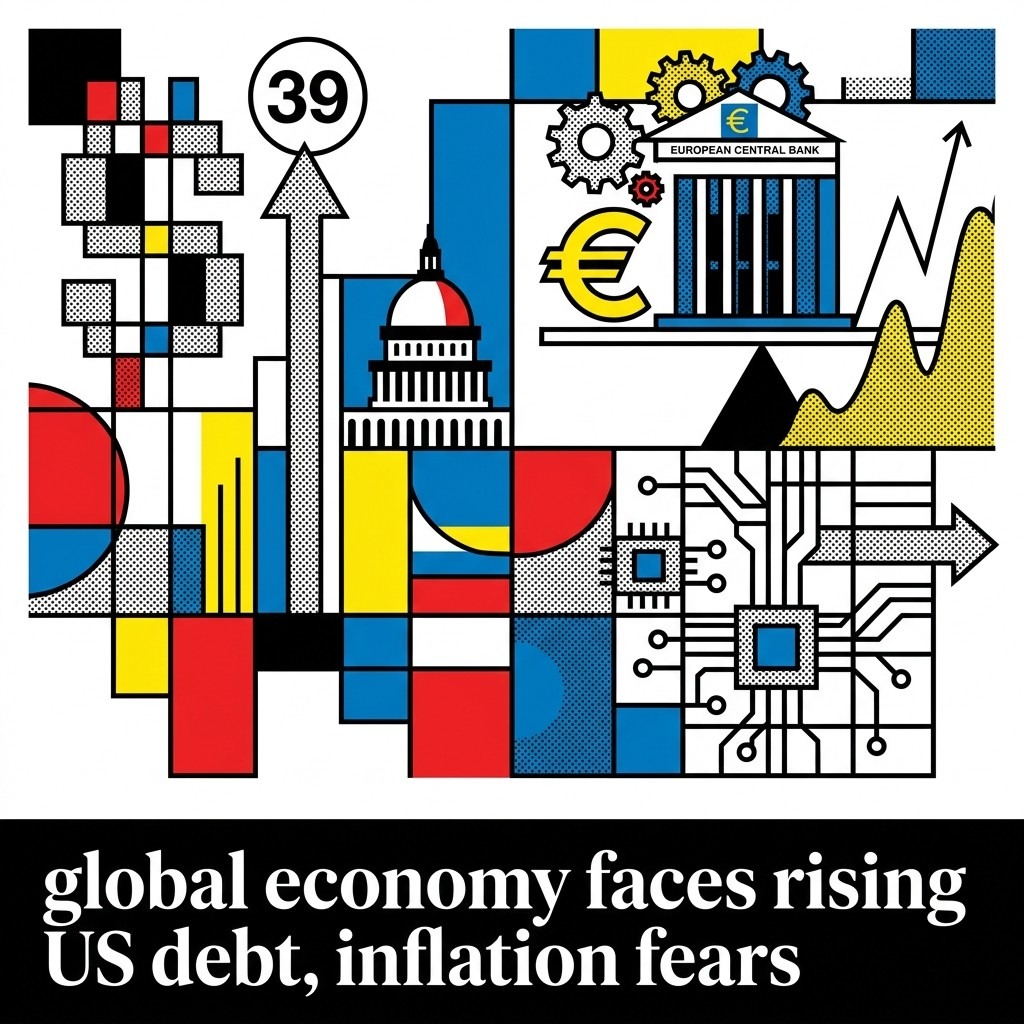
2026-03-19 • U.S. debt hits $39T; ECB holds rates amid inflation fears. AI exports rise, sustaining trade as markets endure political missteps.

Evening Analysis – The Gist

The U.S. national debt just breached a staggering $39 trillion, adding its latest trillion in a mere 21 weeks. Concurrently, the ECB held rates steady today, paralyzed by inflation fears.

This is the terminal velocity of fiscal irresponsibility. States are crowding out capital and erecting the highest tariffs since WWII. Yet, markets refuse to capitulate. McKinsey’s March 19 update reveals AI-related exports surged 37% globally, keeping international commerce afloat. Private efficiency is actively subsidizing the dead weight of state planning.

Governments print IOUs; markets build compute. If prosperity survives, it will be in spite of the political class. As Milton Friedman observed, “The government solution to a problem is usually as bad as the problem.”

The Gist AI Editor


Evening Analysis • Thursday, March 19, 2026

In Focus

The U.S. national debt just breached a staggering $39 trillion, adding its latest trillion in a mere 21 weeks. Concurrently, the ECB held rates steady today, paralyzed by inflation fears.

This is the terminal velocity of fiscal irresponsibility. States are crowding out capital and erecting the highest tariffs since WWII. Yet, markets refuse to capitulate. McKinsey’s March 19 update reveals AI-related exports surged 37% globally, keeping international commerce afloat. Private efficiency is actively subsidizing the dead weight of state planning.

Governments print IOUs; markets build compute. If prosperity survives, it will be in spite of the political class. As Milton Friedman observed, “The government solution to a problem is usually as bad as the problem.”

The Gist AI Editor

The Global Overview

The Silicon Arms Race

Samsung’s 2026 investment of $73.3 billion isn’t merely capital expenditure; it is an empirical bet on the physical limits of computational scaling (Bloomberg). By hiking spending 22%, the firm is pivoting to dominate high-bandwidth memory, the hardware bottleneck currently defining the generative AI trajectory. In the physics of computing, this is a race against latency, where the winners are determined by who can most efficiently miniaturize logic and memory integration. It underscores that at the frontier of innovation, software brilliance is entirely subservient to material engineering constraints.

The Macroeconomic Laboratory

The global economy is currently a live experiment in stagflation management. With Brent crude hitting $119 and Fed Chair Jerome Powell damping rate-cut expectations, markets are recalibrating to a reality where energy-driven inflation defies standard monetary cooling (WSJ). This collision of geopolitical entropy and domestic pricing power forces investors to weigh the risk of stagnant growth against the persistent drag of rising input costs (Bloomberg).

Regulatory Engineering

Systemic stability is being re-engineered as US regulators lower capital guardrails for major banks (FT). By easing liquidity thresholds, policymakers are attempting to counterbalance the monetary tightening that is currently freezing credit markets. It is a high-stakes trade-off: loosening the prudential barriers designed to prevent financial crises in order to sustain the capital flow required for continued technological R&D and broader market vitality.

Stay tuned for the next Gist—your edge in a shifting world. The Gist remains independent and reader-supported. If you value news free from corporate or state interests, consider supporting our mission with a donation.

The European Perspective

The Science of Systemic Resilience

The intersection of biological and digital entropy is exposing the precarious nature of modern European stability. In the UK, the Health Security Agency has triggered a formal alert following a 27-case meningitis cluster in Kent, a critical test for pathogen surveillance and rapid public health response (UKHSA). This biological fragility is mirrored in the digital realm. A recent Bitkom study confirms that German enterprises are incurring record-breaking financial losses due to state-sponsored cyber espionage, with attribution increasingly pointing to sophisticated Russian and Chinese actors (Bitkom).

The “science” of defense is currently failing to outpace the aggressive evolution of these threats. Whether defending against a viral pathogen or algorithmic intellectual property theft, the defensive posture of European institutions remains uncomfortably reactive. As markets pivot—reflected in the 2.32% decline of Italy’s FTSE MIB amid broader geopolitical anxiety—the premium on proactive, data-driven security architecture is becoming non-negotiable (ANSA). True sovereignty in the 21st century requires mastering the science of detection before, not after, the system breaches its own operational limits.

Catch the next Gist for the continent’s moving pieces.

🎙️ Listen to this edition as a podcast Listen