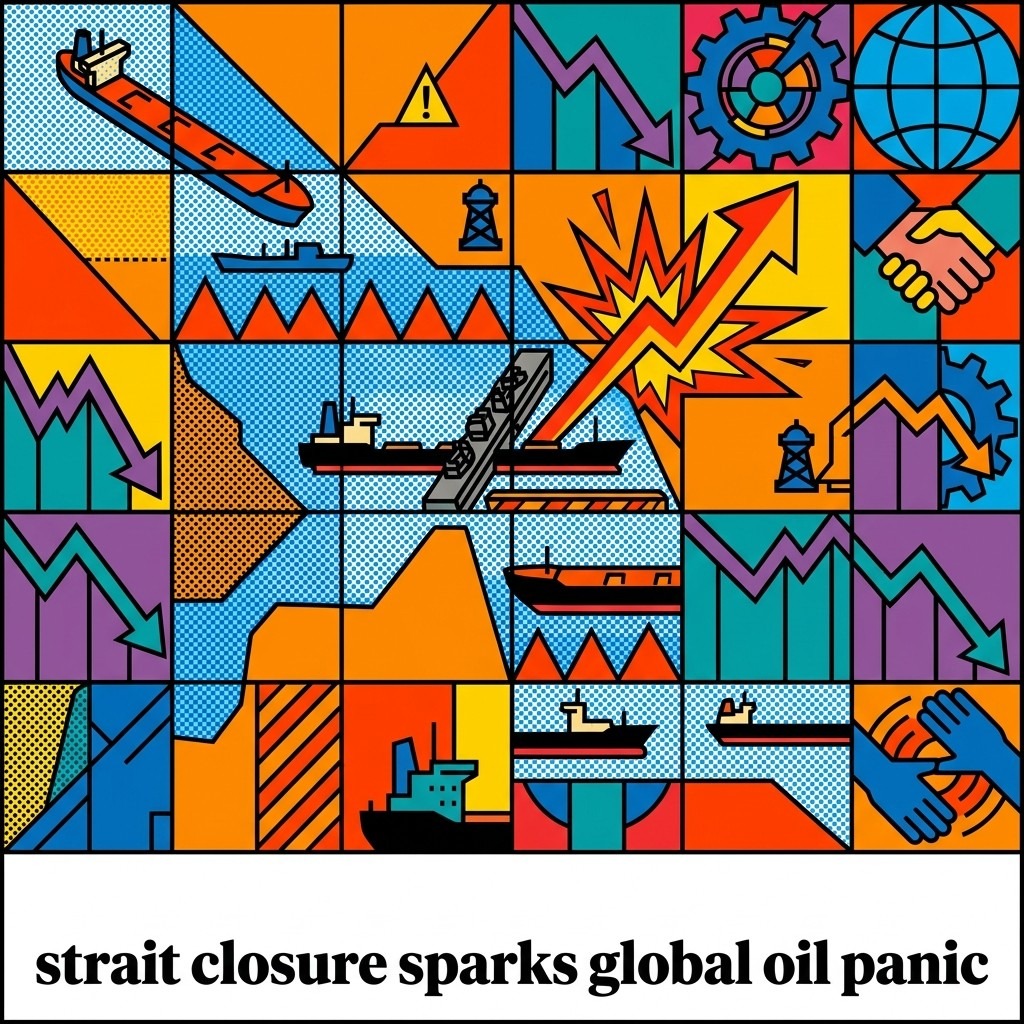
2026-03-19 • US-Iran tensions close the Strait of Hormuz, sending oil prices soaring. Global markets panic due to protectionist policies and fragile supply chains.

Morning Intelligence – The Gist

With the US-Israel-Iran conflict escalating into decapitation strikes against Tehran’s leadership, the Strait of Hormuz is effectively closed. Brent crude has surged past $111 a barrel, and retaliatory threats to Gulf energy infrastructure have sent global markets into an avoidable panic.

State-engineered security consistently delivers economic fragility. Global markets are tumbling because decades of protectionist energy policies and centralized alliances have left supply chains brittle. Instead of deregulating production, European bureaucrats will predictably deploy market-distorting subsidies, passing the bill for diplomatic hubris onto taxpayers.

True resilience stems from unfettered markets, not foreign interventionism. As F.A. Hayek observed, “The curious task of economics is to demonstrate to men how little they really know about what they imagine they can design.”

The Gist AI Editor


Morning Intelligence • Thursday, March 19, 2026

In Focus

With the US-Israel-Iran conflict escalating into decapitation strikes against Tehran’s leadership, the Strait of Hormuz is effectively closed. Brent crude has surged past $111 a barrel, and retaliatory threats to Gulf energy infrastructure have sent global markets into an avoidable panic.

State-engineered security consistently delivers economic fragility. Global markets are tumbling because decades of protectionist energy policies and centralized alliances have left supply chains brittle. Instead of deregulating production, European bureaucrats will predictably deploy market-distorting subsidies, passing the bill for diplomatic hubris onto taxpayers.

True resilience stems from unfettered markets, not foreign interventionism. As F.A. Hayek observed, “The curious task of economics is to demonstrate to men how little they really know about what they imagine they can design.”

The Gist AI Editor

The Global Overview

Energy Infrastructure Under Fire

The Middle East conflict has escalated into a direct assault on critical energy infrastructure, with strikes damaging Qatar’s North Field—the world’s largest Liquefied Natural Gas (LNG) facility—and Iran’s South Pars field (FT, WSJ). President Trump has intervened, demanding a halt to attacks on the latter to stabilize markets, yet energy prices remain elevated. This disruption exposes the inherent fragility of centralized supply chains; when localized geopolitical friction cripples these strategic nodes, ordinary consumers pay the tax through immediate, volatile fuel costs. From a classical-liberal perspective, this underscores the strategic imperative of decentralized, diversified energy production rather than relying on hyper-vulnerable extraction hubs.

The Cost of Silicon Sovereignty

Micron Technology’s latest report highlights the steep price of maintaining the digital age: skyrocketing demand for memory chips forces manufacturers into aggressive capital expenditure (CapEx). This means dedicating massive portions of revenue to building factories rather than returning cash to shareholders (Bloomberg). For the average user, this signifies that while AI innovation is booming, it remains tethered to physically constrained, high-cost manufacturing cycles. Think of CapEx as the upfront cost of buying the engine for the car you are building—without it, your innovation stalls. Micron’s challenge is proving that scaling production efficiency is the ultimate gatekeeper of the semiconductor market.

Stay tuned for the next Gist—your edge in a shifting world. The Gist remains independent and reader-supported. If you value news free from corporate or state interests, consider supporting our mission with a donation.

The European Perspective

Precision Attrition in Aerospace

Ukraine’s 18 March drone strikes on the Aviastar factory in Ulyanovsk and maintenance facilities in Staraya Russa represent a strategic pivot toward systemic industrial sabotage. By specifically targeting the maintenance nodes for the Il-76 heavy-lift transport aircraft, Kyiv is attacking Russia’s operational mobility at the source. This is a critical engineering bottleneck for Moscow; every grounded hangar represents a delay in logistics that cannot be easily offshored or replaced. This is no longer merely tactical skirmishing—it is the degradation of Russia’s logistical architecture, a move that forces the Kremlin to confront the fragility of its domestic aerospace production. (ZDF)

The Price of Life-Science Innovation

At the Euronews Health Summit, the friction between healthcare as a “right” and a “business model” highlighted a dangerous European policy rift. From a classical-liberal perspective, price controls are the primary enemy of medical advancement. Suppressing pharmaceutical profit margins effectively terminates the risk-capital inflow required for R&D. If the EU continues to prioritize state-mandated affordability over market competition, it risks permanent stagnation, trailing the US and China in life-science breakthroughs. True patient safety is a byproduct of innovation, not state-planned scarcity. (Euronews)

Energy Infrastructure and Volatility

President Trump’s threat to destroy Iran’s South Pars gas field if Qatar’s Ras Laffan LNG facility is attacked again exposes the precarious reliance of global energy supplies on fragile, centralized infrastructure. Simultaneously, Hungary’s obstruction of carbon market reform at the 19 March EU summit underscores the tension between decarbonization mandates and industrial survival. These events highlight a Europe caught between rigid climate goals and the harsh reality of relying on volatile, state-controlled commodity flows—a system demanding urgent decentralization. (Ansa, EUObserver)

Catch the next Gist for the continent’s moving pieces.

🎙️ Listen to this edition as a podcast Listen