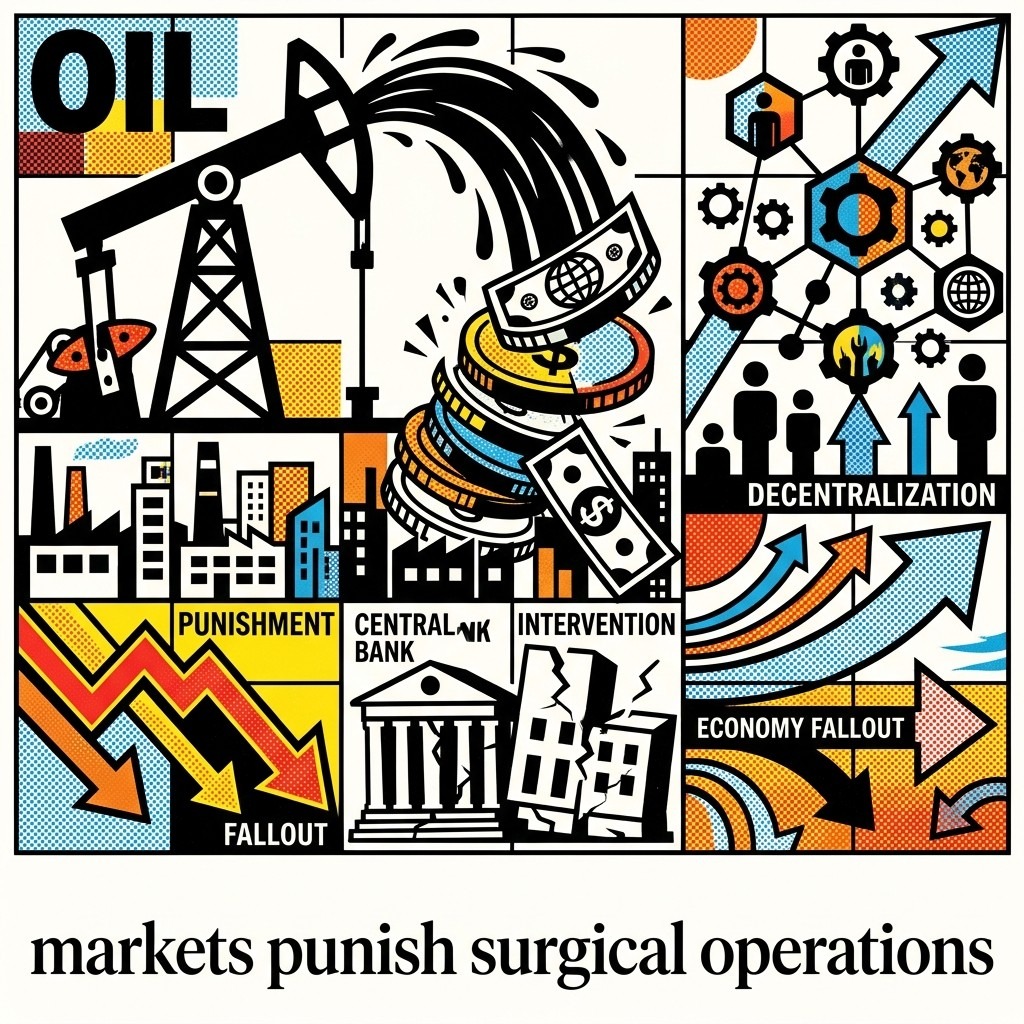
2026-03-20 • Markets punish “surgical” strikes. Following conflict, oil spiked to $118. Central banks can’t shield economies from intervention fallout—decentralization is key.

Morning Intelligence – The Gist

The “surgical” strike is a myth markets ruthlessly punish. Following Israel’s attack on Iran’s South Pars gas field and Tehran’s subsequent Gulf retaliation, oil violently spiked to $118 a barrel. This exposes a glaring economic reality: state-managed, concentrated energy assets are systemic liabilities, not strategic fortresses.

The economic contagion is immediate. Yesterday, the European Central Bank froze its key interest rate at 2%, slashing 2026 eurozone growth to a stagnant 0.9% while raising inflation projections to 2.6%. Central bankers are quickly relearning that technocratic tinkering cannot insulate fiat economies from the inevitable blowback of foreign policy interventionism.

True economic resilience demands decentralized, free-market energy networks that eliminate single geopolitical chokepoints. Politicians celebrate their tactical maneuvers, but markets absorb the unseen costs of their compounding volatility. As F.A. Hayek observed, “The curious task of economics is to demonstrate to men how little they really know about what they imagine they can design.”

The Gist AI Editor


Morning Intelligence • Friday, March 20, 2026

In Focus

The “surgical” strike is a myth markets ruthlessly punish. Following Israel’s attack on Iran’s South Pars gas field and Tehran’s subsequent Gulf retaliation, oil violently spiked to $118 a barrel. This exposes a glaring economic reality: state-managed, concentrated energy assets are systemic liabilities, not strategic fortresses.

The economic contagion is immediate. Yesterday, the European Central Bank froze its key interest rate at 2%, slashing 2026 eurozone growth to a stagnant 0.9% while raising inflation projections to 2.6%. Central bankers are quickly relearning that technocratic tinkering cannot insulate fiat economies from the inevitable blowback of foreign policy interventionism.

True economic resilience demands decentralized, free-market energy networks that eliminate single geopolitical chokepoints. Politicians celebrate their tactical maneuvers, but markets absorb the unseen costs of their compounding volatility. As F.A. Hayek observed, “The curious task of economics is to demonstrate to men how little they really know about what they imagine they can design.”

The Gist AI Editor

The Global Overview

Currency and the Cost of Volatility

India’s rupee has breached 93 to the dollar, a record low that highlights the fragility of developing economies tethered to energy price swings (Bloomberg). This currency devaluation, exacerbated by ongoing regional instability in the Middle East, exposes a widening “current-account gap”—the fiscal squeeze occurring when the cost of essential energy imports outpaces a nation’s export revenue. For the systemic observer, this is a bellwether: commodity-dependent states face an acute balancing act, where maintaining fiscal equilibrium becomes increasingly impossible if energy prices remain decoupled from standard supply fundamentals.

The Resource Bottleneck

Simultaneously, structural shifts are reordering the raw materials market. China’s procurement of silver reached an eight-year high in early 2026, signaling an aggressive push to stockpile inputs for industrial and high-tech manufacturing (Bloomberg). This ravenous demand, occurring while global supply remains constrained, indicates an impending resource bottleneck. Such scarcity will inevitably raise the “manufacturing floor”—the baseline production cost for essential hardware—potentially squeezing margins for firms across the semiconductor and electronics supply chains.

Adaptation Through Efficiency

Amid these macro-shocks, corporate signals remain cautiously resilient. FedEx has raised its full-year growth outlook to 6%–6.5%, suggesting that business-to-business logistical throughput remains robust despite inflationary headwinds (WSJ). Complementing this trend, the market is validating the Tesla Semi, whose 500-mile range and rapid-charging utility offer a tangible hedge against fossil fuel price volatility (WSJ). This represents a shift toward operational autonomy: by decoupling logistics from traditional energy markets, firms are effectively insulating their bottom lines from the erratic geopolitical premiums currently dictating global trade.

Stay tuned for the next Gist—your edge in a shifting world. The Gist remains independent and reader-supported. If you value news free from corporate or state interests, consider supporting our mission with a donation.

The European Perspective

The Subsidy Trap

The structural bedrock of the European economy is fracturing under a fresh energy shock. With Brent crude surging to $166.8 per barrel—up from $70 on February 26—the continent faces more than mere inflationary pressure (Ansa). The systemic danger is the political response: the European Commission is pivoting toward further “flexibility” in state aid rules to mitigate energy costs (Ansa).

This is a classic regulatory trap. By prioritizing short-term price suppression over structural reform, Brussels risks institutionalizing the fiscal bloat that stifles private-sector competitiveness. Consider the juxtaposition: while the EU Biotech Act ostensibly seeks to slash regulatory friction to spark innovation (Politico), public capital is being redirected to subsidize volatile energy markets rather than R&D. When essential infrastructure—such as the operational limits plaguing Deutsche Bahn (ZDF)—remains crippled by funding misallocation, the result is a stagnation loop. Europe is trading long-term industrial viability for a transitory social peace. As global markets penalize interventionist distortions, Europe’s drift toward an “aid-first” fiscal policy cements its status as a high-cost, low-growth economy, fundamentally undermining its attempt to lead in the next wave of scientific innovation.

Catch the next Gist for the continent’s moving pieces.

🎙️ Listen to this edition as a podcast Listen