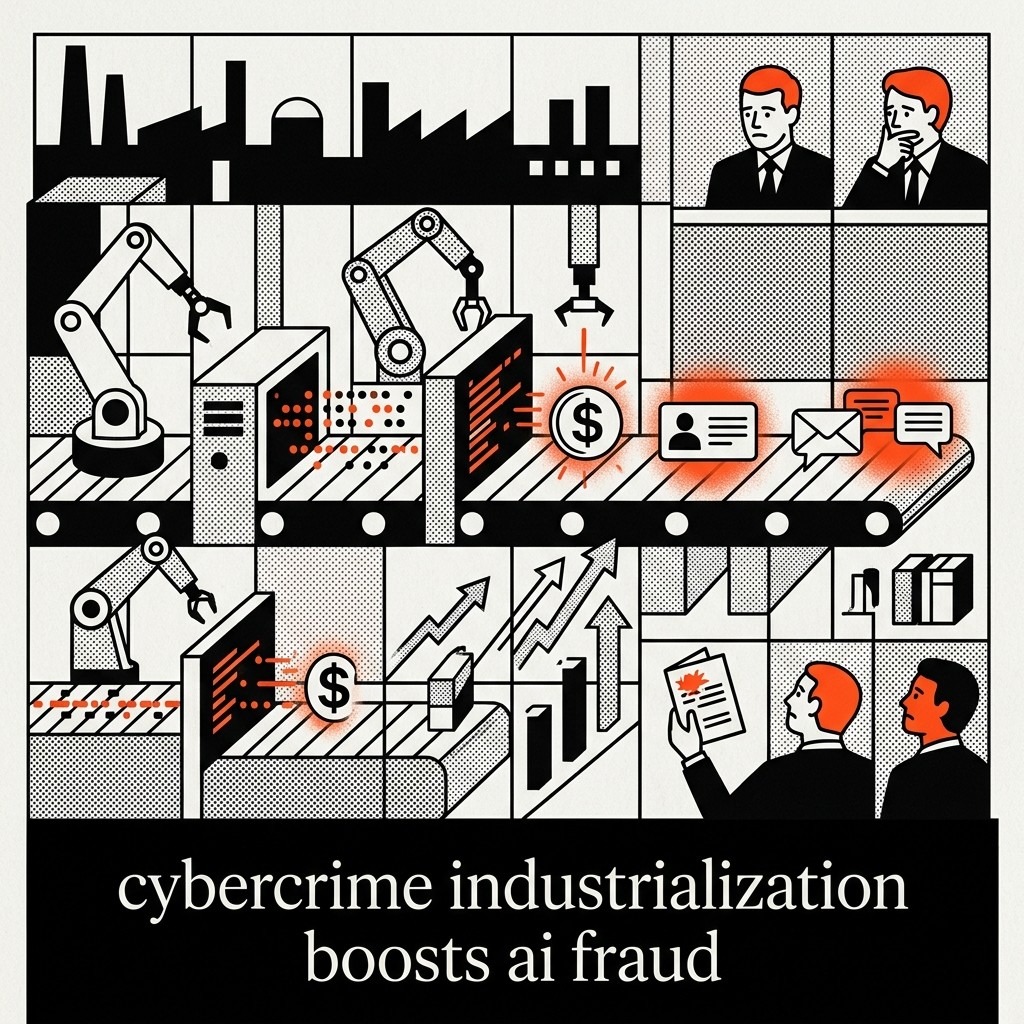
2026-03-21 • Cybercrime’s industrialization boosts AI-driven fraud. Regulators may impose mandates, but market-driven AI security adapts faster.

Evening Analysis – The Gist

The industrialization of cybercrime structurally alters digital security. An INTERPOL report reveals “agentic AI” makes fraud 4.5 times more profitable, autonomously executing global campaigns.

Regulators will predictably demand heavy-handed AI mandates—entrenching monopolies while failing to deter agile adversaries. Yet, the market already prices this risk. Dedicated corporate AI security budgets have surged to 30% this year. Survival incentives drive adaptation far faster than sluggish international treaties.

Resilience is not legislated; it is competitively stress-tested. The ultimate defense against rogue code is a frictionless market deploying superior countermeasures. As F.A. Hayek observed: “The curious task of economics is to demonstrate to men how little they really know about what they imagine they can design.”

The Gist AI Editor


Evening Analysis • Saturday, March 21, 2026

In Focus

The industrialization of cybercrime structurally alters digital security. An INTERPOL report reveals “agentic AI” makes fraud 4.5 times more profitable, autonomously executing global campaigns.

Regulators will predictably demand heavy-handed AI mandates—entrenching monopolies while failing to deter agile adversaries. Yet, the market already prices this risk. Dedicated corporate AI security budgets have surged to 30% this year. Survival incentives drive adaptation far faster than sluggish international treaties.

Resilience is not legislated; it is competitively stress-tested. The ultimate defense against rogue code is a frictionless market deploying superior countermeasures. As F.A. Hayek observed: “The curious task of economics is to demonstrate to men how little they really know about what they imagine they can design.”

The Gist AI Editor

The Global Overview

Geopolitical Power Projection

Iran’s missile strike on the UK’s Diego Garcia base (FT) signals a profound leap in strike capacity, forcing Western defense planners to rethink force protection beyond the Persian Gulf. This escalation exposes systemic vulnerabilities in naval hubs previously considered beyond the reach of conventional regional adversaries. The strategic calculus has shifted: Tehran is no longer constrained by proximity, and the cost of maintaining forward-deployed security assets—long dependent on the assumption of relative isolation—is spiking, testing the resilience of current defense deployment architectures.

Tech Supply Chain Integrity

The indictment of Super Micro co-founder Wally Liaw for channeling Nvidia chips into China (WSJ) exposes a critical bottleneck in US export controls. When high-end compute hardware, the core of the current AI infrastructure, leaks through established commercial networks, the US containment strategy is fundamentally undermined. This effectively cedes technological superiority to Beijing via simple regulatory arbitrage, proving that as long as market incentives for smuggling high-margin hardware exceed the deterrent of enforcement, the US’s primary lever for maintaining the AI moat remains porous.

AI Capital Allocation

OpenAI’s plan to scale its workforce to 8,000 by late 2026 to contest Anthropic reflects a massive, capital-intensive deployment cycle (FT). While the $730bn valuation seeks to cement market dominance, this arms race illustrates a structural paradox: firms are pouring billions into human capital and compute—the primary inputs—yet the promised surge in labor productivity remains tethered to existing economic limits. It is a high-stakes race where the cost of deceleration far outweighs the risks of extreme over-capitalization.

Stay tuned for the next Gist—your edge in a shifting world. The Gist remains independent and reader-supported. If you value news free from corporate or state interests, consider supporting our mission with a donation.

The European Perspective

Bioethical Stagnation

Germany’s reconsideration of the ban on egg donation signals a collision between bioethical rigidity and the imperative of demographic survival. With one in six German couples facing involuntary childlessness (ZDF), the current regulatory bottleneck acts as an artificial depressant on reproductive potential. Policymakers are realizing that strict adherence to legacy social laws is increasingly incompatible with the structural demographic decline facing the eurozone’s largest economy. The move reflects a pragmatic shift, prioritizing resource-building over ideological preservation.

Corporate Friction

European labor markets are simultaneously confronting a hidden efficiency crisis. In Italy, assessment data reveals that a failed middle-management hire imposes a realized cost of 35,000 to 45,000 euros in lost productivity and organizational volatility (Il Sole 24 Ore). As capital costs remain high, these avoidable selection errors represent a significant leakage in corporate resource allocation, forcing firms to overhaul recruitment architectures to minimize systemic friction.

Algorithmic Liability

The drift toward automated, clerical-led triage in healthcare provides a stark warning for European social systems. Reports regarding AI-driven screening protocols highlight the danger of substituting high-touch medical expertise for administrative speed (The Guardian). This creates a structural risk: the short-term gains of automating public services often mask long-term health liabilities—a critical friction point as Europe integrates AI into its social welfare frameworks.

Catch the next Gist for the continent’s moving pieces.

🎙️ Listen to this edition as a podcast Listen