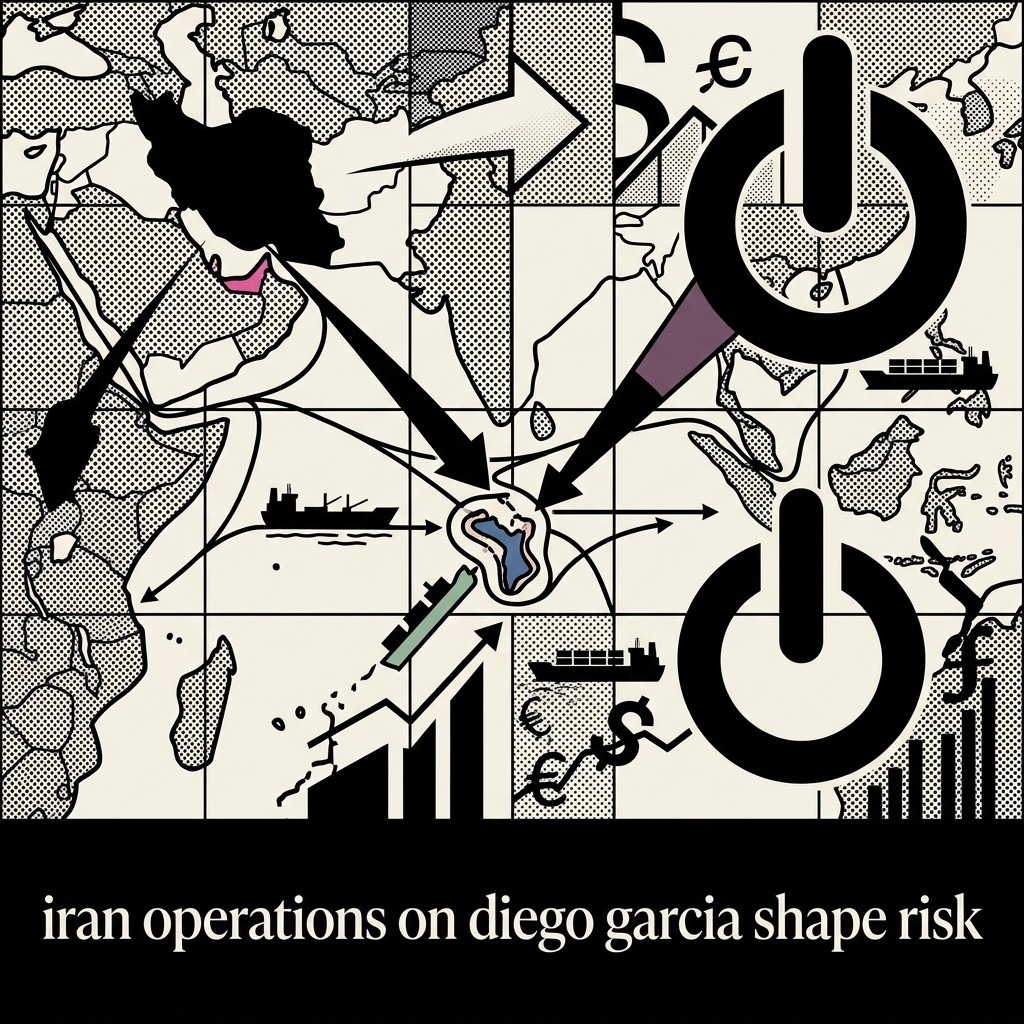
2026-03-22 • Iran’s strike on Diego Garcia extends its conflict reach, impacting global markets and security, as state power reshapes geopolitical risks.

Morning Intelligence – The Gist

Geopolitical boundaries are rarely erased by treaties; they are shattered by the calculus of state power. Tehran’s ballistic strike on Diego Garcia redraws the global risk map. By breaking its 2,000-km limit to target a base 4,000-km away, Iran hasn’t just retaliated for the allied bombing of its Natanz nuclear site—it has expanded the geographic theater of market fragility.

This escalation forces capital to reprice security. When states expand the conflict radius, they inevitably drag private enterprise and energy markets into their vortex. The illusion of isolated instability evaporates, leaving free markets to absorb the friction costs of militarized unpredictability.

As Ludwig von Mises observed, “The market economy involves peaceful cooperation. It bursts asunder when citizens turn into warriors.”

The Gist AI Editor


Morning Intelligence • Sunday, March 22, 2026

In Focus

Geopolitical boundaries are rarely erased by treaties; they are shattered by the calculus of state power. Tehran’s ballistic strike on Diego Garcia redraws the global risk map. By breaking its 2,000-km limit to target a base 4,000-km away, Iran hasn’t just retaliated for the allied bombing of its Natanz nuclear site—it has expanded the geographic theater of market fragility.

This escalation forces capital to reprice security. When states expand the conflict radius, they inevitably drag private enterprise and energy markets into their vortex. The illusion of isolated instability evaporates, leaving free markets to absorb the friction costs of militarized unpredictability.

As Ludwig von Mises observed, “The market economy involves peaceful cooperation. It bursts asunder when citizens turn into warriors.”

The Gist AI Editor

The Global Overview

Energy Scarcity and Social Normalization

The conflict in the Persian Gulf tests global market psychology. With 20% of the world’s oil supply originating from the region, the impending “gas supply cliff edge”—marked by the arrival of the final LNG shipments that departed before the strikes (FT)—signals a critical tightening of energy flows. Yet, the culture of “business as usual” persists; commercial flights continue to traverse the region despite active conflict (WSJ), demonstrating how deep-seated economic dependency compels societies to normalize systemic volatility rather than retreat from high-risk zones.

Private Industrial Sovereignty

Elon Musk’s “Terafab” project in Austin signals a pivot in the culture of innovation: the privatization of strategic industrial capacity. By vertically integrating chip manufacturing across Tesla, SpaceX, and xAI, Musk is essentially opting out of fragile, politicized global semiconductor supply chains. This reflects a broader trend where hyper-capitalized entities assume state-like responsibilities, effectively bypassing the sluggish pace of traditional infrastructure deployment to secure their own institutional survival.

The Structural Cost of Entropy

Climate volatility is no longer a peripheral concern but a primary driver of fiscal instability. With the rate of global warming nearly doubling in the last decade (Straits Times), physical infrastructure is being pushed to the brink. This degradation is forcing a cultural shift from speculative growth toward survivalist resource management, as the systemic friction of a changing planet imposes hard, inescapable limits on the trajectory of global order.

Stay tuned for the next Gist—your edge in a shifting world. The Gist remains independent and reader-supported. If you value news free from corporate or state interests, consider supporting our mission with a donation.

The European Perspective

Security Architecture Recalibration

The tactical stalemate in Ukraine is shifting toward a structural diplomatic re-engagement. As of March 22, 2026, US-brokered negotiations in Miami represent a tacit acknowledgment of resource exhaustion on both sides of the front. This move indicates that the conflict is moving from a phase of attrition to one of managed containment. The integration of diplomatic efforts alongside persistent localized kinetic activity—exemplified by drone strikes in Donetsk—suggests a pivot where military capability is being leveraged primarily to secure positioning for a ceasefire rather than total territorial acquisition. The systemic friction is clear: European energy and logistical resilience are fraying, necessitating a managed de-escalation that preserves the regional status quo while avoiding a complete breakdown of the continental security architecture (DW), (Ansa).

Orbital Hegemony

NASA’s April 1 launch of Artemis 2 signifies a fundamental transformation in orbital power dynamics. Unlike the Apollo-era bilateral rivalry with the USSR, the modern space race is defined by a multi-polar containment strategy against China. With the mission marking the first crewed lunar flight in 50 years, capital and technological incentives are no longer centered on national prestige, but on establishing proprietary lunar infrastructure and in-situ resource utilization rights. This acceleration mirrors a broader shift where space becomes a domain for Earth-bound resource security, forcing European nations to confront a binary choice: align with US-led interoperability or risk exclusion from emerging orbital standards as Chinese influence expands (El Pais).

Catch the next Gist for the continent’s moving pieces.

🎙️ Listen to this edition as a podcast Listen