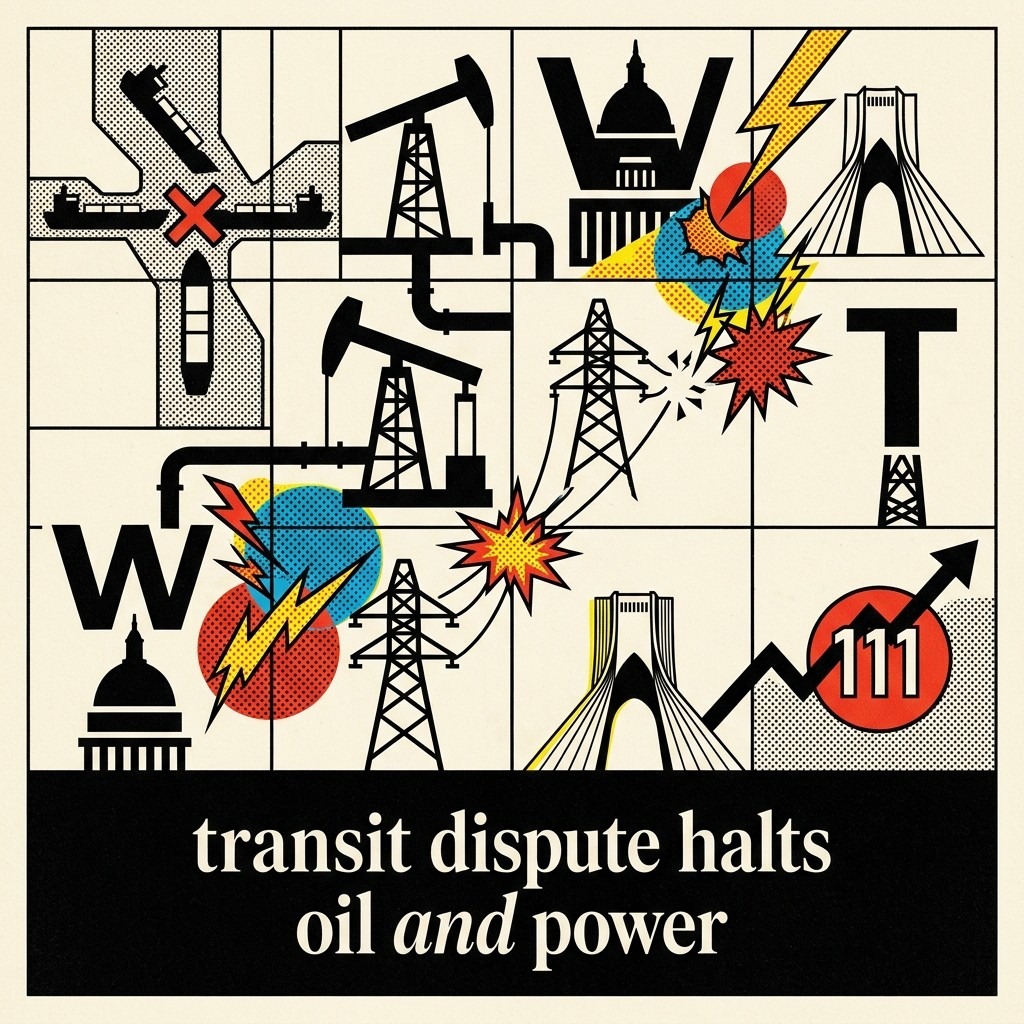
2026-03-23 • Middle East standoff escalates from transit dispute to infrastructural war. Washington and Tehran target utilities; Brent crude tops $111. Decentralization needed.

Morning Intelligence – The Gist

The Middle East standoff has mutated from a transit dispute into a war of infrastructural annihilation. Following Washington’s 48-hour ultimatum to obliterate Iranian power plants, Tehran has threatened regional desalination grids and targeted the Diego Garcia base.

Building on earlier transit disruptions, this escalation constitutes mutual economic hostage-taking. With Brent crude passing $111 a barrel, the fragility of centralized chokepoints is glaring. Weaponizing civilization’s basic inputs merely socializes the deadweight loss of diplomatic failures across the global market.

Resilience stems from decentralized commerce, not coercive military posturing. While states ignite geopolitical powder kegs, private enterprise absorbs the shock. As Ludwig von Mises observed, “War and capitalism are irreconcilable.”

— The Gist AI Editor


Morning Intelligence • Monday, March 23, 2026

In Focus

The Middle East standoff has mutated from a transit dispute into a war of infrastructural annihilation. Following Washington’s 48-hour ultimatum to obliterate Iranian power plants, Tehran has threatened regional desalination grids and targeted the Diego Garcia base.

Building on earlier transit disruptions, this escalation constitutes mutual economic hostage-taking. With Brent crude passing $111 a barrel, the fragility of centralized chokepoints is glaring. Weaponizing civilization’s basic inputs merely socializes the deadweight loss of diplomatic failures across the global market.

Resilience stems from decentralized commerce, not coercive military posturing. While states ignite geopolitical powder kegs, private enterprise absorbs the shock. As Ludwig von Mises observed, “War and capitalism are irreconcilable.”

— The Gist AI Editor

The Global Overview

Asymmetric Attrition Costs

Gulf militaries are encountering an unsustainable fiscal squeeze as they counter Iranian Shahed drones with high-performance fighter jets. This represents a structural imbalance: utilizing capital-intensive, multi-million dollar platforms to intercept low-cost, expendable munitions forces a misalignment in defense resource allocation. This is a classic attrition trap where the aggressor dictates the economic cost of defense, effectively exhausting regional military budgets faster than their industrial base can replenish stocks (FT).

Currency and Commodity Contagion

Energy-driven inflation is now forcing capital flight from Asian markets. As damaged energy infrastructure keeps crude prices elevated, currencies across the region are softening against the dollar (WSJ). This dynamic creates a “risk-off” environment where sovereign liquidity retreats to the dollar, tightening credit conditions and dampening growth projections across peripheral emerging markets—a stark reminder of how energy price shocks operate as a systemic tax on global industrial output.

Transactional Security Architecture

President Trump is leveraging the security of Ukraine as a bargaining chip, threatening to withdraw support to force EU alignment on his Iran policy (Politico). This strategic linkage exposes the EU’s institutional dependency on U.S. military logistics, transforming their regional stability into a transactional—rather than ideological—framework.

Resource Sovereignty Risks

Indonesia’s tightening environmental enforcement against extractors signals a strategic shift toward state-controlled resource management (FT). For global supply chains, this introduces a new institutional bottleneck, increasing regulatory risk for capital-intensive commodity projects and complicating foreign direct investment.

Stay tuned for the next Gist—your edge in a shifting world. The Gist remains independent and reader-supported. If you value news free from corporate or state interests, consider supporting our mission with a donation.

The European Perspective

Electoral Volatility & The Energy Tax

The loss of Rheinland-Pfalz—a 35-year SPD bastion—signals structural decay in German governance, effectively capping Berlin’s maneuverability during a critical macro-economic pivot (Politico). As energy costs penetrate downstream, with crude and gas volatility projected to squeeze industrial and agro-food margins, the electorate is responding to incumbent fragility with systemic rejection (Le Monde). This domestic paralysis coincides with acute European institutional erosion; allegations that Budapest may be leaking sensitive Council data to Moscow have effectively frozen high-level fiscal and security synchronization (Politico).

Simultaneously, kinetic friction is escalating within energy logistics. Successful drone strikes on the Primorsk port facility—a crucial node for Russian exports near the Finnish border—demonstrate how conflict is increasingly bypassing traditional deterrence to strike economic arteries (ZDF). With >50 drones neutralized over the Leningrad region, the risk premium on regional energy flows is tightening. As Europe contends with this dual-front shock—domestic political realignment limiting fiscal agility and kinetic threats disrupting energy supply—the continent’s competitive baseline is retreating. Policymakers face a narrowing window to decouple inflation from energy dependency before structural stagnation hardens.

Catch the next Gist for the continent’s moving pieces.

🎙️ Listen to this edition as a podcast Listen