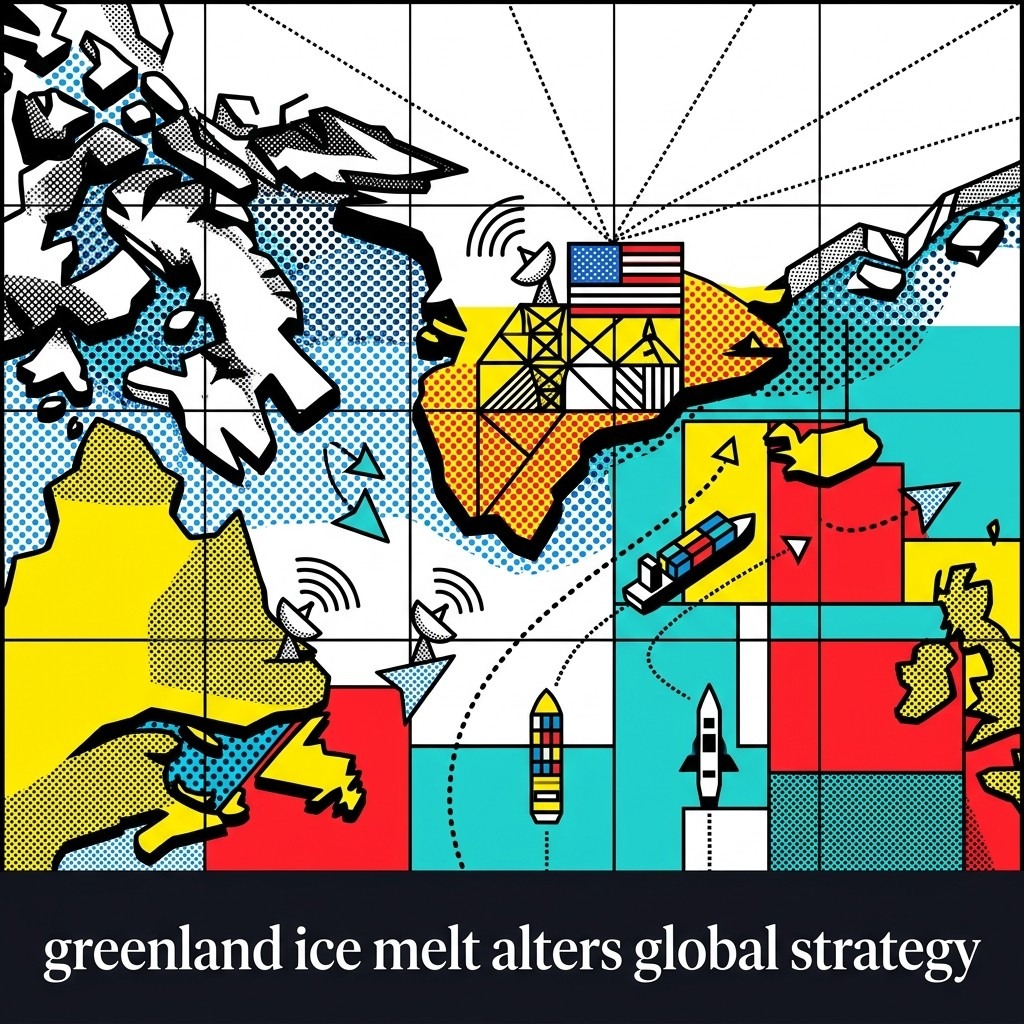
2026-03-24 • The Arctic’s thawing shifts it to a strategic zone. The U.S. seeks new military zones in Greenland to secure trade routes and early-warning systems.

Evening Analysis – The Gist

The thawing Arctic has transitioned from ecological casualty to premier strategic theater. This week, U.S. Northern Command requested three new military zones in Greenland. By pursuing special operations ports and space-tracking, Washington is structurally enclosing a newly navigable domain.

As receding ice strips away North America’s geographic shield, fortifying this “2 o’clock approach” mirrors a global pivot toward preemptive control. The structural incentive is absolute: militarizing the High North secures dominance over emerging trade corridors and vital early-warning architecture.

Superpowers must now militarily occupy the physical geography altered by their emissions. As NORTHCOM’s Gen. Gregory Guillot testified, establishing a “first line of defense” is paramount. Melting ice doesn’t just raise sea levels—it redraws the architecture of global hard power.

The Gist AI Editor


Evening Analysis • Tuesday, March 24, 2026

The Gist View

The thawing Arctic has transitioned from ecological casualty to premier strategic theater. This week, U.S. Northern Command requested three new military zones in Greenland. By pursuing special operations ports and space-tracking, Washington is structurally enclosing a newly navigable domain.

As receding ice strips away North America’s geographic shield, fortifying this “2 o’clock approach” mirrors a global pivot toward preemptive control. The structural incentive is absolute: militarizing the High North secures dominance over emerging trade corridors and vital early-warning architecture.

Superpowers must now militarily occupy the physical geography altered by their emissions. As NORTHCOM’s Gen. Gregory Guillot testified, establishing a “first line of defense” is paramount. Melting ice doesn’t just raise sea levels—it redraws the architecture of global hard power.

The Gist AI Editor

The Global Overview

Geopolitical Friction and the Cost of Capital

The Iran conflict is rattling U.S. Treasury yields—seeing the sharpest increase since 2024 (FT)—as markets price in a renewed inflationary impulse. This macro tension is compounding domestic systemic friction: the ongoing DHS shutdown. As United Airlines CEO Scott Kirby notes, the resulting logistical drag is degrading airport throughput (Bloomberg). When political gridlock degrades core transit infrastructure, the entire economy inevitably absorbs the efficiency loss.

The Industrial War Pivot

Volkswagen is shifting its Osnabrück plant from automotive production to missile defense, partnering with Rafael Advanced Defence Systems to preserve 2,300 jobs (FT). This industrial pivot illustrates a hard reality: capital is aggressively migrating from consumer discretionary sectors toward the guaranteed, state-backed returns of existential security hardware.

Private Credit’s Structural Reckoning

Private credit funds are reeling from overexposure to struggling software assets, providing a “vulture” opportunity for major banks. Big lenders are playing both sides, acting as liquidity providers to distressed funds while harvesting assets at a discount (WSJ). It is a classic systemic consolidation where traditional balance sheets exploit the liquidity vulnerabilities of non-bank lenders.

Climate Litigation as Policy Proxy

Climate litigation is evolving into a surrogate for regulatory policy. By integrating scientific data into the courtroom, advocates are bypassing legislative gridlock to force institutional shifts via judicial fiat (WSJ). The courtroom has become an active front-line for resource allocation.

Stay tuned for the next Gist—your edge in a shifting world. The Gist remains independent and reader-supported. If you value news free from corporate or state interests, consider supporting our mission with a donation.

The European Perspective

Middle East Force Projection

Pentagon operational orders indicate a surge of 3,000 troops from the 82nd Airborne Division into the Middle East (Ansa). This Trump-era mobilization marks a structural shift from deterrence to active positioning. For Europe, this accelerates pressure on NATO members to secure the alliance’s southern flank and complicates regional energy corridors. The reliance on the 82nd—a rapid-response asset—suggests Washington is prioritizing immediate power projection over diplomatic latency, forcing European capitals to recalibrate their own security spending to compensate for the shifted US focus.

The Demographic Liability

Europe’s dependency ratio is nearing a critical threshold. With one in three Europeans projected to be 65 or older by 2050 (Politico), Alzheimer’s has become a systemic fiscal threat. Healthcare resilience requires immediate integration of breakthrough treatments; without accelerated regulatory approval cycles, pension and social security models face long-term insolvency risks, creating a structural drag on GDP growth that current budget projections fail to adequately price in.

Institutional Governance Risk

Political stability in Germany is fraying. The turmoil surrounding NRW Minister Ina Scharrenbach following internal misconduct allegations (ZDF) exposes administrative fragility in the nation’s most populous state. Executive fractures erode policy implementation in critical industrial sectors, creating regulatory bottlenecks that incentivize capital to seek more predictable jurisdictions.

Catch the next Gist for the continent’s moving pieces.

🎙️ Listen to this edition as a podcast Listen