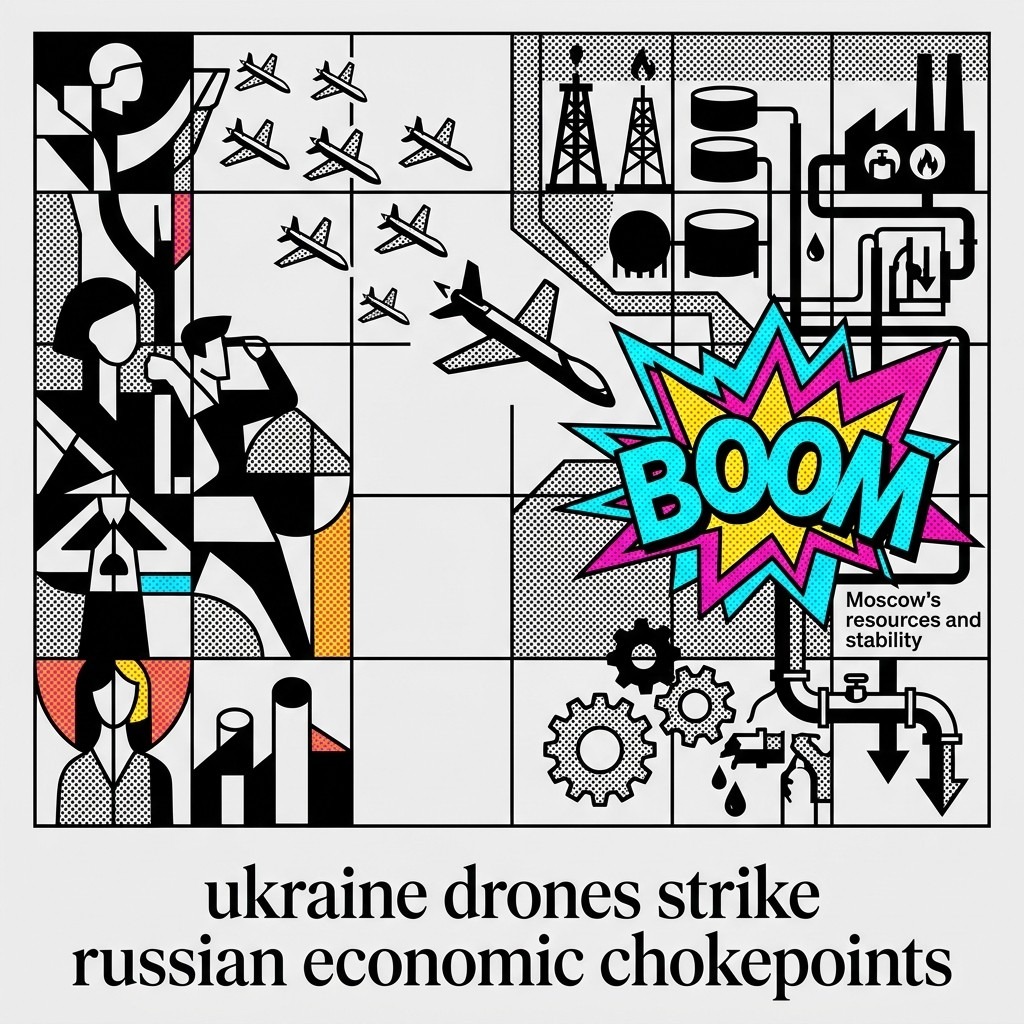
2026-03-24 • Ukraine targets Russian economic chokepoints, using drones to hit key sites like Primorsk to strain Moscow’s resources and stability.

Morning Intelligence – The Gist

What nobody is talking about is how Ukraine is bypassing trenches to wage structural war on Russian economic geography. Overnight, drones struck Primorsk—Russia’s main Baltic export hub—and a Bashkortostan refinery.

This weaponizes industrial chokepoints. By targeting a terminal handling 60 million tons of oil annually, Kyiv imposes an asymmetric tax on Moscow’s war engine. This forces the Kremlin to either redirect air defenses to protect sovereign revenue, or sustain frontline momentum.

Territorial control is secondary to systemic economic friction. Ukraine’s Defense Ministry stated true leverage requires making Russian urban life “uncomfortable”. By bringing “the war back to where it came from”, Kyiv proves modern power hinges on disrupting an adversary’s domestic stability.

The Gist AI Editor


Morning Intelligence • Tuesday, March 24, 2026

The Gist View

What nobody is talking about is how Ukraine is bypassing trenches to wage structural war on Russian economic geography. Overnight, drones struck Primorsk—Russia’s main Baltic export hub—and a Bashkortostan refinery.

This weaponizes industrial chokepoints. By targeting a terminal handling 60 million tons of oil annually, Kyiv imposes an asymmetric tax on Moscow’s war engine. This forces the Kremlin to either redirect air defenses to protect sovereign revenue, or sustain frontline momentum.

Territorial control is secondary to systemic economic friction. Ukraine’s Defense Ministry stated true leverage requires making Russian urban life “uncomfortable”. By bringing “the war back to where it came from”, Kyiv proves modern power hinges on disrupting an adversary’s domestic stability.

The Gist AI Editor

The Global Overview

The $100 Oil Floor

Markets are pricing in a persistent ‘war premium,’ with oil likely to sustain levels above $100 a barrel (WSJ) in the near term. This isn’t speculative; it reflects genuine supply losses and logistical friction. For industrial economies, this creates a sticky inflationary floor, forcing a strategic shift from expansionary investment to defensive cost-containment as energy inputs remain elevated.

India’s Energy Bottleneck

India’s manufacturing output hit a 4.5-year low (Bloomberg), a direct casualty of Iran-related gas shortages. This underscores the fragility of energy-dependent emerging markets; when supply chains seize, industrial capacity craters. India’s heavy reliance on imports creates a structural bottleneck, exposing economic momentum to geopolitical transit risks that central banks simply cannot paper over.

Musk’s Autonomy Play

Elon Musk’s “Terafab” project in Texas signals a strategic convergence of chip and hardware manufacturing. By vertically integrating silicon production for Tesla and SpaceX, Musk is insulating operations from Asia-centric semiconductor dependencies. It is a tactical play for total autonomy, leveraging domestic assets to bypass the systemic fragility inherent in globalized technology supply chains.

Philippine FX Realism

Manila’s refusal to burn national FX reserves to defend the Peso marks a pivot in central banking pragmatism. By preserving liquidity over currency optics and prioritizing a 6% growth target (Bloomberg) by 2028, the Philippines accepts market-driven volatility as a necessary trade-off for long-term fiscal solvency.

Stay tuned for the next Gist—your edge in a shifting world. The Gist remains independent and reader-supported. If you value news free from corporate or state interests, consider supporting our mission with a donation.

The European Perspective

The Iran Contagion

The UK’s economic recovery is hitting a hard geopolitical ceiling. Prime Minister Starmer’s attempt to decouple British growth from Middle Eastern instability is faltering as systemic risks mount (Politico). The challenge is not merely diplomatic; it is a structural threat to the UK’s fiscal pathway. If supply chains fracture, London’s post-recession stabilization risks collapse, proving that trade-dependent economies are increasingly incapable of insulating themselves from third-party state conflicts.

Tactical Escalation in Ukraine

Kyiv has declared Russian drone production facilities as legitimate military targets, marking a sharp pivot in strike doctrine (ZDF). The demand for long-range Western weaponry follows allegations that Moscow’s integration of modernized Iranian Shahed-drone technology is “unprecedented,” fundamentally altering battlefield math (ZDF). By framing Moscow as Teheran’s primary operational partner, Ukraine is forcing a realization: this is now a war against globalized illicit supply chains. Success hinges on whether Western backers concede that neutralizing the source is superior to reactive defense.

Stellantis Outpacing the Bloc

European auto registrations rose only 1.7% in February, yet Stellantis is decoupling from the stagnation (Ansa). A 9.5% delivery surge pushed its market share to 17.4%—up from 16.2% year-over-year—outperforming the wider market, which sits 1% lower over the first two months of 2026 (Ansa).

Catch the next Gist for the continent’s moving pieces.

🎙️ Listen to this edition as a podcast Listen