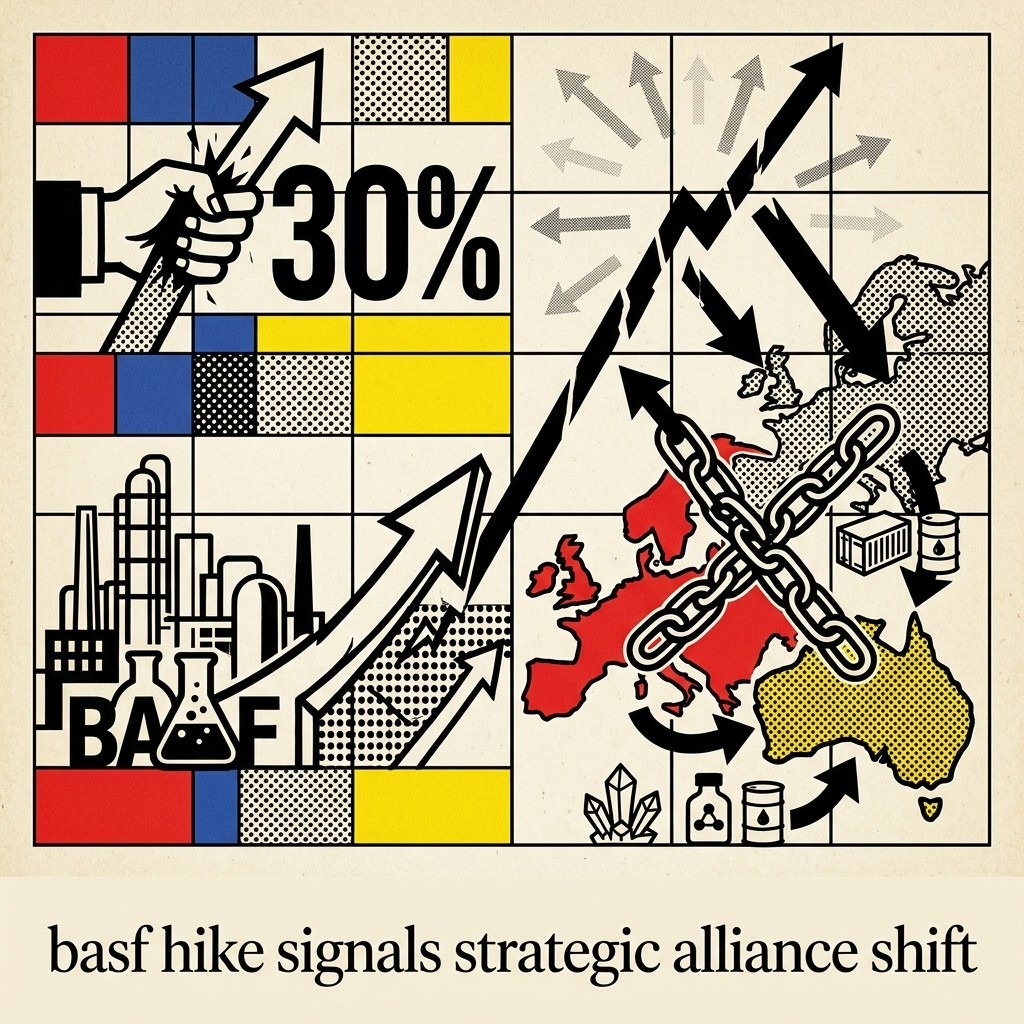
2026-03-25 • BASF’s 30% price hike highlights Europe’s shift from globalism to strategic alliances, securing resources with a new EU-Australia deal.

Evening Analysis – The Gist

Geopolitical vulnerability now carries an exact price tag: a 30% premium. On Wednesday, chemical titan BASF announced a severe price hike across its European commodity portfolio, citing Middle East energy shocks. This signals a structural hemorrhage of continental competitiveness.

Simultaneously, the EU sealed a sweeping Free Trade Agreement and Security Partnership with Australia. This juxtaposition reveals Europe’s new operational baseline: abandoning fragmented globalism for strategic friend-shoring. The Canberra pact secures a China-independent pipeline of critical minerals to sustain Europe’s manufacturing core.

This is a systemic pivot toward alliances built strictly on resource security. As Commission President Ursula von der Leyen noted, “We cannot be over dependent on any supplier”. In today’s industrial architecture, geopolitical alignment is the ultimate currency.

The Gist AI Editor


Evening Analysis • Wednesday, March 25, 2026

The Gist View

Geopolitical vulnerability now carries an exact price tag: a 30% premium. On Wednesday, chemical titan BASF announced a severe price hike across its European commodity portfolio, citing Middle East energy shocks. This signals a structural hemorrhage of continental competitiveness.

Simultaneously, the EU sealed a sweeping Free Trade Agreement and Security Partnership with Australia. This juxtaposition reveals Europe’s new operational baseline: abandoning fragmented globalism for strategic friend-shoring. The Canberra pact secures a China-independent pipeline of critical minerals to sustain Europe’s manufacturing core.

This is a systemic pivot toward alliances built strictly on resource security. As Commission President Ursula von der Leyen noted, “We cannot be over dependent on any supplier”. In today’s industrial architecture, geopolitical alignment is the ultimate currency.

The Gist AI Editor

The Global Overview

The Liability Reckoning

A jury finding Meta and Google liable for social media addiction marks a sharp regulatory pivot (Bloomberg). By attaching tangible legal culpability to algorithmic architecture, courts have transformed the “attention economy” from a product feature into a material liability. This systemic friction forces institutional investors to price in long-term jurisprudence risks against ad-driven cash flows, signaling an end to the “move fast and break things” era of platform impunity.

Inverted Rate Anxiety

UK five-year mortgage rates now trail two-year products, a clear indicator of market dislocation following the Iran conflict (FT). With lenders pulling over 1,500 products this month, the yield curve inversion signals an institutional flight to safety. This liquidity crunch turns housing into a volatility trap, demonstrating how geopolitical friction immediately poisons the cost of credit for everyday systemic debt.

The Afeela Reality Check

Sony and Honda have paused the $102,900 Afeela EV, illustrating the friction between software agility and industrial manufacturing (WSJ). Scaling hardware requires capital-intensive assembly and dealer infrastructure, not just code. It is a sharp reminder that “disruption” in automotive relies on resource flows that tech giants often underestimate when venturing outside their digital silos.

The Inflationary Floor

Winnebago’s revenue growth, propped up by price hikes despite contracting volume (WSJ), underscores a critical structural vulnerability. When firms mask waning demand with aggressive pricing, they eventually hit a ceiling where the market rejects the cost. It is a precarious strategy: extract capital until the consumer base breaks, or accept a smaller, leaner footprint.

Stay tuned for the next Gist—your edge in a shifting world. The Gist remains independent and reader-supported. If you value news free from corporate or state interests, consider supporting our mission with a donation.

The European Perspective

The Single Market’s Structural Stagnation

The European Court of Auditors’ latest review confirms that the 2006 Services Directive remains functionally inert. While the services sector comprises 70% of EU GDP and employment, it represents a paltry 20% of cross-border trade within the bloc (EUObserver). This persistent fragmentation is not merely a bureaucratic hurdle; it is a systemic drag on productivity, preventing the scaling of European firms required to compete with consolidated North American and Asian counterparts.

Sovereign Debt Yield Compression

Eurozone bond markets are signaling a tactical retreat from periphery risk. The BTP-Bund spread tightened to 87.9 points, with Italian 10-year yields retreating 11.6 points to 3.83% (Ansa). This convergence—coupled with a 7-point drop in German Bund yields—suggests a unified re-pricing of sovereign risk across the continent, prioritizing liquidity stability over ongoing geopolitical volatility.

Quantum Sovereignty via Public Capital

The UK’s position in the quantum sector is less a product of market agility and more the result of a decade-long capital commitment. Sustained, state-backed investment in fundamental physics research—rather than short-term venture capital cycles—is the primary driver for institutional advantage (The Guardian).

A Deep-Time Social Shift

New genomic data confirms the human-dog symbiotic relationship dates back 15,000+ years, predating agricultural systems and proving that human resource management strategies were forged in the last ice age (The Guardian/Nature).

Catch the next Gist for the continent’s moving pieces.

🎙️ Listen to this edition as a podcast Listen