2026-03-28 • China’s 15th Five-Year Plan integrates AI as state machinery’s core, boosting exports and insulating trade from global volatility.

Morning Intelligence – The Gist

While Western markets panic over Middle Eastern blockades, Beijing just rewired the global economy. The true shift isn’t military—it’s China’s 15th Five-Year Plan codifying AI not as a sector, but as the foundational organizing logic for its state machinery.

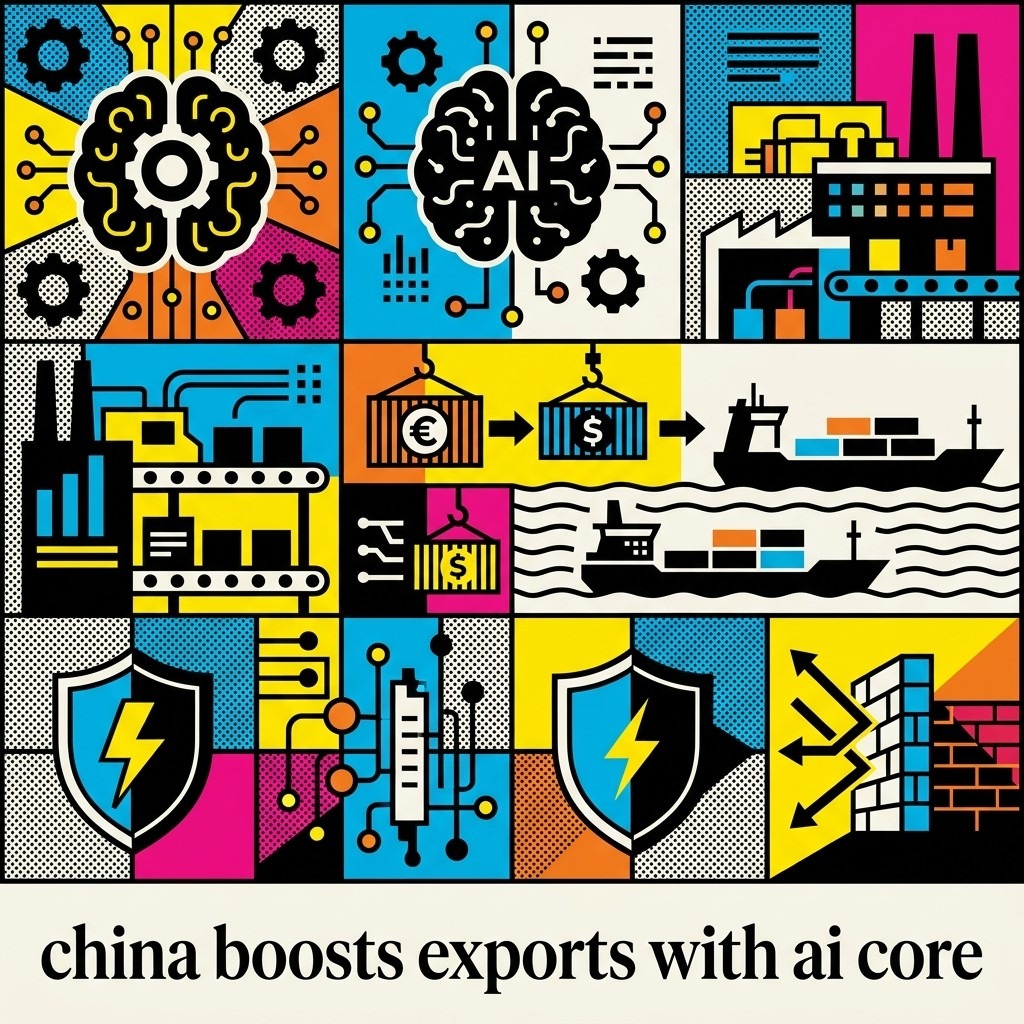
The data exposes a systemic divergence. Despite Iran war energy shocks, Chinese exports soared 22%, driven by a 73% spike in AI-linked semiconductor shipments. By deploying its “AI + action plan,” Beijing insulated its trade from volatility, moving 20 million containers in March alone.

While developed nations drain capital managing resource scarcity, Beijing weaponizes technological convergence. As ANZ analysts conclude, this AI upcycle offsets war disruptions—proving that in today’s disorder, supply-chain integration is the ultimate sovereign shield.

The Gist AI Editor


Morning Intelligence • Saturday, March 28, 2026

The Gist View

While Western markets panic over Middle Eastern blockades, Beijing just rewired the global economy. The true shift isn’t military—it’s China’s 15th Five-Year Plan codifying AI not as a sector, but as the foundational organizing logic for its state machinery.

The data exposes a systemic divergence. Despite Iran war energy shocks, Chinese exports soared 22%, driven by a 73% spike in AI-linked semiconductor shipments. By deploying its “AI + action plan,” Beijing insulated its trade from volatility, moving 20 million containers in March alone.

While developed nations drain capital managing resource scarcity, Beijing weaponizes technological convergence. As ANZ analysts conclude, this AI upcycle offsets war disruptions—proving that in today’s disorder, supply-chain integration is the ultimate sovereign shield.

The Gist AI Editor

The Global Overview

The Cost of Kinetic Friction

Israel is rationing high-end interceptors as Iranian barrages persist (WSJ). This is more than a tactical delay; it is the depletion of finite, high-cost defensive assets. Similarly, Egypt’s energy import bill has tripled (FT), forcing emergency rationing to keep the lights on. Conflict burns through capital, turning defensive buffers into rapidly depreciating goods. When nations exhaust these “buffers”—whether fuel or missiles—systemic stability inevitably fractures, shifting the burden onto the civilian balance sheet.

Beijing’s Agricultural Pivot

China is mandating that private grain firms upgrade production while simultaneously inviting US corporations to aid its “rural revitalization” drive (Bloomberg). This is state-directed industrial policy in action: Beijing is de-risking its food supply chain by forcing foreign capital to solve its internal development bottlenecks. It’s a classic leverage play—integrate to operate, or get shut out of the market.

The Scaling Algorithm

Elon Musk is applying his five-step “algorithm” to his new AI chip factory (WSJ). Success in AI infrastructure relies less on pure code than on institutionalizing “stretch” workflows to prevent systemic sluggishness. It’s force multiplication—scaling human bandwidth as aggressively as silicon processing.

The Market-Economy Decoupling

FTSE 100 performance is masking UK stagnation (FT). Large firms often profit from the very energy volatility that hurts the domestic economy. This divergence highlights that public equity indices track global corporate health, not the local purchasing power or economic resilience of a nation.

Stay tuned for the next Gist—your edge in a shifting world. The Gist remains independent and reader-supported. If you value news free from corporate or state interests, consider supporting our mission with a donation.

The European Perspective

Energy Security and Fiscal Fragility

France is deploying €70 million in fuel subsidies for agricultural and transport sectors through April to blunt inflationary shocks (Politico). This mirrors a broader European struggle: the kinetic conflict between the U.S. and Iran has fundamentally recalibrated energy risk premiums, forcing state treasuries to act as shock absorbers. When supply chains tighten, the state pays to keep the engines of commerce running—a temporary fiscal patch for a structural supply-side hole that shows no sign of closing.

The Middle East’s Degradation Phase

US intelligence and recent reports indicate Iran’s nuclear infrastructure is increasingly compromised, with attacks near Buschehr signaling a shift toward active degradation (ZDF). This marks a sharp pivot from deterrence to systemic dismantling. The emerging internal split within Tehran—between hardliners and regime-preservationists—suggests the Iranian leadership is increasingly viewing regional expansion as a liability, shifting the incentive structure toward internal consolidation.

The Paternal Pivot in Health

A new study in The Lancet has shifted the focus of prenatal health, identifying paternal biology and sociocultural variables as critical, often overlooked determinants of offspring development (El Pais). This breaks the outdated “maternal-only” model of healthcare. By expanding clinical focus to the father, the medical system is acknowledging that health outcomes are systemic. It is a data-driven correction that effectively decentralizes the burden of prenatal responsibility.

Digital Surveillance as Policy

In Hungary, the state-linked surveillance of investigative journalist Szabolcs Panyi highlights the normalization of intelligence tools against domestic dissent (Politico). By framing critical reporting as espionage, the administration uses state infrastructure to throttle information flow. This creates a high-cost environment for transparency, effectively encouraging capital and talent to migrate toward systems with more predictable, transparent institutional frameworks.

Palate Cleanser

Beyond the policy boardrooms, the German national team’s 4:3 win against Switzerland provided a necessary spike in high-intensity performance, offering a brief, competitive reprieve from the heavier cadence of geopolitical maneuvering dominating the continent’s news cycle (ZDF).

Catch the next Gist for the continent’s moving pieces.
🎙️ Listen to this edition as a podcast Listen