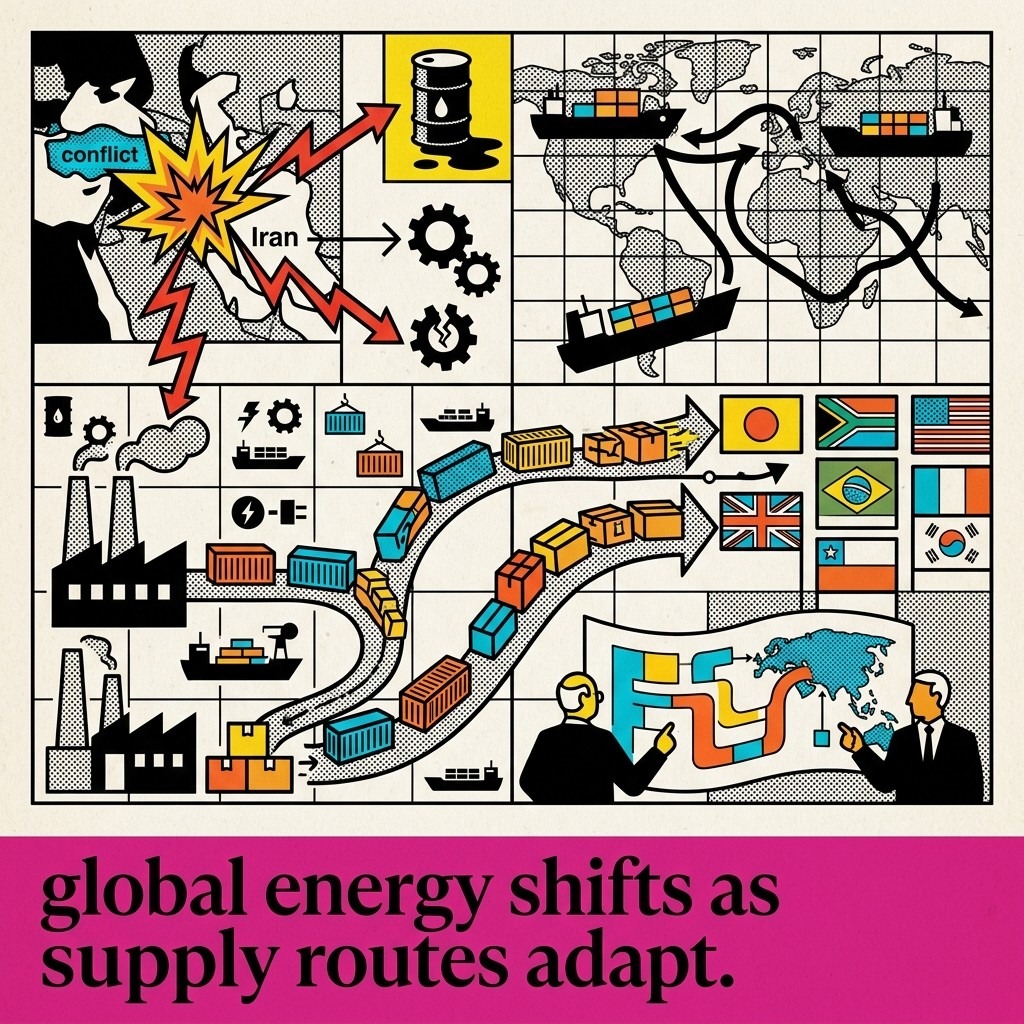
2026-03-29 • Global distance reprices as U.S.-Israeli actions in Iran stress global energy. Supply chains over military power as nations adapt to disruptions.

Morning Intelligence – The Gist

The rapid repricing of global distance is underway. As the U.S.-Israeli military campaign in Iran accelerates, disrupting the Strait of Hormuz has evolved from a regional flare-up into a systemic stress test of the global energy architecture.

Geopolitical leverage is now measured in maritime delays. Tactical military objectives are downloading severe risk onto vulnerable partners. This collision of hard power and macroeconomic fragility forces immediate adaptation: the Philippines just declared a one-year energy emergency , while Germany’s industrial core freezes operations amid soaring import costs .

Power today relies less on military dominance than on supply-chain endurance. The structural reality is stark: India, the world’s third-largest oil importer, faces surging panic-buying, exposing the brittle nature of modern energy interdependence .

The Gist AI Editor


Morning Intelligence • Sunday, March 29, 2026

The Gist View

The rapid repricing of global distance is underway. As the U.S.-Israeli military campaign in Iran accelerates, disrupting the Strait of Hormuz has evolved from a regional flare-up into a systemic stress test of the global energy architecture.

Geopolitical leverage is now measured in maritime delays. Tactical military objectives are downloading severe risk onto vulnerable partners. This collision of hard power and macroeconomic fragility forces immediate adaptation: the Philippines just declared a one-year energy emergency , while Germany’s industrial core freezes operations amid soaring import costs .

Power today relies less on military dominance than on supply-chain endurance. The structural reality is stark: India, the world’s third-largest oil importer, faces surging panic-buying, exposing the brittle nature of modern energy interdependence .

The Gist AI Editor

The Global Overview

Market Friction in Europe

Eurozone government bonds are enduring one of their worst months in a decade (FT). Investors are aggressively pricing in a rapid deterioration of public finances, effectively a “geopolitical tax” levied by markets on regional fiscal stability following the Iran shock. When safe-haven credibility wavers, capital flees, driving up sovereign borrowing costs and sharply constricting state maneuverability.

The Strategic Broker

Pakistan is maneuvering to capitalize on Middle East volatility, with leadership actively courting President Trump to position Islamabad as the indispensable intermediary in the Iran conflict (WSJ). It is a classic high-stakes leverage play: by monopolizing critical diplomatic channels, they secure long-term institutional relevance, ensuring the U.S. remains economically and strategically tethered to their internal stability.

Ceasefire Erosion

Despite a five-month-old, U.S.-brokered ceasefire, recent Israeli airstrikes on Gazan police checkpoints in Khan Younis killed six individuals, including civilians (ST). This underscores the brittleness of external peace frameworks. When ground realities diverge from high-level diplomatic agreements, “ceasefire” degrades into a purely nominal designation, failing to constrain kinetic operations or civilian displacement.

The Algorithmic Echo Chamber

The distraction economy is stalling cultural evolution. Algorithms maximize engagement by feeding users what they already prefer, creating a closed, repetitive loop (FT). We are essentially optimizing for stagnation, trading the serendipity of societal progress for high-frequency, dopamine-rich repetition.

Stay tuned for the next Gist—your edge in a shifting world. The Gist remains independent and reader-supported. If you value news free from corporate or state interests, consider supporting our mission with a donation.

The European Perspective

The Decentering of Intellectual Capital

Scientific leadership is migrating. A 40-year analysis of 44 million publications confirms research is diversifying from Western hubs to emerging economies (CEPR). This signals a structural reallocation of global innovation infrastructure. Nations are now prioritizing local capacity over collaborative dependency, turning scientific output into a core metric of national sovereignty.

Data as Sovereign Currency

The European push for “data spaces” is a calculated play for economic leverage (El Pais). By localizing processing, the continent aims to stem capital flight to dominant foreign cloud providers. The incentive is binary: treat data as a strategic asset to secure competitive advantages in local industrial automation and AI sectors.

Demographic Realignment in the Sahel

Conflict in Sudan is redrawing North African labor markets, with 40,000 to 60,000 refugees integrating into Libya’s Kufra region (El Pais). This creates an informal economic ecosystem that bypasses state policy, effectively turning remote desert outposts into unintended, high-activity hubs of regional trade.

Commercializing Sensory Biology

Decoding the TRPM8 protein—our biological switch for cold perception—provides a blueprint for non-opioid pain markets (El Pais). Pharmaceutical firms can now bypass broad-spectrum drug discovery to target this specific molecular gateway, accelerating high-value therapeutic pipelines.

Efficiency by the Clock

Italy’s daylight savings transition is a macro-economic efficiency play: Terna estimates a reduction of 302 million kWh—powering 115,000 homes—and €80 million in national energy costs (Ansa).

Catch the next Gist for the continent’s moving pieces.

🎙️ Listen to this edition as a podcast Listen