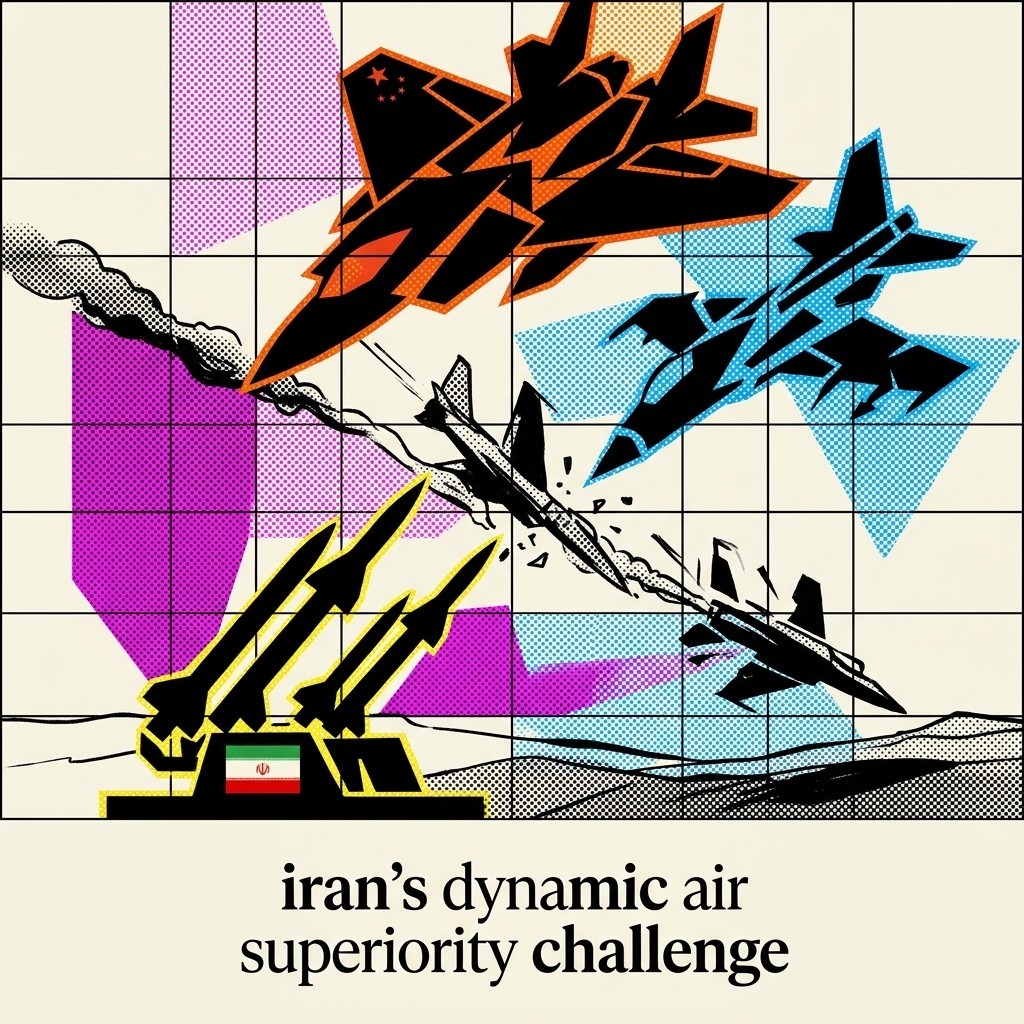
2026-04-05 • Air superiority isn’t binary; Iran’s downing of US jets highlights evolving dynamics. China’s backing of Iran’s missiles reshapes strategic balances.

Morning Intelligence – The Gist

We tend to view air superiority as a binary. But military power is always a negotiated reality.

As the Hormuz standoff evolves, Iran’s shootdown of a US F-15E and A-10 marks the conflict’s first American aircraft losses. This is a structural stress test. While US forces retain functional air dominance, the broader systemic shift is Beijing quietly reconstituting Tehran’s ballistic missile program. China’s incentive isn’t ideological—it’s pure asymmetric leverage. Subsidizing Iranian area-denial buys Beijing vital strategic bandwidth in the Indo-Pacific.

The sky is no longer a monopoly; it’s a high-friction toll road. As the Institute for the Study of War notes, air superiority endures despite losses, provided operations aren’t fundamentally impeded. But the geopolitical cost of access is permanently rising.

The Gist AI Editor


Morning Intelligence • Sunday, April 05, 2026

The Gist View

We tend to view air superiority as a binary. But military power is always a negotiated reality.

As the Hormuz standoff evolves, Iran’s shootdown of a US F-15E and A-10 marks the conflict’s first American aircraft losses. This is a structural stress test. While US forces retain functional air dominance, the broader systemic shift is Beijing quietly reconstituting Tehran’s ballistic missile program. China’s incentive isn’t ideological—it’s pure asymmetric leverage. Subsidizing Iranian area-denial buys Beijing vital strategic bandwidth in the Indo-Pacific.

The sky is no longer a monopoly; it’s a high-friction toll road. As the Institute for the Study of War notes, air superiority endures despite losses, provided operations aren’t fundamentally impeded. But the geopolitical cost of access is permanently rising.

The Gist AI Editor

The Global Overview

The Leverage of Rescue

U.S. forces successfully extracted a second airman from Iran (WSJ, FT), effectively closing the kinetic window on a high-stakes standoff. By recovering their personnel, the U.S. denies Tehran a powerful psychological bargaining chip—turning a potential hostage crisis into a display of tactical projection. Think of it like a poker hand; by removing the risk of captive soldiers, the U.S. retains the strategic flexibility to escalate or pivot without the political anchor of “bring our troops home” public pressure.

The Pump as a Policy Anchor

Bloomberg data signals a pending spike in U.S. inflation, driven by volatile energy prices. Rising crude costs function as a de facto tax on global consumers, squeezing industrial output in Europe and narrowing policy bandwidth in Washington. When regional conflicts create energy friction, they chain domestic economic health directly to military stability, forcing central banks into a defensive posture where every dollar at the pump acts as a brake on broader recovery.

The Cost of Iteration

SpaceX has pushed its next Starship test to May (WSJ). This delay highlights a recurring systemic reality: ambitious timelines are often optimistic guesses, not engineering guarantees. For capital markets, this delay creates friction, as speculative value requires consistent proofs of concept to maintain momentum and justify the massive overhead of space infrastructure.

Auditing the State

The latest Emergent Ventures cohort (Marginal Revolution) highlights a subtle shift: capital is moving toward “audit tech”—tools designed to measure municipal performance or align satellites. It suggests a growing institutional desire to optimize, rather than replace, governance through data-driven accountability, signaling that the next frontier for innovation is making existing systems work with machine-like efficiency.

Stay tuned for the next Gist—your edge in a shifting world. The Gist remains independent and reader-supported. If you value news free from corporate or state interests, consider supporting our mission with a donation.

The European Perspective

Tehran’s Petrochemical Vulnerability

Israel’s recent strikes on Iranian petrochemical facilities signal a tactical pivot from proxy warfare to direct economic attrition. By targeting the regime’s primary hard-currency revenue generators, the strategy aims to systematically degrade the capital available for military mobilization, forcing Tehran to choose between maintaining its offensive capabilities or stabilizing its domestic economy. (Il Sole 24 Ore).

German Economic Stagnation

German companies rate the current federal economic policy at a dismal 4.2/6.0 (IFO), reflecting profound institutional friction. To mitigate the resulting social strain, factions within the SPD are lobbying to zero-rate VAT on healthy food staples—a classic fiscal attempt to lower the cost of living for the voter base without triggering broad, inflationary stimulus. (ZDF).

Border Carbon Leveraging

The EU’s Carbon Border Adjustment Mechanism (CBAM) effectively weaponizes global supply chains. By applying carbon levies to iron, steel, and aluminum imports, the EU forces non-member suppliers to either absorb the cost or green their operations, turning climate regulation into a strategic trade barrier that protects European industrial margins. (CEPR).

Lunar Strategic Vantage

Artemis-2 astronauts are currently observing the lunar far side, a mission significantly advancing deep-space logistical capacity. Mastering these cis-lunar corridors creates an unassailable data and operational advantage for the entities that control the infrastructure, fundamentally altering the incentives for long-term space-faring. (Le Monde).

Catch the next Gist for the continent’s moving pieces.

🎙️ Listen to this edition as a podcast Listen