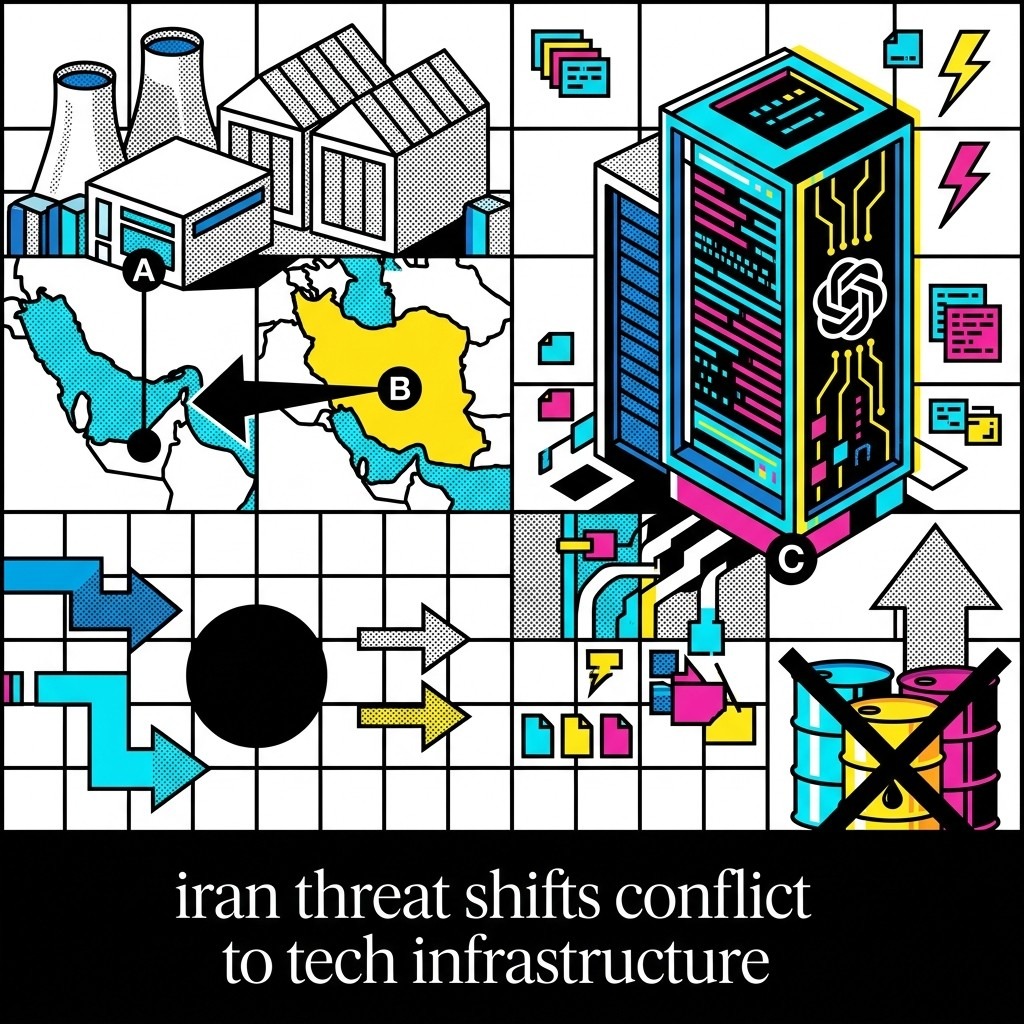
2026-04-07 • Server farms are now war targets as Iran threatens OpenAI’s Abu Dhabi site, shifting conflict from oil to tech, highlighting digital vulnerabilities.

Evening Analysis – The Gist

When does a server farm become a theater of war? As the Hormuz standoff escalates today, the conflict has jumped from oil transit to sovereign compute power. Iran’s Revolutionary Guard threatened the complete annihilation of OpenAI’s planned $30 billion Stargate AI facility in Abu Dhabi, explicitly targeting US tech assets to retaliate for American strikes on Iranian grids.

This exposes a profound structural shift. While capital scales algorithms infinitely in the cloud, the necessary silicon remains physically anchored and highly vulnerable. Mega-investments by tech conglomerates are now frontline targets, proving the digital economy fundamentally requires hard military defense.

Power pivots from controlling maritime straits to defending localized server supremacy. As the IRGC grimly warned regarding the UAE facility: “Nothing stays hidden to our sight, though hidden by Google”.

The Gist AI Editor


Evening Analysis • Tuesday, April 07, 2026

The Gist View

When does a server farm become a theater of war? As the Hormuz standoff escalates today, the conflict has jumped from oil transit to sovereign compute power. Iran’s Revolutionary Guard threatened the complete annihilation of OpenAI’s planned $30 billion Stargate AI facility in Abu Dhabi, explicitly targeting US tech assets to retaliate for American strikes on Iranian grids.

This exposes a profound structural shift. While capital scales algorithms infinitely in the cloud, the necessary silicon remains physically anchored and highly vulnerable. Mega-investments by tech conglomerates are now frontline targets, proving the digital economy fundamentally requires hard military defense.

Power pivots from controlling maritime straits to defending localized server supremacy. As the IRGC grimly warned regarding the UAE facility: “Nothing stays hidden to our sight, though hidden by Google”.

The Gist AI Editor

The Global Overview

The Tehran-Trump Brinkmanship

As President Trump’s ultimatum for Iran to cut a deal nears expiration, two French hostages were released from Tehran—a tactical signaling move to de-escalate ahead of potential consequences. With the Strait of Hormuz blocked and energy prices spiking, Iran is shedding soft-power liabilities while bracing for a kinetic standoff. The systemic incentive: prioritizing survival leverage over traditional negotiation.

Industrial Realignment in Texas

Intel is partnering with SpaceX and Tesla for the Terafab project. This is a structural pivot where legacy semiconductor manufacturing integrates into Musk’s vertically integrated tech ecosystem. By tethering chip production to high-demand aerospace and automotive partners, Intel secures a captive customer base, effectively insulating itself from broader semiconductor market volatility.

Activist Capital Aggression

Bill Ackman’s Pershing Square has bid ~$60 billion for Universal Music Group. This move highlights a broader shift: institutional capital is aggressively targeting “moat” assets—intellectual property that maintains pricing power regardless of the macroeconomic cycle. It is a bet on the enduring scarcity of human content in an AI-saturated future.

Securing the Copper Lifeline

The $5 billion Zambia-Lobito railway project signals a critical shift in securing supply chains. By connecting landlocked Zambian mines to Angola’s coast, this infrastructure bypasses maritime bottlenecks, hardwiring essential mineral access for the green energy transition directly into Western-aligned logistics.

Stay tuned for the next Gist—your edge in a shifting world. The Gist remains independent and reader-supported. If you value news free from corporate or state interests, consider supporting our mission with a donation.

The European Perspective

The Geopolitical Brinkmanship

Donald Trump’s threat to erase Iran’s “whole civilization” is being met with calculated indifference by Brussels. The European incentive is to ignore digital volatility rather than dignify it; officials are signaling a refusal to react to online rhetoric (Politico). Yet, Italian Defense Minister Guido Crosetto sees genuine escalation risk, invoking Hiroshima and Nagasaki parallels to underscore the danger (Politico). The structural outcome here is clear: decoupling continues as geopolitical rhetoric sharpens, forcing European strategic autonomy to move from theory to a necessary defensive posture.

AI’s Fiscal Restructuring

OpenAI is actively advocating for ‘robot taxes’ and a four-day work week to manage mass labor displacement (Euronews). This represents a fundamental structural pivot: as AI productivity outpaces human labor, the traditional income-tax revenue model falters. Capital is flowing toward automation-resilient sectors, while policymakers are beginning to treat the 40-hour work week as an artifact of the pre-AI era, preparing for a future where tax bases must shift from human labor to machine output.

The Fragility of Legacy Infrastructure

Four decades after the Chernobyl disaster, the site remains a acute strategic vulnerability (ZDF). The ongoing conflict in Ukraine highlights that critical infrastructure—often ignored in peacetime—is the primary casualty of modern instability. The structural risk is no longer theoretical, forcing defense planners to overhaul protection protocols for nuclear assets continent-wide to mitigate the risk of catastrophic environmental event.

Regulatory Barriers to Cultural Capital

The UK government’s move to block Ye (formerly Kanye West) from entry is a localized test of ‘public good’ versus the free flow of influence (Politico). While ostensibly about inflammatory comments, it reveals how sovereign borders are increasingly used to filter high-profile entities based on political risk assessments, prioritizing domestic cohesion over cultural exchange.

Catch the next Gist for the continent’s moving pieces.

🎙️ Listen to this edition as a podcast Listen