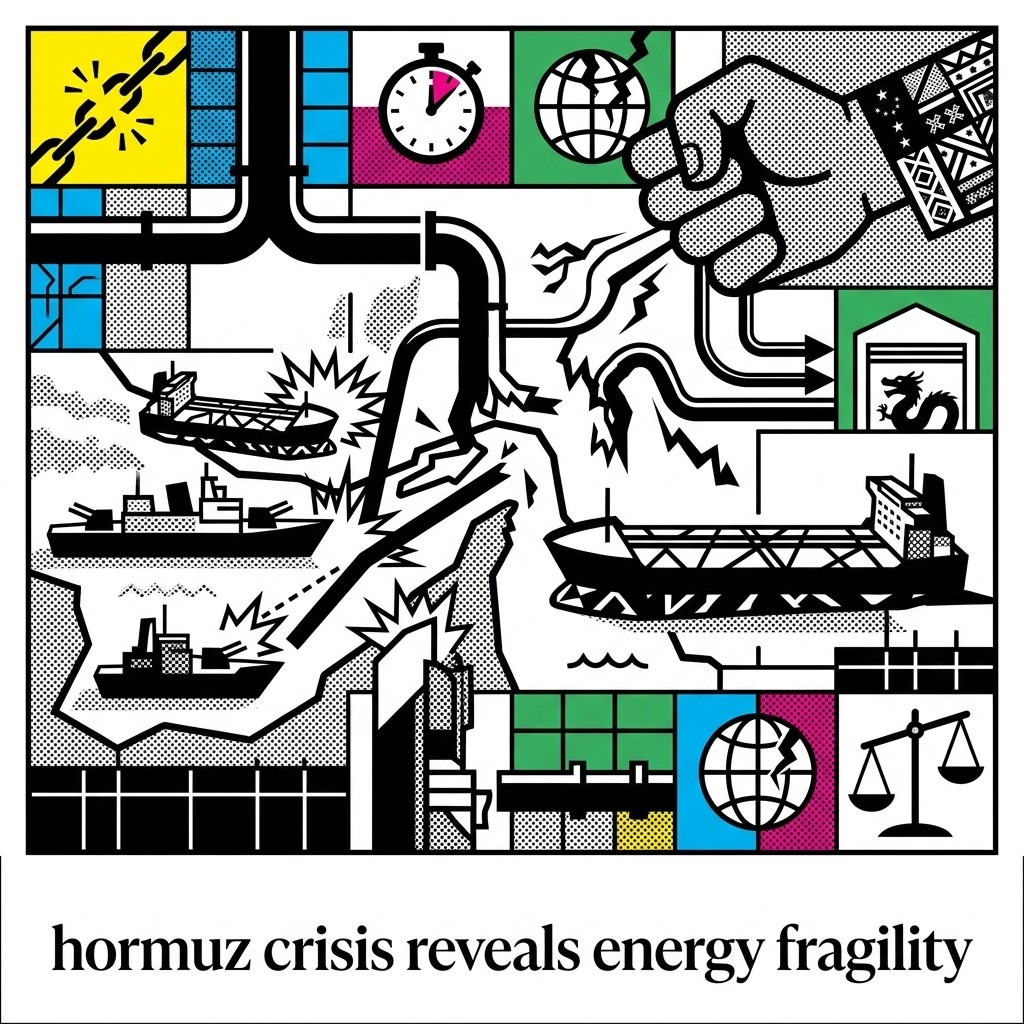
2026-04-07 • The Hormuz crisis exposes global energy fragility. Despite threats, military might can’t open chokepoints. China gains leverage, exploiting U.S. focus.

Morning Intelligence – The Gist

Why does a single waterway dictate American power? As the Hormuz standoff enters week six, the crisis exposes the fragility of global energy geography. Trump’s latest ultimatum to Tehran—threatening to obliterate Iranian power plants—reveals a structural truth: military dominance cannot simply bomb a commercial chokepoint open.

The math dictates the leverage. With 20% of global oil trapped and Brent crude hitting $109, Beijing brilliantly exploits the vacuum. While publicly urging peace, China covertly ships sodium perchlorate for Iran’s missile program, subsidizing a massive U.S. distraction without firing a shot.

This is a calculated realignment. Washington burns munitions to stabilize markets while adversaries secure asymmetric leverage. As The Cipher Brief bluntly concluded: “This is asymmetric warfare embedded in great power competition”.

The Gist AI Editor


Morning Intelligence • Tuesday, April 07, 2026

The Gist View

Why does a single waterway dictate American power? As the Hormuz standoff enters week six, the crisis exposes the fragility of global energy geography. Trump’s latest ultimatum to Tehran—threatening to obliterate Iranian power plants—reveals a structural truth: military dominance cannot simply bomb a commercial chokepoint open.

The math dictates the leverage. With 20% of global oil trapped and Brent crude hitting $109, Beijing brilliantly exploits the vacuum. While publicly urging peace, China covertly ships sodium perchlorate for Iran’s missile program, subsidizing a massive U.S. distraction without firing a shot.

This is a calculated realignment. Washington burns munitions to stabilize markets while adversaries secure asymmetric leverage. As The Cipher Brief bluntly concluded: “This is asymmetric warfare embedded in great power competition”.

The Gist AI Editor

The Global Overview

Beijing’s Strategic Buffer

China’s continued purchase of Iranian oil acts as a shadow insurance policy, effectively neutralizing Western sanctions (WSJ). By underwriting Tehran’s war machine, Beijing signals that US economic containment has a distinct ceiling. President Trump’s assertion that Iran could be “taken out in one night” (WSJ) marks a pivot to high-stakes brinkmanship, forcing the Pentagon to scramble for strike options that bypass legal scrutiny (Politico).

Structural Realignment

VP Vance’s trip to Hungary is a tactical bid to salvage Prime Minister Orbán’s fading election prospects (Politico), revealing the fragility of relying on personality-driven diplomacy over institutional statecraft. Simultaneously, energy markets have decoupled from supply-demand fundamentals, trading instead on “deadlines and detonations” (WSJ). One-Dyas BV is capitalizing on this insecurity, bypassing North Sea environmental protections to ramp up gas output to 1 billion cubic meters annually (Bloomberg), proving that in a crisis, sustainability mandates are the first to bend.

The High Ground and The Thaw

A new human spaceflight duration record (WSJ) marks a quiet but significant shift toward operational resilience—essential infrastructure for the next generation of satellite dominance. Conversely, Kim Jong Un’s rare praise for South Korean President Lee following drone apologies (Bloomberg) suggests a pragmatic, opportunistic retreat from escalation, prioritizing domestic stability over regional friction.

Stay tuned for the next Gist—your edge in a shifting world. The Gist remains independent and reader-supported. If you value news free from corporate or state interests, consider supporting our mission with a donation.

The European Perspective

EU Diplomacy at a Deadlock

The European Union’s rigid reliance on unanimity is fast becoming a structural liability. As geopolitical velocity outpaces bloc consensus, the inability to move—notably stalling a €90 billion loan for Kyiv and fragmented responses to Middle East instability—is eroding the bloc’s global leverage (Politico). The incentive structure favors national vetoes, prioritizing domestic political optics over collective security. Unless Brussels pivots to qualified majority voting, it risks becoming a bystander in rapid-response global realignments.

Artemis II: Routine Blackout

Lunar exploration moved from novelty to standard operations as the Artemis II crew completed their far-side flyby. The 40-minute communication blackout was a planned technical milestone, not a crisis (ZDF). This shift indicates deep-space navigation is maturing from heroic improvisation into predictable, procedural logistics.

Capital’s New Map

Geopolitical volatility is physically shifting wealth. With Dubai’s stability questioned following Iranian missile strikes, the super-rich are pivoting toward Milan to leverage Italy’s flat-tax regime (The Guardian). This represents a flight to safety; capital is prioritizing the “boring” legislative certainty of Europe over the high-growth, high-risk Middle East.

Orbán’s High-Stakes Gamble

With elections just 5 days away, Hungary remains a critical friction point. US Vice President Vance’s arrival in Budapest signals a deliberate ideological wedge against Brussels (Politico). It is a classic move to leverage external, anti-establishment backing to solidify domestic power as polls tighten.

European Pitch Volatility

Champions League tension peaks as Real Madrid prepares to host Bayern Munich. For the continent’s observer class, this legacy rivalry serves as a high-stakes diversion from current geopolitical stress (ZDF).

Catch the next Gist for the continent’s moving pieces.

🎙️ Listen to this edition as a podcast Listen