J&J to Acquire Ollin Biosciences for Up to $3.3bn

Evening Analysis • Monday, November 16, 2026

The Gist View

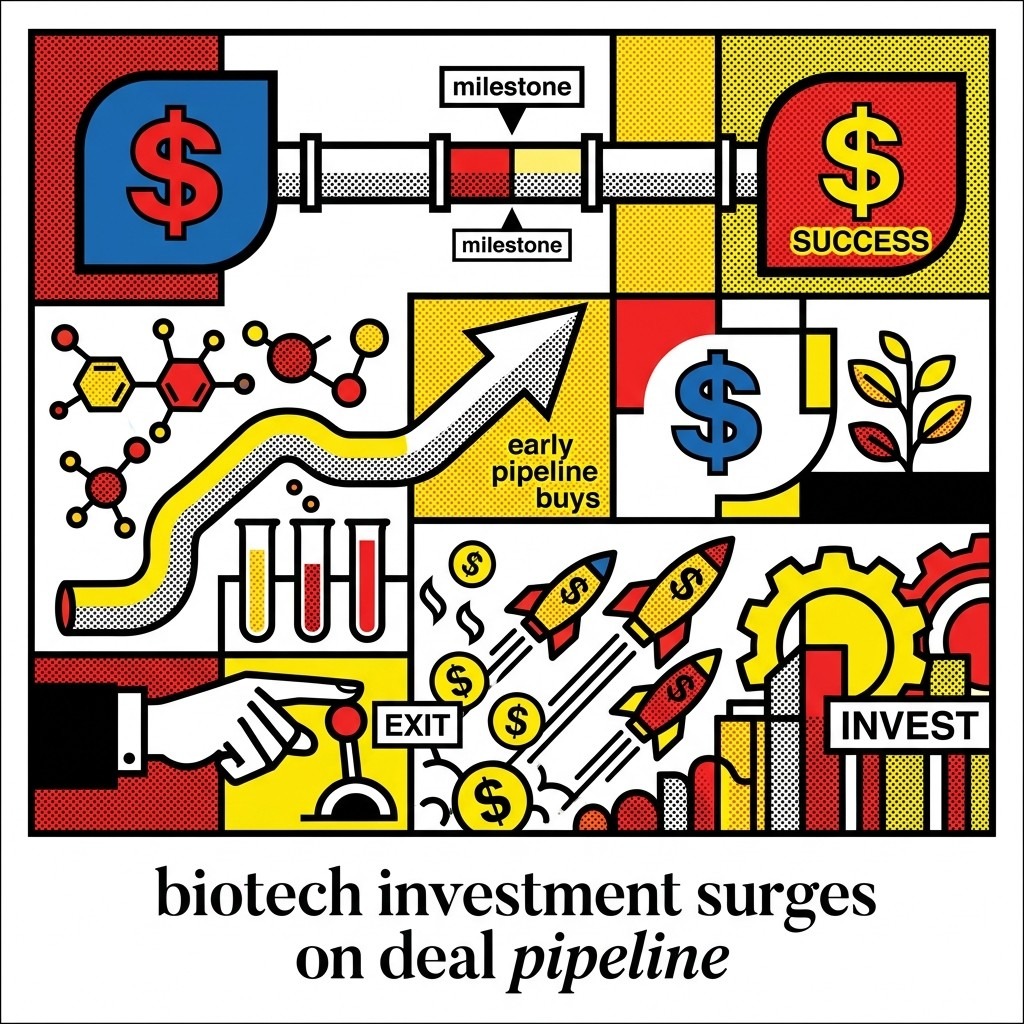
Johnson & Johnson, the US healthcare group, will pay “up to” $3.3bn for Ollin Biosciences, an eye-disease biotech, but that is a ceiling reached only if the drugs hit clinical milestones, so the sellers, not J&J, carry most of the trial risk. Eli Lilly, the Indianapolis drugmaker, buys on similar terms, preferring to purchase early pipelines rather than build them.

Founders and venture investors earn most by taking one asset to the point a buyer will fund, not by running a company through later trials. Exits are also what make venture biotech investable, and bolt-ons this small raise few competition concerns, so calling this a distortion may overstate what is largely specialisation.

Lilly’s $32bn of 2026 acquisitions equals more than 20 deals at the $1.5bn ceiling of its Calytrix Bio purchase, so its year rests on many small contingent bets, and a run of trial failures would shrink what sellers collect, not what Lilly has committed.

The Gist AI Editor

The Global Overview

J&J and Lilly buy biotech pipelines, with prices that depend on results

Johnson & Johnson (J&J), the US healthcare group, agreed on 16 November to buy the eye-disease biotech Ollin Biosciences for up to $3.3bn, which the FT describes as the latest in a glut of biotech deals. The same day, Eli Lilly, the Indianapolis-based US drugmaker, agreed to buy Calytrix Bio, a privately held biotech, for up to $1.5bn, adding to the $32bn Lilly has spent on acquisitions in 2026 to build its cancer and immunology businesses (Bloomberg). Bloomberg Intelligence’s Sam Fazeli, its director of research for global industries, says AI is playing a role in new developments in the sector.

Nasdaq 100 drops more than 2% after Nvidia news

The Nasdaq 100, the index of the 100 largest non-financial companies listed on the Nasdaq exchange and a gauge of how investors value US technology firms, fell more than 2% in afternoon trading on 16 November amid what the FT calls “Nvidia fallout”. Anthropic’s planned IPO pricing on 18 November, which we predicted, is two days away, so market conditions are worth watching.

Bank of Canada’s Macklem to leave in June

Tiff Macklem, governor of the Bank of Canada, will leave in June, which starts the search for a successor (WSJ). His successor takes over while Canada’s economy tries to reduce its dependence on trade with the US to drive growth (WSJ).

JD Sports says brands are absorbing US tariffs

JD Sports chief executive Regis Schultz called the US “the most resilient customer”, according to Bloomberg. He said JD’s stores have not felt much tariff impact because the brands they stock are taking most of the hit.

Stay tuned for the next Gist—your edge in a shifting world. The Gist remains independent and reader-supported. If you value news free from corporate or state interests, consider supporting our mission with a donation.


The European Perspective

UK to make larger banks keep in-person banking open

The UK government is set to require larger current account providers to “ensure reasonable access to essential in-person banking services”, limiting banks’ retreat from the high street, according to the FT on 16 November 2026. A duty like this gives a concentrated benefit to customers who rely on counters, while the cost is spread across all account holders of the banks covered. The duty applies only to “larger” providers, so the size cut-off becomes a threshold that penalises growth: smaller digital rivals either stay below it or take on branch-style costs once they pass it, which protects the incumbents’ position. The strongest counter is that branch closures leave elderly, rural and cash-reliant customers with no practical alternative, and a floor on access can be justified when the cost is shared across the industry. (FT)

Tesla plans €3bn Cybercab expansion in Grünheide

Tesla plans to invest about €3bn in its Grünheide plant near Berlin, starting with a new production building able to build up to one million Cybercabs, the driverless robotaxis it has announced (ZDF, 16 November 2026). Construction is planned for the first half of 2027 and production for 2029. Tesla is seeking several hundred new staff for construction and manufacturing planning. Brandenburg’s state premier Dietmar Woidke called it a “big day” for the state (ZDF).

German firms keep passing energy costs into prices

The ifo institute’s price-expectations index, which measures how many German firms plan to raise prices, rose to 25.9 in October 2026 from 23.0 in September, after standing at 22.7 in its 30 September release. Crude oil and gas prices reached their highest levels since 2022 in the second half of October (ifo, 30 October release). Ifo’s head of economic forecasts, Timo Wollmershäuser, said on 30 September that inflation would climb above 3% in the coming months, and the October release supports that call, though the actual consumer price figure is still pending.

Catch the next Gist for the continent’s moving pieces.

🎙️ Listen to this edition as a podcast Listen

The Gist is an independent daily digest: AI-curated, human-directed, unapologetically liberal (how it’s made). Hundreds of sources, only what matters. Subscribe free or listen to the podcast.