The Gist View
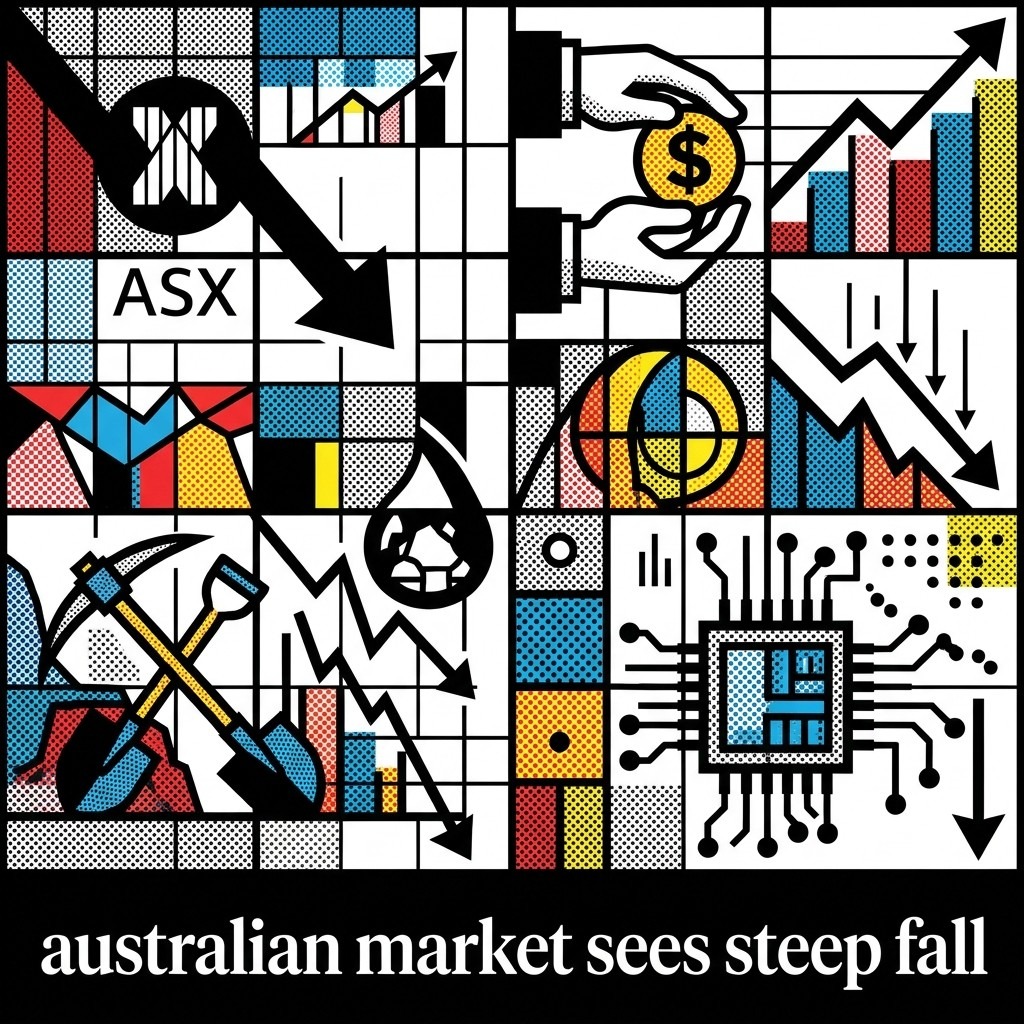
Australian shares had their worst week in more than four years, Bloomberg reported on 20 November, with miners, which dig commodities rather than build AI, hit hardest. That points to a shared macro driver, not AI doubts, though miners trade on China demand and AI developer Anthropic’s record $107.3bn listing opened well above its offer price on 19 November.
The likelier channel is the price of money: Treasury yields, the rate on US government bonds, are elevated and the dollar is strong, which WSJ says raises the cost of holding gold. Energy keeps yields up, since the blockade of the Bab al-Mandab, the Red Sea’s southern strait, lifts oil and gas prices passed on to consumers.
The vulnerability is a market priced for falling yields while energy-driven inflation holds them up, so AI shares, gold and commodity exporters reprice together when that gap closes. The previous rout this size, in 2022, came in a year of rising bond yields.
The Gist AI Editor
|
The Global Overview
Australian stocks post their worst week in more than four years as miners tumble
Australian shares had their biggest weekly rout since 2022, following a deepening global selloff driven by strains in the AI trade, with mining stocks slumping (Bloomberg, 20 Nov). Gold also fell in Asian trade. Critical Metals, a commodities-research firm, told the WSJ that elevated Treasury yields, the interest rate the US government pays on its bonds and the benchmark cost of money worldwide, and a strong dollar are raising the cost of holding a metal that pays no interest. One possible explanation for why a tech-led selloff reached Australian miners is that high yields and a strong dollar lower the value of AI shares, make gold less attractive, and squeeze dollar-priced commodity producers all at once. Meanwhile, Anthropic, the US developer of the Claude assistant, listed on 19 November with a $107.3bn debut that broke SpaceX’s record for the biggest offering, and its shares opened well above the IPO price (Bloomberg). Because outside shareholders still get no vote under dual-class shares, disclosure alone gives them little say.
US envoys float NATO membership for Ukraine in exchange for Donbas territory
According to the WSJ (20 Nov), President Trump’s envoys discussed Ukraine surrendering Donbas territory in exchange for NATO membership, which reverses longstanding US policy. The idea goes beyond the maximalist Russian terms that EU foreign ministers have been weighing since the Abu Dhabi talks.
TPG and Corpay to buy Bill Holdings
Bill Holdings, a finance platform, will be acquired in a deal valued at about $6bn, with TPG, a US private-equity firm, taking a majority stake and Corpay a minority interest (WSJ, 20 Nov).
AI-written economics papers fail verification
An AI verifier checked 1,000 papers produced by the APE research system, and none was error-free, according to The Economist as quoted by Marginal Revolution (20 Nov). In total, 842 contained at least one severe error, including some that invalidate the headline results.
Stay tuned for the next Gist—your edge in a shifting world. The Gist remains independent and reader-supported. If you value news free from corporate or state interests, consider supporting our mission with a donation.
|
The European Perspective
French start-up Look Up switches on a private radar to track suspicious satellites
Look Up, a start-up founded by General Michel Friedling, the first head of France’s Space Command, has commissioned its first radar at Monts-de-Randon in Lozère, according to Le Monde. The radar is the first in a planned network to monitor space traffic, at a time of exploding satellite numbers and rising threats in orbit (Le Monde). Tracking objects in orbit has long been a government task, so a private company is now selling a service the state used to run itself. That raises open questions about who gets access to the data and who becomes the customer. Because the founder previously led the military space command, the start-up’s first customer and its competitor are the same state, so the business depends on how far governments choose to buy rather than build. The strongest counter is that space surveillance is a core sovereign military function and a vendor cannot offer the control a state-built system does.
UK and EU meet on closer ties while Prime Minister Burnham stays vague
Europeans and the UK are due to discuss their relationship on Friday 20 November, according to Le Monde. Prime Minister Andy Burnham insists he wants closer ties with the EU but keeps the nature of the rapprochement unclear (Le Monde).
Activist fund Parvus targets the head of hotel group Accor
Parvus, an activist investment fund, is demanding the departure of the chief executive of French hotel group Accor, saying he has presided over an “unfocused strategy” (FT).
SPD chair: Schwesig hedges, leaving Heil as the only declared candidate
Manuela Schwesig, the re-elected premier of Mecklenburg-Vorpommern, is still hedging on whether to seek the Social Democratic Party (SPD) chair, according to Politico’s Berlin Playbook. Hubertus Heil, who declared first, therefore remains the only declared candidate so far, and his positioning carries implications for Lars Klingbeil (Politico).
Catch the next Gist for the continent’s moving pieces.
|
The Data Point
842 out of 1,000. That’s how many AI-written economics papers contained at least one severe error, according to an AI verifier that checked them, and some of those errors invalidated the headline results. Not one paper came back error-free.
|
|
The Editor’s Listenings
Arek Gulbenkoglu & Matthew Revert – What About Security? (2025)
Hypnotic warehouse hums and clatter shape a mysterious, hard-to-place experimental soundscape.
|
|
|
|
🎙️ Listen to this edition as a podcast
|
Listen
|
|
|
|