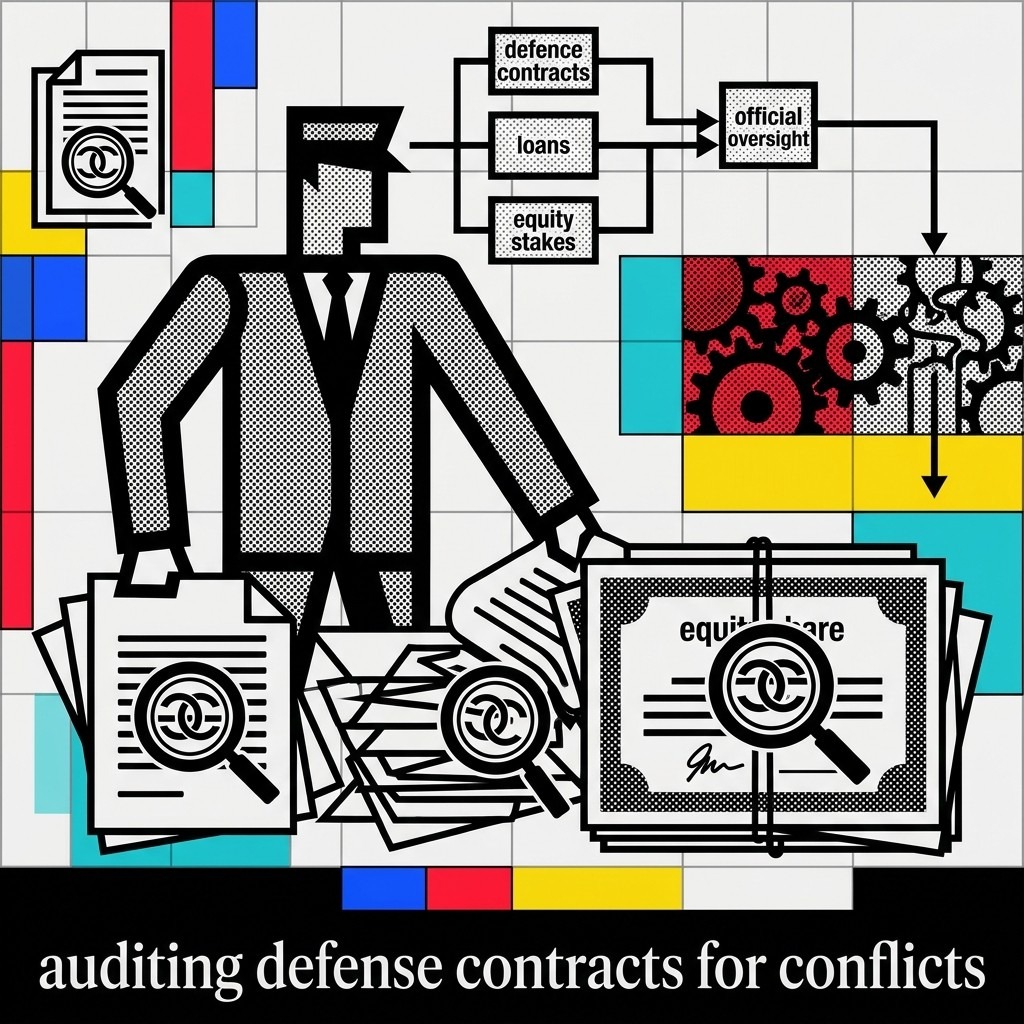
Pentagon Audit Targets Defense Contract Conflicts

Evening Analysis • Tuesday, November 24, 2026

The Gist View

The Pentagon’s inspector general, the Defense Department’s internal watchdog, is auditing its contracts, loans and equity stakes, Bloomberg reported on 24 November. The last two matter most, because procurement rules govern how a contract is awarded but say little about a department that also lends to a supplier and owns its shares, and so gains when that supplier wins.

Democrats in Congress promising conflict-of-interest probes have an incentive to find wrongdoing, so Republicans can wave their findings away; a watchdog report arriving first could give both parties a baseline. Equity stakes can be defended as taxpayer upside and industrial policy where private investors underinvest, and some of the probing will be opposition research.

Even so, an audit can show whether forms were followed, not whether a firm gains from closeness to its government shareholder while rivals without it lose. President Eisenhower’s 1961 farewell address warned against “unwarranted influence, whether sought or unsought,” by the military-industrial complex.

The Gist AI Editor

The Global Overview

Pentagon watchdog opens sweeping audit of contracts, loans and equity stakes

The Pentagon’s inspector general, the Defense Department’s internal watchdog that audits spending and conduct and reports to both the department and Congress, is launching a major audit of the department’s contracts, loans and equity stakes, meaning government ownership of shares in companies rather than simply buying their products, according to Bloomberg on 24 November. The audit will test whether proper procedures were followed. It comes as Democrats in Congress vow to investigate the Trump administration over alleged conflicts of interest (Bloomberg). Bloomberg’s summary names no firms, dollar amounts or dates.

AI agents in phones raise surveillance alarms among privacy advocates

Privacy advocates say AI agents built into phones read users’ messages, pictures and emails, a breach one group says “makes the Edward Snowden revelations look like a joke” (Politico Europe, 24 November). The same report notes that AI agents have already proven to be a cybersecurity risk. It also says the messaging app Signal has started blocking screenshots by default.

HHS publishes more than 92,000 documents on Kennedy and Covid-era correspondence

The US Department of Health and Human Services (HHS), the federal health ministry, has launched a website hosting more than 92,000 documents, including the calendars of Secretary Robert F. Kennedy Jr. and agency correspondence from the Covid-19 pandemic (Bloomberg, 24 November). HHS described the release as a push for greater transparency.

Webb images a supernova remnant while astronomers log the most distant quasar

NASA’s Webb telescope released a mid-infrared image of Cassiopeia A on 23 November that shows hot dust. The data supports a scenario in which the star’s interior changed dramatically, possibly just hours before its death (NASA, 24 November). Separately, scientists found a quasar, a very bright core of a galaxy, that formed 630 million years after the Big Bang, the most distant ever recorded (Euronews, 24 November).

In a brief update on a running story, Bloomberg’s analysis of dual-class stock at Anthropic, SpaceX and Google shows the AI boom weakening “one share, one vote”, so investors who price on cash flow are also accepting less governance protection.

Stay tuned for the next Gist—your edge in a shifting world. The Gist remains independent and reader-supported. If you value news free from corporate or state interests, consider supporting our mission with a donation.
The European Perspective

Bulgaria faces an EU fine while Hungary risks frozen funds

The European Commission on Tuesday threatened Bulgaria with a fine of up to €23 million for failing to rein in spending, according to Politico Europe. Hungary also faces Brussels’ pressure over its public finances, but because fines of up to 0.02% of GDP are reserved for euro-area countries, Budapest could only have EU funds frozen. The sanction menu is therefore unequal: Bulgaria faces both a fine and a funding cut, while Hungary faces only the funding cut. A fine this size is small for a national budget, so the real lever is the money, and enforcement ends up depending on how much EU cash each government needs. Both countries could lose some EU funds unless they meet Brussels’ fiscal demands by spring, and Economy Commissioner Valdis Dombrovskis said the decision on the fine is expected late this year or very early next year. Fiscal rules may also work through reputation and market pressure rather than fine size, and the Commission has threatened penalties before without a large payoff.

Germany’s digital minister cools on a European TikTok deal

Digital Minister Karsten Wildberger of Germany dampened expectations for a European TikTok deal, responding to the push from Wolfram Weimer, according to Politico Europe’s German edition. Wildberger said a sale alone is not enough, because the technology behind the app must also come to Europe.

Bundestag debates the 2027 health ministry budget

Germany’s Bundestag, the lower house of parliament, is debating the Health Ministry’s 2027 budget as part of its wider deliberations on the 2027 federal budget, ZDF reported on Tuesday.

Italy marks the first UN day against forced marriage

The first UN international day against forced marriage falls on 27 November, Il Sole 24 Ore reported. The paper calls forced marriage a submerged phenomenon in Italy and opens with Saman Abbas, who was 18 when she disappeared after refusing a marriage.

Catch the next Gist for the continent’s moving pieces.

🎙️ Listen to this edition as a podcast Listen

The Gist is an independent daily digest: AI-curated, human-directed, unapologetically liberal (how it’s made). Hundreds of sources, only what matters. Subscribe free or listen to the podcast.