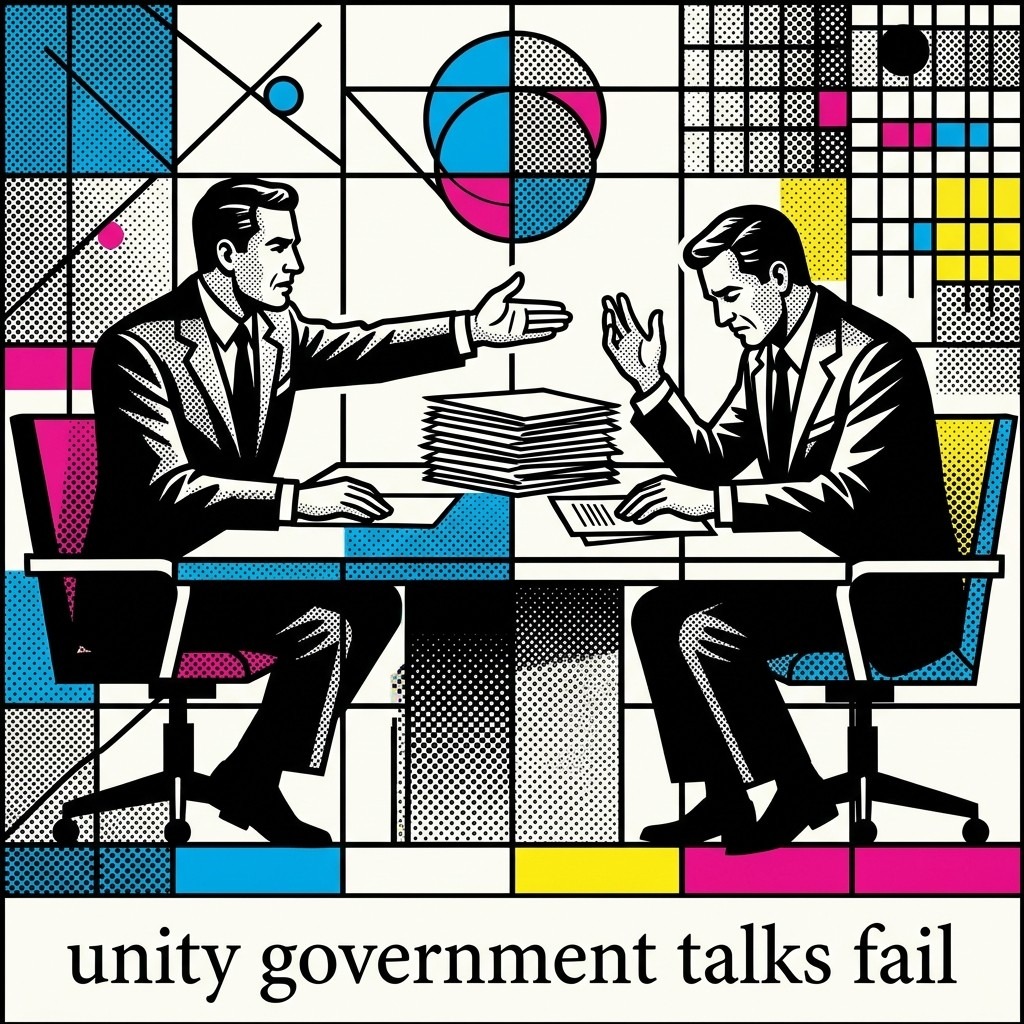
Eisenkot Leaves Netanyahu Meeting Without Unity Deal

Evening Analysis • Sunday, November 29, 2026

The Gist View

Gadi Eisenkot, Israel’s opposition leader and former military chief, left a two-hour meeting with caretaker prime minister Benjamin Netanyahu on 29 November without a unity deal, though Netanyahu offered him the first turn in a rotation. The offer costs Netanyahu little while he remains in office setting the terms, and next Sunday’s deadline presses the challenger harder than the incumbent.

Eisenkot’s refusal protects his opposition bloc, his main leverage; joining Likud, Netanyahu’s conservative party, would spend it for a promise. The parties’ joint statement called the talks businesslike, and a first-slot offer is a real concession, yet the cancelled follow-up meeting suggests the dispute is about guarantees, not seats.

Rotation deals put the whole risk on whoever goes second, so even offered first place, Eisenkot needs to know what enforces the second half, since the offer is worth only what Netanyahu can be held to. In 2020, Netanyahu’s rotation deal with Benny Gantz collapsed before Gantz’s turn came.

The Gist AI Editor

The Global Overview

Israel’s Eisenkot and Netanyahu end unity talks without a deal

Gadi Eisenkot, the Israeli opposition leader and former military chief who was tasked with forming a government after an inconclusive election, met caretaker prime minister Benjamin Netanyahu for two hours on 29 November without reaching an agreement (ZDF). A caretaker prime minister stays in office with reduced powers while a new government is formed. Eisenkot’s centre-right Yashar party and Netanyahu’s conservative Likud issued a joint statement saying both sides tried to bridge deep differences, and Israeli media cited by ZDF report that the two negotiating teams cancelled a further planned meeting. Netanyahu had offered Eisenkot the first place in a rotation, while Eisenkot is holding to his opposition bloc, and because the election produced no clear majorities, he has until next Sunday to form a government (ZDF).

World Liberty’s token falls 50% and its stablecoin slips below its peg

The token of World Liberty, the Trump-linked crypto venture, crashed 50% on 29 November (WSJ). Its USD1 stablecoin, which is meant to stay worth one dollar, briefly traded as low as 94 cents before recovering (WSJ). A stablecoin is only useful as a payment or savings tool if holders can count on getting a full dollar back, so even a brief six-cent gap matters for anyone holding it.

Institutions from the US to Australia restrict Meta’s camera glasses

Businesses and other institutions from the US to Australia are restricting smart glasses such as Ray-Ban Meta, according to Wired on 29 November. The stated driver is people’s discomfort at being filmed covertly by the wearers.

Niger says Chinese oil firms must carry pipeline costs

Niger said it will penalise Chinese oil companies and shift the cost of maintaining and financing its crude export pipeline onto them, according to Bloomberg on 29 November. The move escalates a dispute over the terms of the country’s oil partnership.

Stay tuned for the next Gist, your edge in a shifting world. The Gist remains independent and reader-supported. If you value news free from corporate or state interests, consider supporting our mission with a donation.
The European Perspective

UK pension and benefit systems stay offline after a cyberattack

Work and Pensions Secretary Pat McFadden said on Saturday evening (28 Nov 2026) that an incident flagged to him overnight Thursday was a cyberattack, according to Politico Europe. It disrupted the systems that administer state pensions and welfare benefits, and several Department for Work and Pensions (DWP) online services were still down on Sunday, more than 72 hours after the unauthorised access attempt was detected (Politico Europe). Taking systems offline is standard practice for containing a breach, and McFadden said it was done to protect the public, but pensioners and claimants bear the cost of the shutdown. Education Secretary Lucy Powell told Sky News on 29 Nov that such attacks are “going to happen potentially more frequently” and that the UK needs systems that respond very quickly (Politico Europe), which concedes that the state’s real standard is now recovery rather than prevention. Unlike a bank, the DWP has no competitor that customers can leave, so the outage carries no market penalty, and accountability depends only on political pressure; the length of the shutdown is therefore the clearest measure of how fast the department can recover. No source has attributed the attack to any actor.

Ministers in Rome vote on a €10bn European crewed spaceflight programme

Ministers meet in Rome on 15 December to decide whether to approve Europe’s first human spaceflight programme, which will ultimately cost €10bn (Guardian, 29 Nov 2026). The aim is to cut Europe’s dependence on the US for getting astronauts into space (Guardian).

Merz welcomes EU pause on stricter plug-in hybrid CO2 rules

German Chancellor Friedrich Merz said the EU’s suspension of stricter emissions rules for certain plug-in hybrids gives carmakers more clarity as they rebalance their fleets (Bloomberg, 29 Nov 2026).

Italian furniture makers prepare for EU Ecodesign rules

The EU Ecodesign regulation was approved in 2024, and the Italian furniture trade body FederlegnoArredo is running a game-based initiative to make firms aware of it. The Conlegno roadshow closes 2026 at Mercato San Severino (Il Sole 24 Ore, 29 Nov 2026).

Catch the next Gist for the continent’s moving pieces.

🎙️ Listen to this edition as a podcast Listen

The Gist is an independent daily digest: AI-curated, human-directed, unapologetically liberal (how it’s made). Hundreds of sources, only what matters. Subscribe free or listen to the podcast.