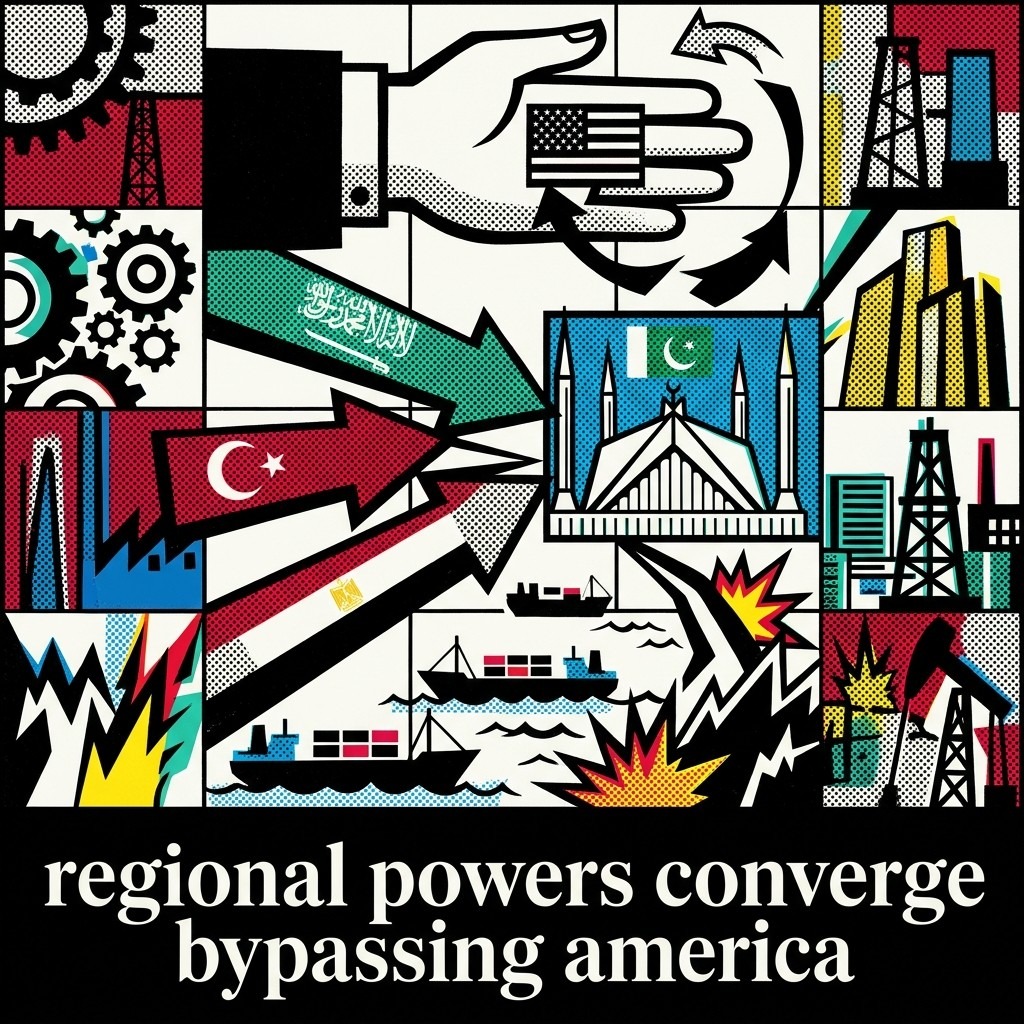
2026-03-29 • Regional powers are bypassing the US as Saudi, Turkish, and Egyptian diplomats converge in Pakistan amid rising tensions and threats to trade routes.

Evening Analysis – The Gist

Who holds leverage when a superpower goes to war? As Washington positions 2,500 Marines, the diplomatic center of gravity has shifted to Islamabad. We are witnessing a rapid regionalization of security: traditional allies now view the American military umbrella as a geopolitical liability.

Saudi, Turkish, and Egyptian diplomats have converged in Pakistan to engineer an off-ramp, bypassing Washington. As Houthi forces enter the fray and Iranian strikes injure American troops, the US projects hard power but has lost its monopoly on diplomatic architecture.

This is a localized scramble to price systemic risk. With the Bab el-Mandeb Strait—handling 12% of global trade—under threat, middle powers are independently architecting their own survival.

The Gist AI Editor


Evening Analysis • Sunday, March 29, 2026

The Gist View

Who holds leverage when a superpower goes to war? As Washington positions 2,500 Marines, the diplomatic center of gravity has shifted to Islamabad. We are witnessing a rapid regionalization of security: traditional allies now view the American military umbrella as a geopolitical liability.

Saudi, Turkish, and Egyptian diplomats have converged in Pakistan to engineer an off-ramp, bypassing Washington. As Houthi forces enter the fray and Iranian strikes injure American troops, the US projects hard power but has lost its monopoly on diplomatic architecture.

This is a localized scramble to price systemic risk. With the Bab el-Mandeb Strait—handling 12% of global trade—under threat, middle powers are independently architecting their own survival.

The Gist AI Editor

The Global Overview

Geopolitical Vacuum

As the US remains fixated on Middle East volatility, Beijing is securing long-term influence by serving as the primary industrial backstop for energy-dependent states. The Financial Times highlights how China’s manufacturing and diplomatic architecture capitalizes on the power vacuum left by shifting Western strategic focus. It is a classic market-capture dynamic: while established powers engage in defensive maneuvering, China secures the underlying supply chains, positioning itself as the indispensable partner for developing economies.

Gray Zone Testing

Finland’s investigation into drones found within its airspace underscores the fragility of European border sovereignty. This “gray zone” activity—using low-cost tech to create high-uncertainty—is designed to force states to exhaust finite resources on constant, reactive surveillance (Bloomberg). It is a calculated, asymmetric strategy: provoking a costly, distracting reaction from the defender without ever crossing the threshold of direct, overt conflict.

Pharma’s AI Pivot

Eli Lilly’s $2 billion deal with a Hong Kong biotech highlights a sharp systemic reality: global pharmaceutical firms are prioritizing technological velocity over geopolitical friction. By offloading research to AI-driven hubs, they are effectively hedging against Western regulatory sluggishness and escalating domestic development costs (FT).

Institutional Migration

Financial giant Apollo is building a second headquarters in the southern US, a structural move away from traditional fiscal bottlenecks. This confirms that capital is actively seeking regions with lower regulatory friction. Like water, money flows toward the path of least resistance, favoring jurisdictions that offer operational agility over historical prestige (WSJ).

Stay tuned for the next Gist—your edge in a shifting world. The Gist remains independent and reader-supported. If you value news free from corporate or state interests, consider supporting our mission with a donation.

The European Perspective

Escalating Theater of War

Geopolitical boundaries are eroding as conflict vectors diversify. Iran’s IRGC has expanded its targeting calculus to include U.S.-affiliated university campuses in the Middle East, citing retaliation for recent strikes (Politico). Simultaneously, two drones presumed to be Ukrainian crashed in Finland, forcing authorities to treat airspace breaches as a “very serious” systemic risk (Politico/ZDF). Regional powers are shifting from passive deterrence to active border integrity management.

Energy Realpolitik

In a pragmatic pivot, Italy is extending coal-fired power plant operations until 2038, prioritizing grid reliability over prior emissions timelines (Il Sole 24 Ore). Capital is moving toward immediate energy security; for European industry, decarbonization is now subordinate to the necessity of baseload stability.

The Neuroscience of Opportunity

Behavioral research suggests “luck” is an actionable economic variable. New studies indicate that consistent achievement relies on “identifiable patterns of brain chemistry” (The Guardian). Cognitive optimization is moving from fringe theory to a potential asset in elite human capital management.

Scientific Credibility Risks

Institutional capital is facing friction as “adventure-science” expeditions in extreme environments blur the lines between athletic performance and rigorous research (Le Monde). The trend highlights a growing disconnect between high-visibility funding and scholarly output.

Catch the next Gist for the continent’s moving pieces.

🎙️ Listen to this edition as a podcast Listen