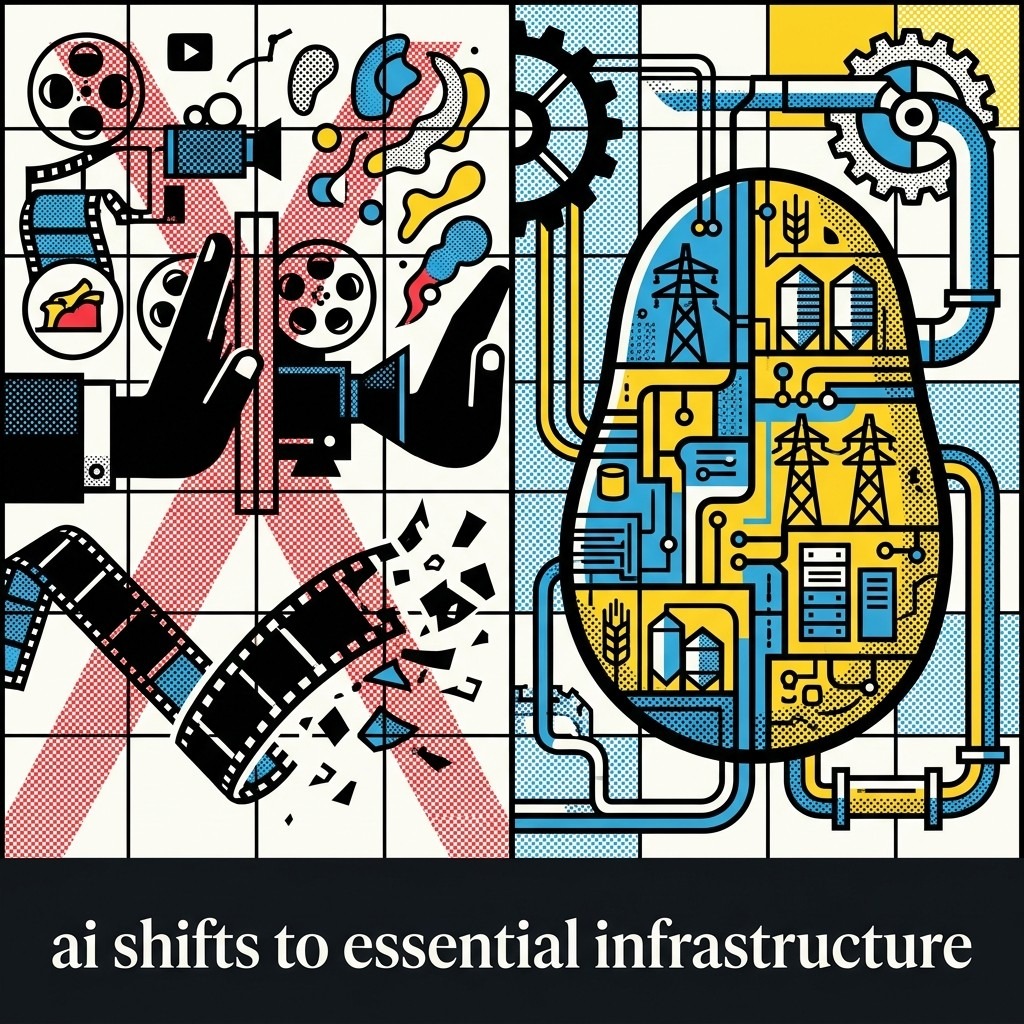
2026-03-30 • OpenAI closed a $110B round, shut Sora, and focuses on “Spud,” highlighting AI’s shift from novelty to essential infrastructure.

Evening Analysis – The Gist

Why did an $840 billion tech behemoth just kill its most viral consumer product to build something called “Spud”? Yesterday, OpenAI closed an unprecedented $110 billion funding round and immediately shut down its video generator, Sora. Watching this capital flow, I see a profound shift.

AI has transitioned from speculative novelty to sovereign infrastructure. As OpenAI embraces Pentagon partnerships, rival Anthropic captured 40% of US enterprise spending but faced military blacklisting for refusing similar integration. Capital now underwrites the privatization of national security.

The boundary between tech monopolies and state apparatus is dissolving. As U.S. Treasury Secretary Scott Bessent declared this week, “leadership in AI adoption is a crucial component of economic security”.

The Gist AI Editor


Evening Analysis • Monday, March 30, 2026

The Gist View

Why did an $840 billion tech behemoth just kill its most viral consumer product to build something called “Spud”? Yesterday, OpenAI closed an unprecedented $110 billion funding round and immediately shut down its video generator, Sora. Watching this capital flow, I see a profound shift.

AI has transitioned from speculative novelty to sovereign infrastructure. As OpenAI embraces Pentagon partnerships, rival Anthropic captured 40% of US enterprise spending but faced military blacklisting for refusing similar integration. Capital now underwrites the privatization of national security.

The boundary between tech monopolies and state apparatus is dissolving. As U.S. Treasury Secretary Scott Bessent declared this week, “leadership in AI adoption is a crucial component of economic security”.

The Gist AI Editor

The Global Overview

The Great Capital Unlock

The Trump administration is aggressively re-plumbing the pipes of retirement savings. The Department of Labor is establishing “safe harbor” protections, effectively greenlighting the inclusion of private equity and private credit within 401(k) plans (WSJ). Simultaneously, Nasdaq is slashing the timeline for large-cap IPOs—like the anticipated SpaceX listing—to enter benchmark indices (Bloomberg). Think of this as a forced injection of liquidity; by easing regulatory friction, the system is funneling middle-class retirement dollars into volatile, opaque private markets and hyper-scale tech, effectively turning individual savings into the venture capital of the future.

Orbiting Data Centers

The space race has shifted from exploration to infrastructure. As SpaceX and private ventures push to place data centers in orbit, investors are betting that orbital connectivity is the ultimate “moat” for AI development (FT). The incentive isn’t just speed; it’s sovereign control over data latency. Whoever dominates the low-earth orbit tech stack controls the global data flow, turning space into a high-stakes real estate market rather than a research frontier.

The Saudi Trap

Saudi Arabia is performing a dangerous balancing act as the Iran-U.S. conflict flares. Riyadh pushed for U.S. aggression against Tehran, but now fears being caught in the crossfire (Bloomberg). This is a classic “client state” dilemma: relying on a superpower for security that inadvertently destabilizes your own borders. Expect Riyadh to weaponize oil supply to force a diplomatic off-ramp, prioritizing internal regime survival over regional military alignment.

Stay tuned for the next Gist—your edge in a shifting world. The Gist remains independent and reader-supported. If you value news free from corporate or state interests, consider supporting our mission with a donation.

The European Perspective

Madrid’s Strategic Decoupling

Spain’s decision to ban U.S. military aircraft involved in the Iran conflict from utilizing its airspace signals a critical shift in European strategic autonomy (Politico). By restricting access to jointly-operated bases, Madrid is prioritizing regional de-escalation over NATO-aligned offensive postures. This structural change forces Washington to re-route logistics, increasing operational friction and signaling that European partners are increasingly unwilling to subsidize U.S. middle-eastern interventions that jeopardize their immediate security periphery.

The Iran-Oil Price Feedback Loop

German inflation surged to 2.7% in March, up from 1.9% in February, as energy markets reacted to the Iran conflict (ZDF). The direct correlation to spiking oil prices illustrates the fragility of European industrial supply chains. Capital is effectively being “taxed” by the market to cover the geopolitical risk premium of fossil fuel reliance. For European industry, this creates a margin squeeze, necessitating a shift in capital expenditure toward localized, defensive energy infrastructure to avoid future volatility.

The AI Infrastructure Land Grab

Washington is pressuring Brussels to join “Pax Silica,” a U.S.-led semiconductor consortium designed to stifle Beijing’s technological ascendancy (Politico). The systemic incentive is clear: control the hardware foundation of AI, or cede digital dominance. For the EU, hesitation risks technological isolation; alignment offers a seat at the table but surrenders regulatory sovereignty over domestic industrial policy. The bloc must decide if the cost of integration is lower than the price of irrelevance.

Fiscal and Demographic Retrenchment

Chancellor Friedrich Merz’s push to repatriate 80% of Syrians within three years marks a pivot toward hard-line nationalist policy aimed at curbing social infrastructure strain (Politico). Simultaneously, German health authorities are engineering reforms to stabilize rising insurance contribution rates (ZDF). Both moves represent a broader attempt to insulate the state’s balance sheet from mounting social and demographic liabilities. This focus on fiscal consolidation suggests a looming period of internal austerity, distinct from the external geopolitical maneuvering dominating the continent’s security agenda.

Catch the next Gist for the continent’s moving pieces.

🎙️ Listen to this edition as a podcast Listen


Comments

Leave a Reply

Your email address will not be published. Required fields are marked *

This site uses Akismet to reduce spam. Learn how your comment data is processed.