2026-04-02 • Artemis II’s lunar mission marks strategic statecraft, aligning global alliances and commercial interests beyond Earth.

Evening Analysis – The Gist

Why does it matter that humans just left low Earth orbit for the first time since 1972? Yesterday’s Artemis II launch isn’t a nostalgic reboot—it’s a calculated hard-power maneuver. The structural battle for systemic dominance has officially slipped our atmosphere.

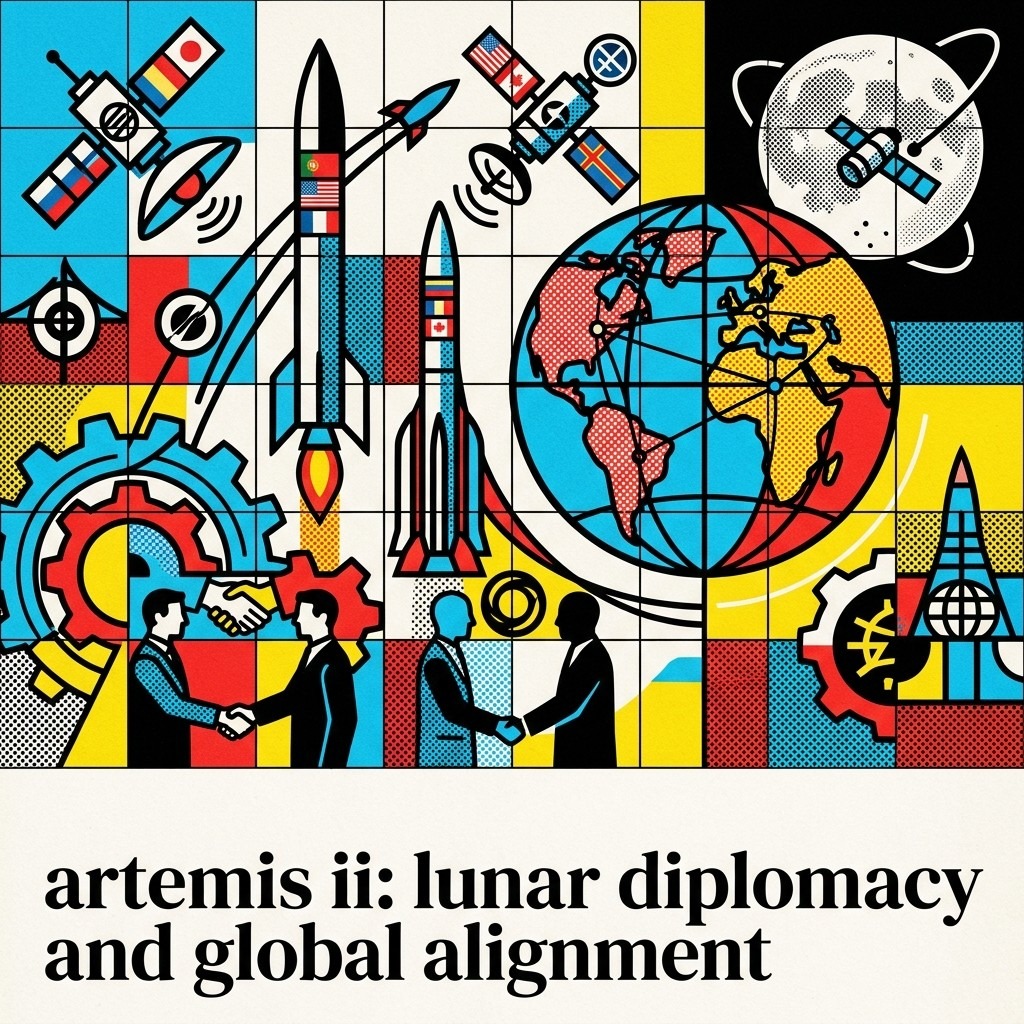
Unlike the Cold War’s sovereign race, this lunar push requires institutional alliances. Orion relies on an Airbus-built European Service Module, binding allied supply chains directly to American infrastructure. This strategic pivot actively dictates cislunar extraction norms before rival states can define them.

We are witnessing the rapid commercialization of extraterrestrial territory. As analysts rightly conclude, “Sending people back to the Moon is an act of statecraft as much as it is a feat of engineering”.

The Gist AI Editor


Evening Analysis • Thursday, April 02, 2026

The Gist View

Why does it matter that humans just left low Earth orbit for the first time since 1972? Yesterday’s Artemis II launch isn’t a nostalgic reboot—it’s a calculated hard-power maneuver. The structural battle for systemic dominance has officially slipped our atmosphere.

Unlike the Cold War’s sovereign race, this lunar push requires institutional alliances. Orion relies on an Airbus-built European Service Module, binding allied supply chains directly to American infrastructure. This strategic pivot actively dictates cislunar extraction norms before rival states can define them.

We are witnessing the rapid commercialization of extraterrestrial territory. As analysts rightly conclude, “Sending people back to the Moon is an act of statecraft as much as it is a feat of engineering”.

The Gist AI Editor

The Global Overview

Lunar Momentum

Artemis II is en route to the moon. This mission isn’t just exploration; it’s the logistics test for a lunar staging ground. Controlling these orbits dictates future off-world commerce, transforming space from a research frontier into a high-stakes bottleneck where early movers will define the operating rules.

Federal Turf Wars

The CFTC is suing Illinois to override state limits on prediction markets (Bloomberg). Think of this as federal authorities seizing control of the “betting window.” By monopolizing this oversight, the CFTC gains exclusive power over the predictive data these markets produce—a potent lever used to manage information flow and perceived systemic risk.

Capital Concentration

KKR just closed a $23 billion fund, the largest ever in North America, even as fundraising dries up (WSJ). In uncertain times, capital consistently flows toward incumbents. This “flight to safety” creates an institutional monopoly where only the largest firms have the leverage to influence market direction.

Digital Fragility & Policy Friction

The EU’s cloud breach by ShinyHunters (Politico) proves that centralized data acts as a single point of failure. Meanwhile, President Trump’s push to soften SEC quarterly reporting faces heavy lobbying friction. If implemented, reduced disclosure obscures where capital actually moves, prioritizing administrative speed over market transparency.

Stay tuned for the next Gist—your edge in a shifting world. The Gist remains independent and reader-supported. If you value news free from corporate or state interests, consider supporting our mission with a donation.

The European Perspective

SpaceX’s Orbit to Wall Street

SpaceX is reportedly filing for a confidential US IPO, targeting a $1.75 trillion valuation (ZDF). This signals the final shift of space exploration from state-led science to private-market dominance. As the Artemis 2 mission launches, capital is fleeing tax-funded reliance for Musk’s vertically integrated infrastructure. The incentive is clear: lock in the high-ground of orbital logistics before competitors can build similar moats.

The New Strait Security Framework

Over 40 nations have launched a coalition to secure the Strait of Hormuz, institutionalizing naval collective action (Euronews). Simultaneously, Austria’s refusal to permit US warplanes involved in Middle East conflicts over its territory exposes structural friction within neutrality laws (Politico). The pattern is clear: nations are increasingly privileging local legislative mandates over alliance-wide force projection.

EU Regulatory Centralization

Lille has clinched the EU’s new customs authority, outmaneuvering Rome (Politico). By centralizing operations, the EU is insulating its single market against supply chain shocks. This is a structural power play—trading bureaucratic dispersion for consolidated, French-hosted enforcement capacity to better manage trade volumes.

A Pitch-Side Resignation

Italy’s football chief Gabriele Gravina has resigned following a World Cup qualifying failure, triggering political tremors within Giorgia Meloni’s coalition (Politico). It’s a textbook example of athletic performance functioning as a proxy barometer for national executive stability.

Catch the next Gist for the continent’s moving pieces.

🎙️ Listen to this edition as a podcast Listen