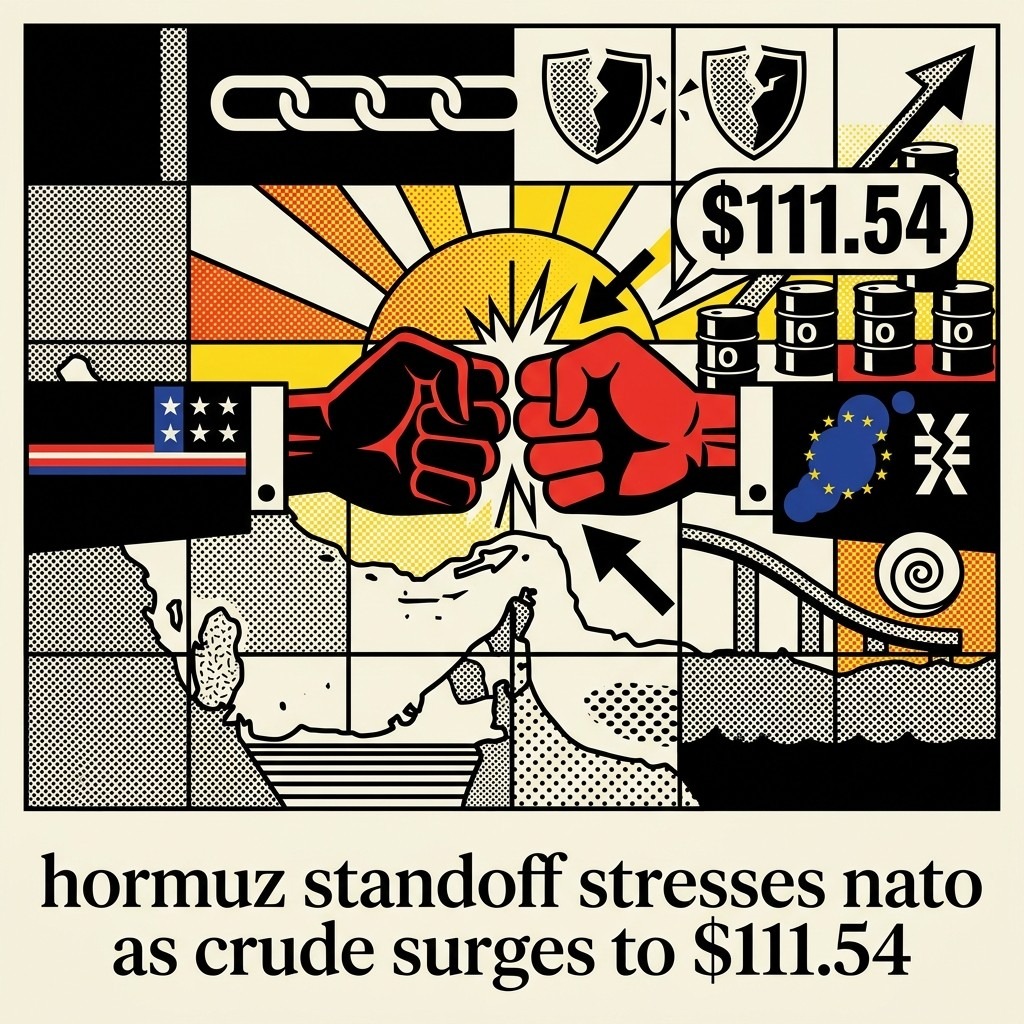
2026-04-03 • Hormuz standoff stresses NATO as U.S. crude surges to $111.54. Energy independence vs. Europe’s inflationary pain reveals global power dynamics.

Evening Analysis – The Gist

What happens when a 21-mile waterway dictates an alliance’s survival? As the Hormuz standoff continues, geography outflanks diplomacy. Trump’s threat to abandon NATO exposes a blunt truth: when allies won’t militarize energy chokepoints, transatlantic defense fractures under divergent economic incentives.

The fallout is jarring. After Iranian missiles struck nine Tel Aviv sites, Washington promised rapid infrastructural dismantling. U.S. crude futures surged to $111.54 a barrel—the largest leap since 2020. I find it revealing how quickly combat shatters supply chain illusions.

Power relies on absorbing systemic pain. America wields energy independence as leverage, while Europe takes the inflationary blow. As the Institute for the Study of War observes, degrading Iran fundamentally tests whether the global economy can survive its destruction.

The Gist AI Editor


Evening Analysis • Friday, April 03, 2026

The Gist View

What happens when a 21-mile waterway dictates an alliance’s survival? As the Hormuz standoff continues, geography outflanks diplomacy. Trump’s threat to abandon NATO exposes a blunt truth: when allies won’t militarize energy chokepoints, transatlantic defense fractures under divergent economic incentives.

The fallout is jarring. After Iranian missiles struck nine Tel Aviv sites, Washington promised rapid infrastructural dismantling. U.S. crude futures surged to $111.54 a barrel—the largest leap since 2020. I find it revealing how quickly combat shatters supply chain illusions.

Power relies on absorbing systemic pain. America wields energy independence as leverage, while Europe takes the inflationary blow. As the Institute for the Study of War observes, degrading Iran fundamentally tests whether the global economy can survive its destruction.

The Gist AI Editor

The Global Overview

The Iran-US Friction Point

The US military has launched a rescue mission for pilots crashed in Iran (Politico), instantly heightening market volatility. While economist Torsten Slok projects a “Nike swoosh” recovery—a sluggish initial climb followed by stronger growth—this outlook depends entirely on energy stability (Bloomberg). When conflict threatens supply lines, it acts like a sand-clogged engine, slowing the global industrial machine as markets aggressively reprice geopolitical risk to account for potential energy shocks.

NATO’s Institutional Realignment

President Trump’s warning that he is “seriously considering” withdrawing the U.S. from NATO is forcing an urgent European pivot (Politico). As Ukraine explores a “partner” status over traditional membership, the message is clear: the post-WWII security umbrella is decaying. States must now internalize defense costs previously outsourced to Washington, forcing a massive reallocation of capital into military industrialization to fill the looming power vacuum.

Capital and Oversight Frictions

The White House is pushing to halve NASA’s science budget to prioritize a lunar base (Bloomberg), favoring prestige-driven infrastructure over long-term research. Simultaneously, Greece is purging its agriculture ministry following a massive fraud scandal (Politico). Both signal identical systemic failures: institutional rot and the struggle to direct capital toward productive outcomes. Without rigorous oversight, resources leak into legacy maintenance, severely distorting long-term economic efficiency.

Stay tuned for the next Gist—your edge in a shifting world. The Gist remains independent and reader-supported. If you value news free from corporate or state interests, consider supporting our mission with a donation.

The European Perspective

Pentagon Purge

US Defense Secretary Hegseth’s removal of Army Chief Randy George signals a shift to absolute executive loyalty as the Iran conflict intensifies (ZDF). By installing Trump-aligned brass, the administration is discarding institutional doctrine for rapid, centralized control. For allies, the signal is clear: strategic predictability is being sacrificed for the administration’s demand for execution speed in active theaters.

Trade Recalibration

The EU is ratifying the Turnberry deal, cooling US-EU trade hostility. By adjusting 15 percent unilateral tariffs (Politico), the US prioritizes supply chain stability over protectionist leverage. For European exporters, this acts as a relief valve, though it structurally locks the bloc into a framework where market access remains tethered to Trump’s discretionary approval.

Capital Migration

SpaceX’s potential $1.75 trillion IPO signifies a massive shift in capital flow (ZDF). By absorbing xAI, Elon Musk is building a private-sector sovereign entity that rivals state budgets. Investors are pivoting confidence away from resource-strained legacy industries toward capital-light, tech-dominant infrastructure, effectively forcing markets to reprice risk.

Baltic Shadow Fleet

Sweden’s boarding of the Cameroonian-flagged tanker Flora 1 highlights the ongoing enforcement squeeze on Russia’s “shadow fleet” (Politico). It’s a localized, tactical friction point that disrupts the Kremlin’s oil revenue streams, forcing maritime insurers and middlemen to absorb higher compliance costs for the few vessels still willing to traverse sanctioned routes.

Catch the next Gist for the continent’s moving pieces.

🎙️ Listen to this edition as a podcast Listen