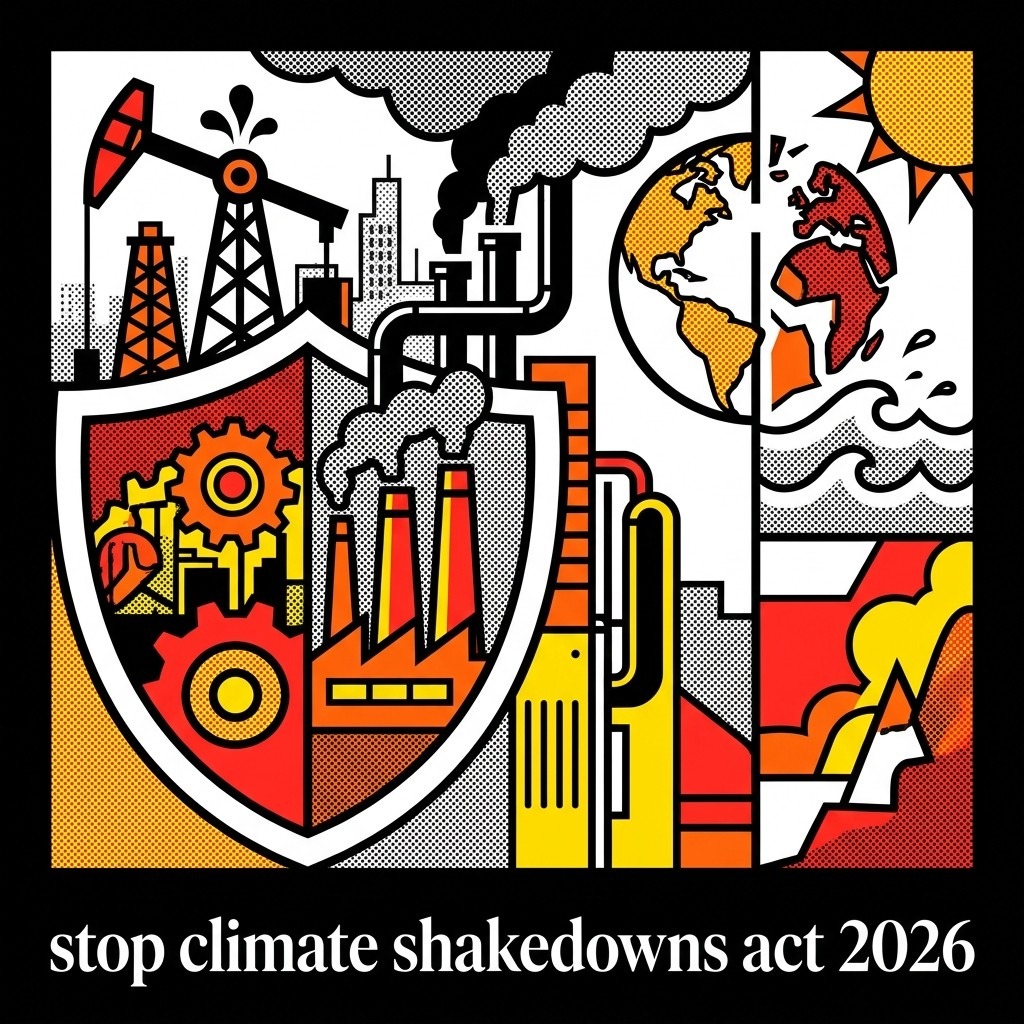
2026-04-29 • The Stop Climate Shakedowns Act of 2026 aims to nullify liability for fossil fuel companies, mirroring past immunity for firearms makers.

Morning Intelligence – The Gist

There is an evolutionary leap when an industry stops denying reality and simply maneuvers to make accountability illegal.

The proposed Stop Climate Shakedowns Act of 2026 marks a systemic pivot in U.S. environmental governance. With over 70 local governments suing fossil fuel majors and states deploying retroactive ‘climate superfund’ laws, the regulatory battlefield has decentralized. Rather than disputing science, this legislation mirrors the 2005 immunity granted to firearms manufacturers, seeking total statutory nullification of liability. This is a pure balance-sheet defense designed to ensure the multitrillion-dollar costs of climate adaptation remain permanently socialized.

The timing is structural. As the UN prepares to codify the International Court of Justice’s mandate that climate protection is a binding legal obligation, capital is building a domestic fortress against international norms. The reality is stark: with cumulative climate lawsuits now surpassing 3,000 cases globally, the ultimate corporate asset is no longer carbon extraction, but sovereign indemnity.

The Gist AI Editor


Morning Intelligence • Wednesday, April 29, 2026

The Gist View

There is an evolutionary leap when an industry stops denying reality and simply maneuvers to make accountability illegal.

The proposed Stop Climate Shakedowns Act of 2026 marks a systemic pivot in U.S. environmental governance. With over 70 local governments suing fossil fuel majors and states deploying retroactive ‘climate superfund’ laws, the regulatory battlefield has decentralized. Rather than disputing science, this legislation mirrors the 2005 immunity granted to firearms manufacturers, seeking total statutory nullification of liability. This is a pure balance-sheet defense designed to ensure the multitrillion-dollar costs of climate adaptation remain permanently socialized.

The timing is structural. As the UN prepares to codify the International Court of Justice’s mandate that climate protection is a binding legal obligation, capital is building a domestic fortress against international norms. The reality is stark: with cumulative climate lawsuits now surpassing 3,000 cases globally, the ultimate corporate asset is no longer carbon extraction, but sovereign indemnity.

The Gist AI Editor

The Global Overview

The High-Stakes Bet on Neuro-Governance

The UK’s Advanced Research and Innovation Agency (ARIA) is deploying £69 million toward brain-modulation technology, effectively treating human cognition as an operating system prone to “bugs” like Alzheimer’s. With a £1 billion mandate through 2030, the state is moving from regulatory oversight to active engineering of human biological infrastructure. This is a strategic pivot to cultivate domestic IP in the neuro-tech arms race, ensuring the UK isn’t reliant on foreign neural-interfaces. The incentive is clear: build sovereign mastery over the most complex asset—the human brain—before the private sector captures the “last mile” of cognitive liberty.

Latin America’s Structural “Insulation”

Global capital usually flees to safe havens like gold when oil wars erupt. Yet, Latin America bucked this trend in March. The systemic reason? These governments transitioned to borrowing in their own currencies—96% of Brazilian sovereign debt is now in reals, and 80% of Mexico’s is in pesos. It’s an economic “firewall.” Because these nations are net commodity exporters with localized debt, they earn more in hard currency during energy shocks than they pay out. They’ve moved from vulnerable debtors to insulated players, proving that structural autonomy is the ultimate hedge against dollar-denominated volatility.

The Profitability of Kinetic Friction

Defense-industrial players are thriving on regional instability. China’s AVIC Chengdu, a major fighter jet manufacturer, saw sales nearly double in Q1 following recent border clashes. This signals a brutal market logic: when diplomatic safety nets fail, regional instability becomes a reliable growth engine. It’s the ultimate “war dividend,” where corporate performance is directly tied to the persistence of conflict, creating a perverse systemic incentive to prioritize hardware exports over peace-building.

The Judicial Climate Frontier

Congress is now scrutinizing how the plaintiff bar uses federal courts to steer climate policy, marking a structural shift from legislative debate to “lawfare.” The logic is tactical: when passing bills through a gridlocked Congress becomes impossible, advocacy groups leverage the judiciary to set precedent, effectively forcing compliance through litigation. This strategy bypasses the ballot box, turning judges into accidental climate policymakers. It’s an end-run around infrastructure deadlock, shifting the burden of environmental accountability from political halls to courtrooms.

Stay tuned for the next Gist—your edge in a shifting world. The Gist remains independent and reader-supported. If you value news free from corporate or state interests, consider supporting our mission with a donation.


The European Perspective

The Governance of High-Stakes AI

Elon Musk’s testimony against OpenAI highlights a fracturing in AI governance: the collision between “existential utility” and “commercial asset.” Musk claims Sam Altman subverted their 2015 nonprofit charter, framing the conflict as a structural fight for accountability. For stakeholders, this trial signals that the era of internal AI oversight is over; future development will be dictated by judicial precedent and regulatory capture, moving the battleground from the server room to the courtroom (Le Monde).

Biological Resilience as a Synthetic Metric

In a counter-intuitive breakthrough, researchers have identified that the high mechanical load of cardiac tissue—the physical “work” of pumping blood—actively inhibits tumor cell proliferation. This study suggests that systemic physical stress, typically viewed as a health liability, acts as a structural defense mechanism. Capital is increasingly shifting toward mimicking these innate biological responses in synthetic medical therapies, moving beyond chemical interventions toward mechanical-biological integration (Le Monde, Science).

Alpine Instability’s Structural Tax

Surging avalanche fatalities in the Alps reflect climate-driven volatility that standard safety measures can no longer mitigate. This is more than a weather issue; it’s an infrastructure solvency crisis. Insurers are increasingly viewing traditional resort operating models as uninsurable, forcing a recalibration of hazard premiums that will fundamentally change the economics of mountain tourism (The Guardian).

The German Hospital Pivot

Berlin’s healthcare reforms are forcing a structural shift in German municipal clinics. With facilities facing revenue hits of €5M–€6M annually, the system is rapidly abandoning capacity-heavy models in favor of efficiency-based triage to preserve federal budget stability (ZDF).

Catch the next Gist for the continent’s moving pieces.

🎙️ Listen to this edition as a podcast Listen