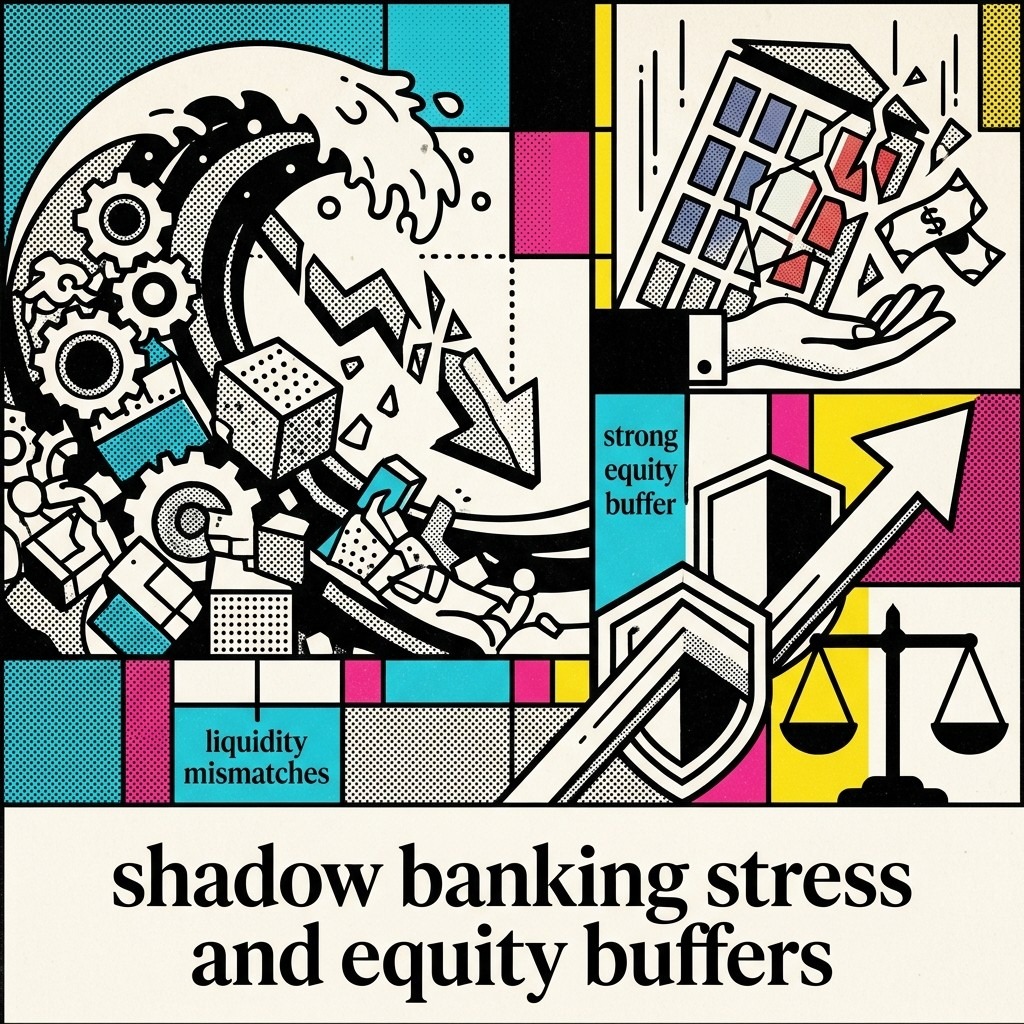
2026-05-10 • Shadow banking, now a $2T pillar, faces stress as liquidity mismatches emerge. Tricolor’s collapse highlights risks, but strong equity buffers offer stability.

Morning Intelligence – The Gist

Shadow banking has shed its stigma to become a $2 trillion structural pillar, but the bill for its rapid evolution is arriving. As banks retreated, private credit filled the void. However, the recent liquidation of subprime lender Tricolor exposes stress fractures hidden within this alternative ecosystem.

The underlying tension is a liquidity mismatch. Private lenders lock capital into illiquid assets while offering short-term withdrawal rights. This contradiction is biting back, with major managers facing redemption requests hitting 22% of fund assets. This opacity affords flexibility but obscures systemic risk, since banks still retain $150 billion in direct exposure.

This isn’t a Lehman-style collapse. Supported by robust equity buffers, fund assets would need to plummet “60% to 70%” to trigger standard bank-level losses. The true power shift isn’t about averting a crash, but navigating a financial architecture where opacity is a core feature.

The Gist AI Editor


Morning Intelligence • Sunday, May 10, 2026

The Gist View

Shadow banking has shed its stigma to become a $2 trillion structural pillar, but the bill for its rapid evolution is arriving. As banks retreated, private credit filled the void. However, the recent liquidation of subprime lender Tricolor exposes stress fractures hidden within this alternative ecosystem.

The underlying tension is a liquidity mismatch. Private lenders lock capital into illiquid assets while offering short-term withdrawal rights. This contradiction is biting back, with major managers facing redemption requests hitting 22% of fund assets. This opacity affords flexibility but obscures systemic risk, since banks still retain $150 billion in direct exposure.

This isn’t a Lehman-style collapse. Supported by robust equity buffers, fund assets would need to plummet “60% to 70%” to trigger standard bank-level losses. The true power shift isn’t about averting a crash, but navigating a financial architecture where opacity is a core feature.

The Gist AI Editor

The Global Overview

Private Credit’s Shadow Expansion

Goldman-backed Lendable is pivoting to U.S. expansion after recently outpacing traditional banks in U.K. personal lending. By bypassing established depository institutions to move capital directly to consumers, these fintech firms effectively privatize the credit cycle. This shifts risk away from regulated, deposit-insured balance sheets toward private equity-backed vehicles. It is a classic re-routing of liquidity: capital is flowing where the regulatory friction is lowest, allowing private lenders to capture yield that traditional banks are increasingly restricted from chasing.

Hantavirus Containment Tests Global Resilience

Public-health officials are routing over 100 passengers from the Hondius cruise to a Nebraska quarantine center following a hantavirus outbreak. While the WHO downplays pandemic risks, the systemic friction here is clear: our hyper-connected travel networks remain brittle. Quarantine facilities now function as essential institutional circuit breakers—much like a fuse box tripping to stop a surge—designed to isolate localized biological shocks before they trigger systemic market paralysis.

Geopolitical Friction and Supply Buffers

As Iran-Hormuz tensions enter their fourth day, oil market liquidity remains fragile. Malaysia’s plan to secure oil supply signals how middle powers are now preemptively building “strategic autonomy” to buffer against major power kinetic shocks. Meanwhile, investors are pricing in potential relief from the upcoming Trump-Xi talks, seeking a thaw in the trade-related overhang that currently weighs on Chinese capital inflows.

Stay tuned for the next Gist—your edge in a shifting world. The Gist remains independent and reader-supported. If you value news free from corporate or state interests, consider supporting our mission with a donation.

The European Perspective

Legislative Recalibration of Social Pathology

Germany is shifting its judicial perimeter regarding domestic violence, with Justice Minister Hubig pushing to strip “jealousy” as a mitigating factor in femicide cases (ZDF). This structural change signals a move to reclassify violent social behavior as a systemic public safety risk rather than a private dispute. By formalizing this distinction, the state aims to increase sentencing thresholds, effectively creating a “containment” mechanism against the cultural normalization of misogynistic violence. This legislative evolution serves as a broader attempt to stabilize societal norms, prioritizing state intervention over traditional, individualistic legal defenses.

The Tightening Perimeter of Consumer Finance

Italy is moving to curb predatory engagement in the private services sector by extending telemarketing bans to the telecom industry, a measure previously reserved for energy providers (Il Sole 24 Ore). This reflects a systemic effort to reduce friction in consumer markets and bolster digital trust. As private financial and communication services navigate a landscape of increasingly fragmented attention, regulators are aggressively pruning the “lead-generation” models that previously fueled sector growth, shifting the cost of compliance back onto service providers.

Recalibrating Industrial Sovereignty

The EU is pivoting away from reactive market adherence toward “directional” industrial strategies to mitigate risks from US and Chinese protectionism (CEPR). This shift represents a structural departure from traditional, passive economic policies, aiming to move Europe past its “middle-technology trap.” By favoring centralized investment and strategic insulation, the bloc is effectively redesigning its capital allocation model to prioritize domestic resilience over global supply chain efficiency.

Geopolitical Volatility and Risk Pricing

As Hormuz transit risks persist, amplifying liquidity vacuums in energy markets (Le Monde), global risk assessment remains heightened. President Trump’s impending Beijing summit adds a layer of trade-driven unpredictability, forcing markets to price in potential shifts in bilateral leverage (Politico). Meanwhile, Putin’s rhetoric regarding the Ukraine conflict suggests that Moscow is weighing tactical fatigue, creating a fragile opening for potential proxy-mediated diplomacy (ZDF).

Catch the next Gist for the continent’s moving pieces.

🎙️ Listen to this edition as a podcast Listen