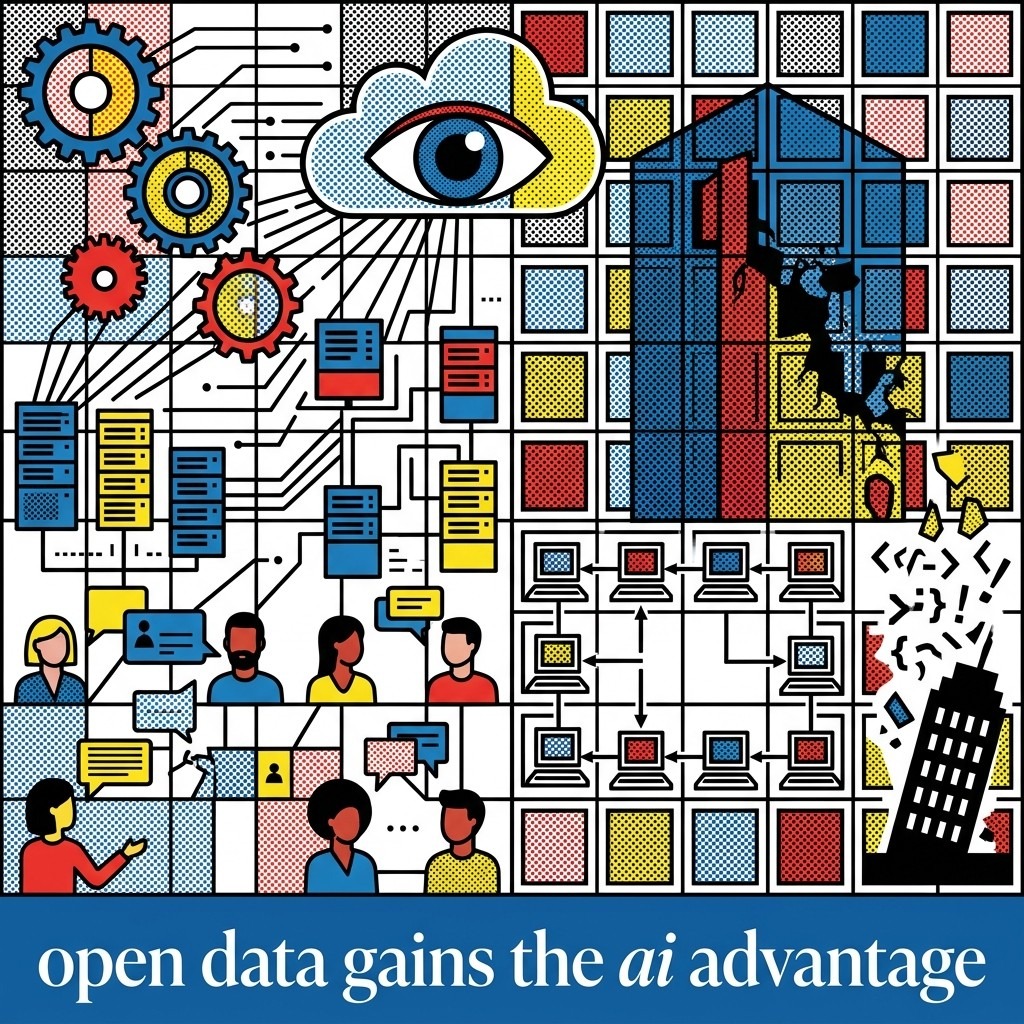
2026-05-11 • Open data is now the ultimate AI advantage, as China’s censored ecosystem risks “model collapse” by relying on state-approved, synthetic data.

Evening Analysis – The Gist

The ultimate geopolitical moat in artificial intelligence is no longer semiconductor supremacy—it is open data. As rivals maneuver for computing dominance, authoritarian regimes face a critical structural vulnerability: algorithmic inbreeding.

Analysts at Defense News warn China’s censored ecosystem is rapidly accelerating toward “model collapse”. Trapped behind the Great Firewall, developers increasingly train next-generation AI on state-approved, synthetic data. Building on recent military purges that systematically prioritize loyalty over reality, this strict information control now mathematically corrupts the very predictive systems Beijing relies upon for strategic forecasting.

Unrestricted networks have quietly evolved into a hard-power asset. Models trained on closed propaganda merely amplify institutional blind spots. As researchers observe regarding this self-defeating technological loop, deploying AI strictly governed by state narratives “is not an intelligence system. It is a mirror”.

The Gist AI Editor


Evening Analysis • Monday, May 11, 2026

The Gist View

The ultimate geopolitical moat in artificial intelligence is no longer semiconductor supremacy—it is open data. As rivals maneuver for computing dominance, authoritarian regimes face a critical structural vulnerability: algorithmic inbreeding.

Analysts at Defense News warn China’s censored ecosystem is rapidly accelerating toward “model collapse”. Trapped behind the Great Firewall, developers increasingly train next-generation AI on state-approved, synthetic data. Building on recent military purges that systematically prioritize loyalty over reality, this strict information control now mathematically corrupts the very predictive systems Beijing relies upon for strategic forecasting.

Unrestricted networks have quietly evolved into a hard-power asset. Models trained on closed propaganda merely amplify institutional blind spots. As researchers observe regarding this self-defeating technological loop, deploying AI strictly governed by state narratives “is not an intelligence system. It is a mirror”.

The Gist AI Editor

The Global Overview

Biocontainment as Macro-Risk

US citizens isolated in Nebraska following a cruise ship hantavirus outbreak signals a sharp pivot toward aggressive, localized health containment. This isn’t merely medical policy; it is the hardening of borders against biological volatility. When “intermittent isolation” becomes a routine bureaucratic procedure rather than an emergency response, it functions as a new structural friction for global trade and supply chains. Industries must now price in localized shutdowns as a permanent cost of doing business, favoring firms with decentralized, resilient infrastructure.

Demand-Side Intelligence

AI maneuvering is shifting from “build-at-all-costs” to “integrative utility.” Research is evolving toward platforms that allow users to stress-test chemical and economic models in real-time, effectively commoditizing the process of experimentation. The structural winners are no longer just the companies with the most data, but those controlling the platform where the simulation happens. This forces competitors to either adapt or risk obsolescence as the barrier to entry shifts from raw data volume to tool-set depth.

The Parabolic Trap

Michael Burry’s warning on Nasdaq 100 valuations signals a dangerous decoupling where market sentiment inflates prices far beyond current productivity. As liquidity tightens, the gap between hyped potential and actual fiscal sustainability creates latent systemic risk. Meanwhile, the US-Iran ceasefire is on “massive life support” following the rejection of Tehran’s latest peace offer, and German fiscal stasis persists as regional actors prioritize local industrial protection over federal stimulus.

Stay tuned for the next Gist—your edge in a shifting world. The Gist remains independent and reader-supported. If you value news free from corporate or state interests, consider supporting our mission with a donation.

The European Perspective

Containment Protocols Tested

France has activated emergency protocols after a repatriation flight confirmed a hantavirus case. Authorities are enforcing mandatory isolation for high-risk contacts, prioritizing rapid-response containment over broad community lockdowns. This localized strategy is a pragmatic hedge, protecting healthcare system throughput while managing sporadic transmission clusters (Politico).

The Compute Pragmatism Pivot

SpaceX is leasing its Colossus 1 supercomputer to Anthropic, despite Musk’s past ‘evil’ branding of the firm. This reveals a fundamental structural incentive: the scarcity of high-end compute overrides ideological friction. Access to hardware now dictates the AI market’s ceiling, forcing even sworn rivals into functional partnerships to scale capacity (Euronews).

Funding as Regulatory Leverage

Norway’s pause in UN Environment Programme funding ahead of budget talks is a tactical play. By withholding capital, the bloc’s largest donor is weaponizing financial dependency to force movement on the stalled global plastics treaty. It signals a structural shift: diplomatic gridlock is increasingly met with blunt fiscal pressure (The Guardian).

Refinery Stability Measures

Germany’s PCK refinery faces ongoing throughput risks following the cessation of Kazakh oil supplies. Berlin’s response—an extended employment guarantee through year-end—is a classic preservation tactic, insulating the regional labor market from energy shocks while maintaining industrial readiness (ZDF).

Mercosur Legal Pushback

Poland has taken its opposition to the Mercosur trade agreement to the EU’s top court. While the deal targets a 39% export boost by 2040, the challenge underscores the deep structural friction between agricultural protectionism and bloc-wide economic integration (Euronews).

Catch the next Gist for the continent’s moving pieces.

🎙️ Listen to this edition as a podcast Listen