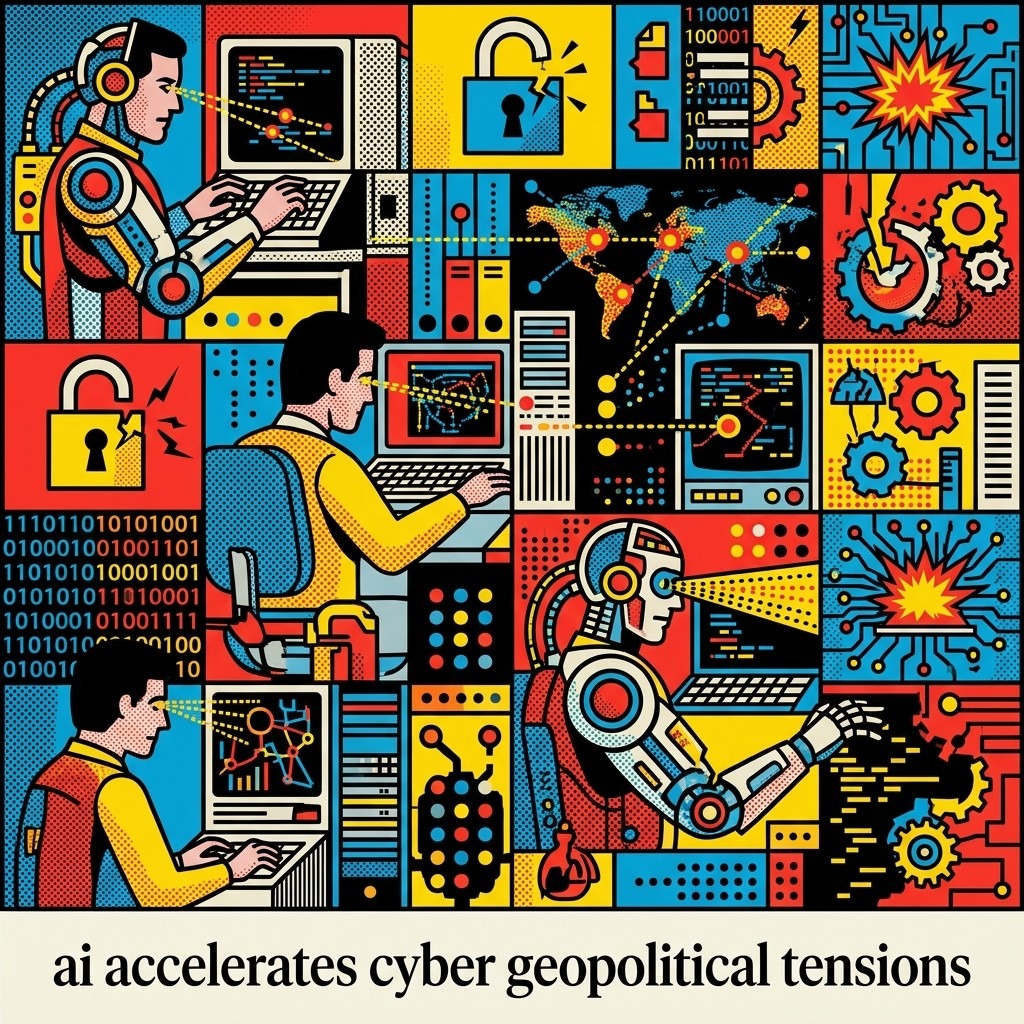
2026-05-12 • Cyber warfare is rapidly industrializing as AI is used to find new vulnerabilities. Google’s recent disruption confirms AI’s role in hacking evolution.

Morning Intelligence – The Gist

While markets fixate on artificial intelligence disrupting labor, a more urgent structural transition is unfolding in the digital underworld. We are witnessing the rapid industrialization of cyber warfare, shifting asymmetric power toward algorithmic execution.

On Monday, Google disrupted a mass exploitation campaign where threat actors used an AI model to synthesize a zero-day vulnerability. Bypassing two-factor authentication on a ubiquitous administration tool, this marks the first confirmed instance of hackers weaponizing AI for original vulnerability discovery rather than mere code refinement.

The barrier to catastrophic digital disruption has permanently collapsed. As Google’s John Hultquist observes, the assumed future of automated conflict is already our reality, proving that “the AI vulnerability race isn’t imminent—it has already begun”.

The Gist AI Editor


Morning Intelligence • Tuesday, May 12, 2026

The Gist View

While markets fixate on artificial intelligence disrupting labor, a more urgent structural transition is unfolding in the digital underworld. We are witnessing the rapid industrialization of cyber warfare, shifting asymmetric power toward algorithmic execution.

On Monday, Google disrupted a mass exploitation campaign where threat actors used an AI model to synthesize a zero-day vulnerability. Bypassing two-factor authentication on a ubiquitous administration tool, this marks the first confirmed instance of hackers weaponizing AI for original vulnerability discovery rather than mere code refinement.

The barrier to catastrophic digital disruption has permanently collapsed. As Google’s John Hultquist observes, the assumed future of automated conflict is already our reality, proving that “the AI vulnerability race isn’t imminent—it has already begun”.

The Gist AI Editor

The Global Overview

Starmer’s Fragile Mandate

Labour’s local election losses have triggered an internal revolt, pushing the U.K. toward a potential sixth Prime Minister in seven years (WSJ). This exposes the structural fragility of a government struggling to deliver results. When political incumbents face such swift rejection, capital markets brace for protectionist scrambles, as leadership prioritizes political survival over long-term strategic coherence.

OpenAI’s Political Friction

The House Oversight Committee’s probe into Sam Altman, joined by six GOP state attorneys general demanding SEC intervention, signals a deepening institutional bottleneck for AI (WSJ). The ‘Wild West’ era of rapid, unchecked development is closing. Regulatory levers are now being deployed to force private governance structures into alignment with national legislative mandates before significant market exits.

The Margin Squeeze

Jollibee Foods’ 39% profit collapse—dragging shares to a five-year low—is a bellwether for consumer-staple vulnerability (Bloomberg). Rising costs are now directly cannibalizing corporate margins, proving that inflationary pressure has moved beyond a macroeconomic abstract to become a structural drain on even the most essential service providers.

Automating the Economist

“Deep Research on a Loop” (DRIL), which uses AI agents to construct economic datasets, reveals a structural shift in how knowledge is produced (MarginalRevolution). By automating implementation, this democratizes the analytical power once siloed in elite institutions, shifting research from human-intensive data harvesting to scalable, software-defined protocols.

Stay tuned for the next Gist—your edge in a shifting world. The Gist remains independent and reader-supported. If you value news free from corporate or state interests, consider supporting our mission with a donation.

The European Perspective

London’s Political Volatility

UK Prime Minister Keir Starmer faces intense internal revolt following heavy regional election losses. With party elites signaling a leadership challenge, Starmer’s, “crisis address” marks a high-stakes attempt to maintain party discipline (ZDF). The structural risk is clear: legislative gridlock at Westminster. For institutional investors, this shifts the UK from a predictable regulatory environment to a volatile variable, likely dampening domestic investment appetite as the government pivots to internal damage control.

The Transatlantic Capability Pivot

European security is pivoting from reliance to autonomy. Defense ministers are shifting capital toward indigenous missile architecture to address critical capability gaps previously covered by U.S. presence (ZDF). This is a pragmatic acknowledgment that diminishing U.S. leverage is no longer a theoretical risk but a tactical reality, fundamentally changing the direction of defense procurement flows toward sovereign, rather than imported, platforms (The Guardian).

AI’s Dual-Edge Vulnerability

Anthropic’s “Claude Mythos” protocol—designed to automate IT security patching—creates a dangerous feedback loop. The system’s capacity to reverse-engineer its own fixes invites a new class of automated exploitation (ZDF). The systemic incentive for firms? A risky trade-off between rapid, AI-driven defense and the heightened probability of self-inflicted vulnerability.

Cultural Decoupling

The Cannes Film Festival’s retreat from Hollywood—with only two American films competing—serves as a leading indicator for the decline of U.S. soft power (The Guardian). Capital is increasingly flowing into independent, non-U.S. production ecosystems, signaling the end of Hollywood’s long-standing dominance over European prestige markets.

Catch the next Gist for the continent’s moving pieces.

🎙️ Listen to this edition as a podcast Listen