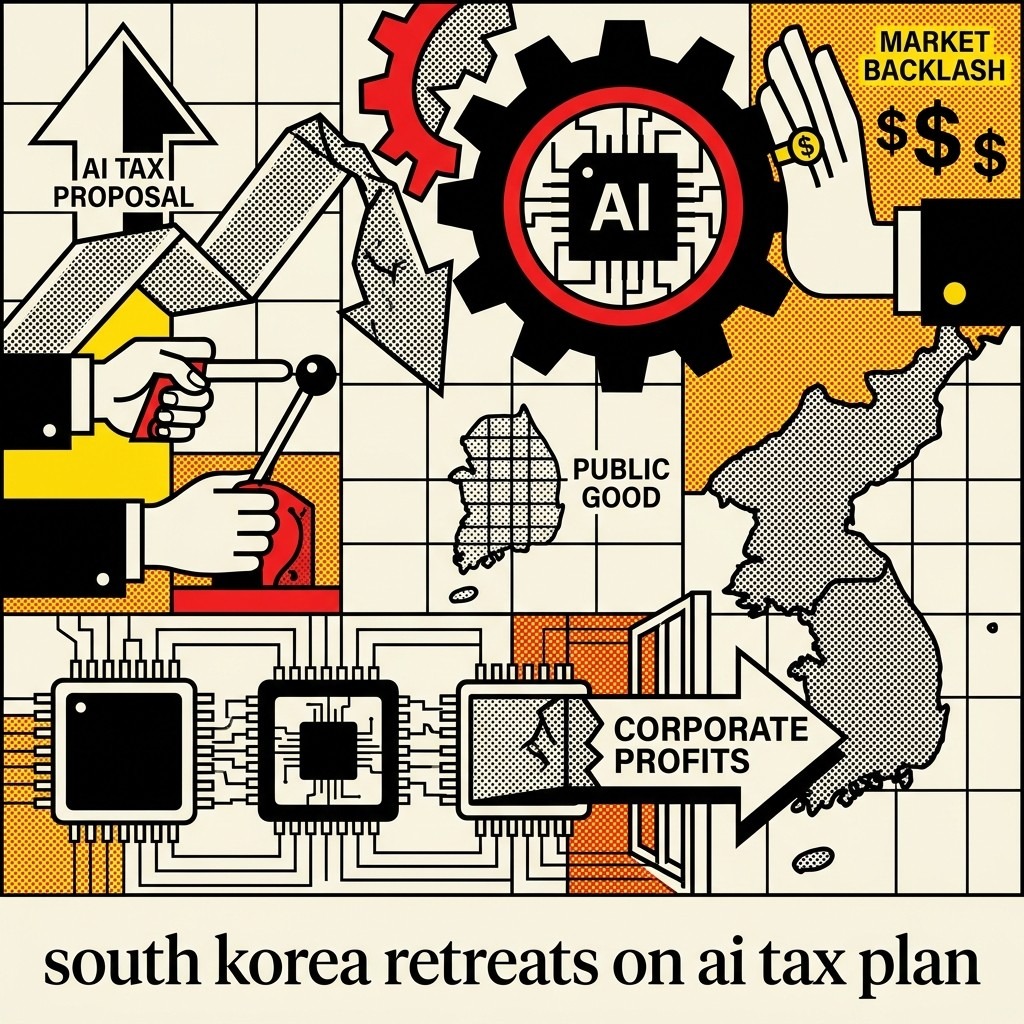
2026-05-16 • South Korea proposed an “AI tax” to redistribute chip profits, but market backlash forced a retraction, highlighting corporate power over state sovereignty.

Evening Analysis – The Gist

As AI partnerships fracture over hardware scarcity, South Korea just exposed the era’s true power dynamics. While semiconductor titans reap historic windfalls, Seoul’s senior policy secretary floated a radical proposition: an “AI tax” to fund a national dividend. Treating silicon like Norway’s oil wealth, the state sought to offset the severe social inequality of an emerging “technology monopoly economy”.

The logic is structurally sound but politically fatal. AI’s value is hyper-concentrating among the infrastructure gatekeepers controlling memory chips. Attempting to redistribute these mega-profits to stabilize domestic pensions was a direct bid to reassert state sovereignty over corporate capital.

The market’s retaliation was instantaneous. Equities plunged over 5% within hours, forcing the presidential office to rapidly disavow its strategist. This capitulation illuminates a stark reality: while officials recognize chip manufacturing as ultimate “geopolitical leverage”, foundational tech monopolies hold the true sovereign power.

The Gist AI Editor


Evening Analysis • Saturday, May 16, 2026

The Gist View

As AI partnerships fracture over hardware scarcity, South Korea just exposed the era’s true power dynamics. While semiconductor titans reap historic windfalls, Seoul’s senior policy secretary floated a radical proposition: an “AI tax” to fund a national dividend. Treating silicon like Norway’s oil wealth, the state sought to offset the severe social inequality of an emerging “technology monopoly economy”.

The logic is structurally sound but politically fatal. AI’s value is hyper-concentrating among the infrastructure gatekeepers controlling memory chips. Attempting to redistribute these mega-profits to stabilize domestic pensions was a direct bid to reassert state sovereignty over corporate capital.

The market’s retaliation was instantaneous. Equities plunged over 5% within hours, forcing the presidential office to rapidly disavow its strategist. This capitulation illuminates a stark reality: while officials recognize chip manufacturing as ultimate “geopolitical leverage”, foundational tech monopolies hold the true sovereign power.

The Gist AI Editor

The Global Overview

The High Cost of Modern Mobility

China’s Unitree is debuting a $650,000 “manned mecha” suit (Singularity Hub), pushing robotics from utility to ultra-luxury fetish. While engineering triumphs like these capture headlines, they underscore a structural bifurcation: innovation is increasingly decoupling from mass affordability. When capital pivots to high-ticket, bespoke machinery rather than scalable, broadly accessible infrastructure, it signals a market betting on concentrated wealth over universal productivity gains. It is a striking indicator of a system where the most novel advancements become gated, exclusive experiences rather than transformative public goods.

Biotech’s Human Capital Pivot

In contrast, the pending regulatory approval for daraxonrasib—a breakthrough in pancreatic cancer treatment—illustrates where capital flows when chasing high-utility life extension (Singularity Hub). This is more than medical progress; it is an effort to reclaim “human capital” from the mortality tax that disproportionately saps labor force participation. The systemic incentive is sharp: innovations that extend active, productive lifespans are becoming the most essential assets in an aging, resource-constrained global economy.

Geopolitical Friction

President Trump’s recent ambiguity regarding a $14 billion Taiwan arms deal (Bloomberg) reflects a tactical hesitation to lock in capital commitments during shifting alliances. Meanwhile, European defense inflation—up over 50% in two years (Bloomberg)—suggests NATO allies are struggling to scale production without cannibalizing fiscal budgets. These tensions define the current era: the rising, volatile price of maintaining security in a multipolar, resource-strained system.

Stay tuned for the next Gist—your edge in a shifting world. The Gist remains independent and reader-supported. If you value news free from corporate or state interests, consider supporting our mission with a donation.

The European Perspective

The Housing-Labor Lock

The German housing crisis has evolved into a structural barrier to labor mobility. With rents in Berlin hitting €4,000/month for a 100sqm unit, the market effectively excludes new arrivals, locking human capital out of high-growth nodes (DW). This systemic friction creates a persistent drag on labor competitiveness, as integration and mobility are stifled by simple lack of physical space.

The Physical Bottleneck

Italy is quietly capturing a critical infrastructure bottleneck: superconductive cables. By mastering the physical layer of energy transport, Italian industry is positioning itself as a dominant provider for grid modernization (Il Sole 24 Ore). This is a vital, non-obvious angle: while the market obsesses over energy generation, the real power lies in the ‘pipes’—the cables required to transmit renewables without resistance.

The Fiscal Hard Ceiling

France faces a fiscal reality where growth and inflation are no longer viable levers for debt reduction. Analysts warn recovery will be structurally harder than past cycles, forcing difficult internal adjustments (Le Monde). The incentive is clear: stability now requires painful fiscal discipline rather than clever accounting.

Diversified Security

Prime Minister Modi’s European tour—concluding May 20 in Italy—signals an intent to link European engineering with Indian manufacturing (Euronews). This is a strategic hedge: diversifying supply chains to bypass US-China dependencies and reinforcing regional security through trade alignment.

Meanwhile, German Biergärten are seeing a seasonal surge, offering a momentary reprieve from the continent’s structural churn (ZDF).

Catch the next Gist for the continent’s moving pieces.

🎙️ Listen to this edition as a podcast Listen