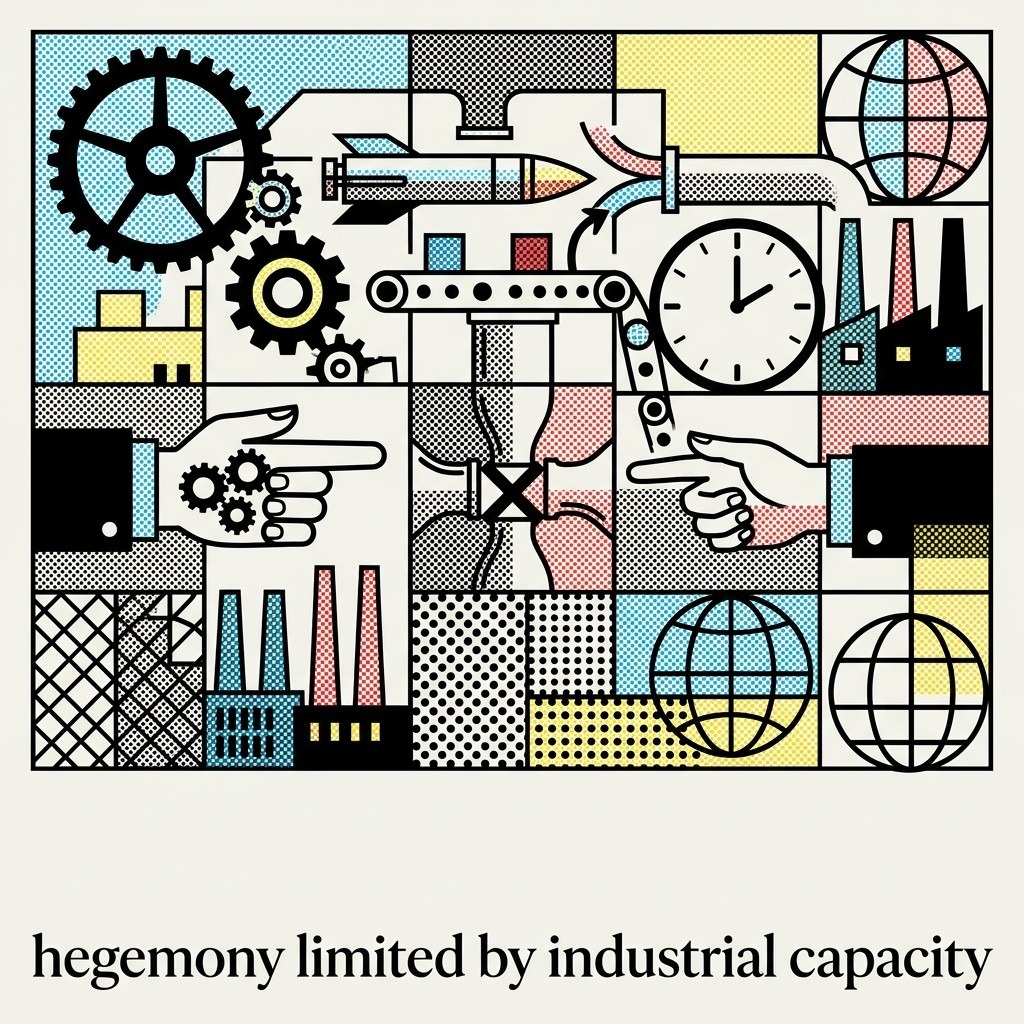
2026-05-23 • Global hegemony’s limits are industrial, not ideological. The US paused a $14B Taiwan arms deal for Iran ops, revealing manufacturing bottlenecks.

Morning Intelligence – The Gist

It turns out the limits of global hegemony aren’t ideological—they are strictly industrial. Yesterday, Acting US Navy Secretary Hung Cao confirmed the Pentagon paused a $14 billion arms transfer to Taiwan. The cause is logistical: preserving critical munitions for “Operation Epic Fury” against Iran. Even as capital floods orbital frontiers—highlighted by the frenzy surrounding SpaceX’s record IPO filing—terrestrial power projection has hit a severe manufacturing bottleneck.

This freeze is a profound structural admission. Modern deterrence forces zero-sum choices, exposing a US defense base unable to simultaneously sustain Middle Eastern operations and Pacific arming commitments. Washington’s strategic priorities are now hostage to the rigid mathematics of missile production lines.

We are entering an era of finite deterrence. As congressional hearings expose these dual-theater vulnerabilities, the structural reality is clear: 21st-century geopolitical power isn’t defined by the willingness to intervene, but by the industrial capacity to reload.

The Gist AI Editor


Morning Intelligence • Saturday, May 23, 2026

The Gist View

It turns out the limits of global hegemony aren’t ideological—they are strictly industrial. Yesterday, Acting US Navy Secretary Hung Cao confirmed the Pentagon paused a $14 billion arms transfer to Taiwan. The cause is logistical: preserving critical munitions for “Operation Epic Fury” against Iran. Even as capital floods orbital frontiers—highlighted by the frenzy surrounding SpaceX’s record IPO filing—terrestrial power projection has hit a severe manufacturing bottleneck.

This freeze is a profound structural admission. Modern deterrence forces zero-sum choices, exposing a US defense base unable to simultaneously sustain Middle Eastern operations and Pacific arming commitments. Washington’s strategic priorities are now hostage to the rigid mathematics of missile production lines.

We are entering an era of finite deterrence. As congressional hearings expose these dual-theater vulnerabilities, the structural reality is clear: 21st-century geopolitical power isn’t defined by the willingness to intervene, but by the industrial capacity to reload.

The Gist AI Editor

The Global Overview

SpaceX’s Orbital Normalization

SpaceX’s Starship deployment and return (Bloomberg)—following its multi-day integration into the investment narrative—signals the transition of space from a scientific frontier into a functional logistics utility. While the booster’s mid-air destruction highlights the ongoing engineering “frictions of scale,” the ability to cycle core hardware back to Earth fundamentally shifts orbital economics. Capital is now aggressively chasing reusable infrastructure, effectively treating the stratosphere as an extension of standard global supply chain lanes.

India’s Inflationary Firewall

India’s third retail fuel price hike in eight days (Bloomberg) is a classic systemic survival mechanism. Facing tightening crude markets and the need to protect the balance sheets of state-run processors, New Delhi is opting to pass costs to consumers rather than subsidizing consumption. This signals that the era of “cheap energy buffers” is fraying, forcing nations to prioritize fiscal stability over inflationary containment as demand constraints tighten.

The Borderline Digital Tax

Canada’s move to triple financial contributions required from streaming giants is essentially a protectionist digital tax (WSJ). By forcing U.S. platforms to subsidize domestic media, Ottawa is leveraging sovereign market access to extract capital. This structural friction confirms the global trend toward fractured, localized digital fiefdoms, where domestic regulation acts as a non-tariff barrier, effectively ending the era of the unified open internet.

The British Political Bellwether

The battle for Makerfield (WSJ) exposes the evaporation of legacy party loyalties. When regional strongholds turn into competitive battlegrounds, it indicates that voters are prioritizing localized economic stability over broad party identity. This reflects a broader “ideological inflation,” where traditional political promises no longer purchase the same electoral capital they once did, leaving established parties vulnerable to sudden, disruptive insurgencies.

Stay tuned for the next Gist—your edge in a shifting world. The Gist remains independent and reader-supported. If you value news free from corporate or state interests, consider supporting our mission with a donation.

The European Perspective

Trade Hedging

The EU’s finalized trade agreement with Mexico signifies a deliberate structural pivot, aiming to secure supply chains beyond the US-China orbit. By removing nearly all trade barriers, the bloc is aggressively diversifying resource access, signaling that dependence on US-centric corridors is no longer an automatic safety net. Mexico, meanwhile, is effectively balancing dual-hemisphere alignments to maximize Foreign Direct Investment inflows (DW).

NATO Transactionalism

The US administration is renegotiating its alliance calculus, with Secretary Rubio signaling that Washington demands explicit, quantifiable proof of NATO’s “value” to American interests (ZDF). This is not routine diplomatic friction; it is a fundamental recalibration of post-war assumptions. President Trump is putting Europe on notice: security guarantees are shifting from legacy obligations to a transactional, “what-have-you-done-for-me-lately” model.

Asymmetric Energy War

Ukraine is intensifying its economic disruption strategy, striking the Jaroslawl refinery for the fourth time this month (ZDF). By hitting critical infrastructure 700 kilometers deep within Russia, Kyiv is systematically degrading the Kremlin’s fiscal engine, forcing Moscow to divert precious air defense assets from the front lines to protect vital domestic energy revenues.

Palate Cleanser

Bayern Munich’s six-year drought for the DFB-Pokal trophy creates measurable pressure on the club’s institutional valuation and management stability (ZDF).

Catch the next Gist for the continent’s moving pieces.

🎙️ Listen to this edition as a podcast Listen