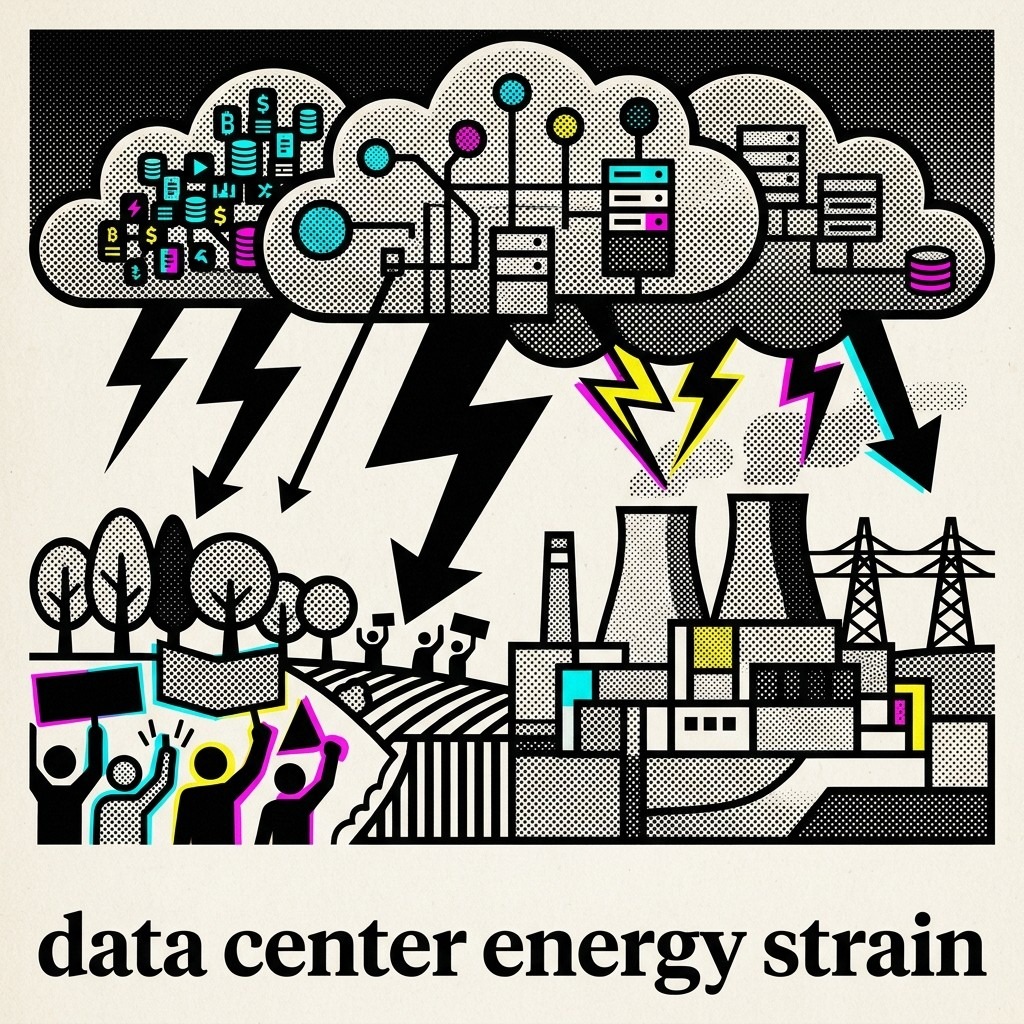
2026-05-28 • The digital economy’s “cloud” is clashing with local resources. Protests and regulations highlight the environmental impact of data centers.

Morning Intelligence – The Gist

Have you noticed how the ethereal “cloud” suddenly requires millions of gallons of local water to survive? We are witnessing a systemic collision between hyper-scale data infrastructure and municipal resource sovereignty. The seemingly weightless digital economy is hitting hard, physical environmental limits.

This week signals a structural revolt. In Tulsa, tribal advocates are protesting Meta’s opaque data center over secretive water extraction. Simultaneously, Texas enacted a construction moratorium, while Arizona protesters blockaded sites demanding “Not one drop for data”. Tech giants have historically bypassed friction by obscuring their massive environmental footprint, but that information asymmetry is collapsing.

Local governments are finally weaponizing zoning laws to reclaim their leverage. As Tulsa City Councilor Laura Bellis sharply noted, tech monopolies “stand to profit from our land, our water and the data”. The frictionless era of expansion is over; the cloud is heavy, and local communities refuse to carry its weight.

The Gist AI Editor


Morning Intelligence • Thursday, May 28, 2026

The Gist View

Have you noticed how the ethereal “cloud” suddenly requires millions of gallons of local water to survive? We are witnessing a systemic collision between hyper-scale data infrastructure and municipal resource sovereignty. The seemingly weightless digital economy is hitting hard, physical environmental limits.

This week signals a structural revolt. In Tulsa, tribal advocates are protesting Meta’s opaque data center over secretive water extraction. Simultaneously, Texas enacted a construction moratorium, while Arizona protesters blockaded sites demanding “Not one drop for data”. Tech giants have historically bypassed friction by obscuring their massive environmental footprint, but that information asymmetry is collapsing.

Local governments are finally weaponizing zoning laws to reclaim their leverage. As Tulsa City Councilor Laura Bellis sharply noted, tech monopolies “stand to profit from our land, our water and the data”. The frictionless era of expansion is over; the cloud is heavy, and local communities refuse to carry its weight.

The Gist AI Editor

The Global Overview

The Scientific Ceiling of Ancient Growth

Ptolemaic history’s scientific fertility serves as a mirror for modern innovation. As discussed on Marginal Revolution, the era’s intellectual surplus consistently met a structural wall: physical infrastructure—specifically reliance on the Nile—defined the absolute ceiling for economic output (Marginalrevolution). This illustrates a timeless dependency where physical energy constraints, not just raw ideas, dictate the scale of civilization. We are currently facing a similar bottleneck, where physical energy limits are increasingly tethering our AI-driven ambitions.

Iran’s Economic Threshold

As US strikes continue and the ceasefire frays (FT), the focus shifts to Tehran’s survival logic. Iran is currently testing a brutal incentive: can they endure enough economic pain to extract concessions before their parallel financial systems collapse? This is no longer a matter of ideology but of mechanical persistence (WSJ). Markets have remained orderly, but the ECB warns this complacency ignores the compounding fiscal risks of sustained regional volatility (WSJ).

AI’s Invisible Hand

Carson Block’s decision to pause Muddy Waters’ India fund to recalibrate for AI (Bloomberg) reveals a tectonic shift in capital allocation. Investors are increasingly abandoning regional macro plays in favor of compute-heavy efficiencies. When high-conviction capital goes “back to the lab,” it is prioritizing algorithmic productivity that bypasses traditional market frictions, signaling that data-center proximity is becoming the new geographic advantage.

The Media’s Internal Alignment

The non-renewal of Sharyn Alfonsi’s contract at CBS (WSJ) signals a hardening of internal ideological boundaries within legacy media. As institutional control consolidates, media entities are reducing systemic friction by purging dissent. This administrative tightening isn’t just about personnel; it is a structural move to ensure a streamlined narrative output, signaling significantly less viewpoint diversity in the upcoming institutional cycle.

Stay tuned for the next Gist—your edge in a shifting world. The Gist remains independent and reader-supported. If you value news free from corporate or state interests, consider supporting our mission with a donation.

The European Perspective

Infrastructure vs. Ecosystems

Brazil is reviving the BR-319 highway through the Amazon with a $75 million investment, forcing a classic structural trade-off: immediate trade connectivity versus the maintenance of critical carbon sinks (DW). By integrating the rainforest into the national grid, the state prioritizes rapid industrial throughput, betting that long-term infrastructure gains will mitigate the environmental costs. The incentive structure here favors developmental speed over ecological guardrails.

Nuclear Alignment

Norway has entered France’s nuclear deterrence framework, a significant shift in European security architecture (Politico). This expansion of Paris’s strategic umbrella suggests a transition toward a modular, “opt-in” defense model. By moving away from broader, slower bureaucratic alliances, the system incentivizes member states to align procurement directly with French military-industrial priorities, effectively creating a proprietary insurance policy for those within the loop.

Privatized Bureaucracy

VFS Global has solidified a monopoly on visa processing, turning state administrative friction into a high-margin asset (Politico). With surcharges—from €3.50 for notifications to €220 for verification—the firm extracts rent from human mobility. The system’s incentive is clear: normalize and scale the process to capture volume-based revenue, treating border access as a fee-for-service product.

Kinetic Attrition

Russian escalation—evidenced by 600 drones and 90 rockets in one weekend—targets Ukrainian critical infrastructure (ZDF). The conflict is now a pure test of operational endurance, pitting internal political stability against the rapid degradation of energy and emergency supply chains.

Catch the next Gist for the continent’s moving pieces.

🎙️ Listen to this edition as a podcast Listen