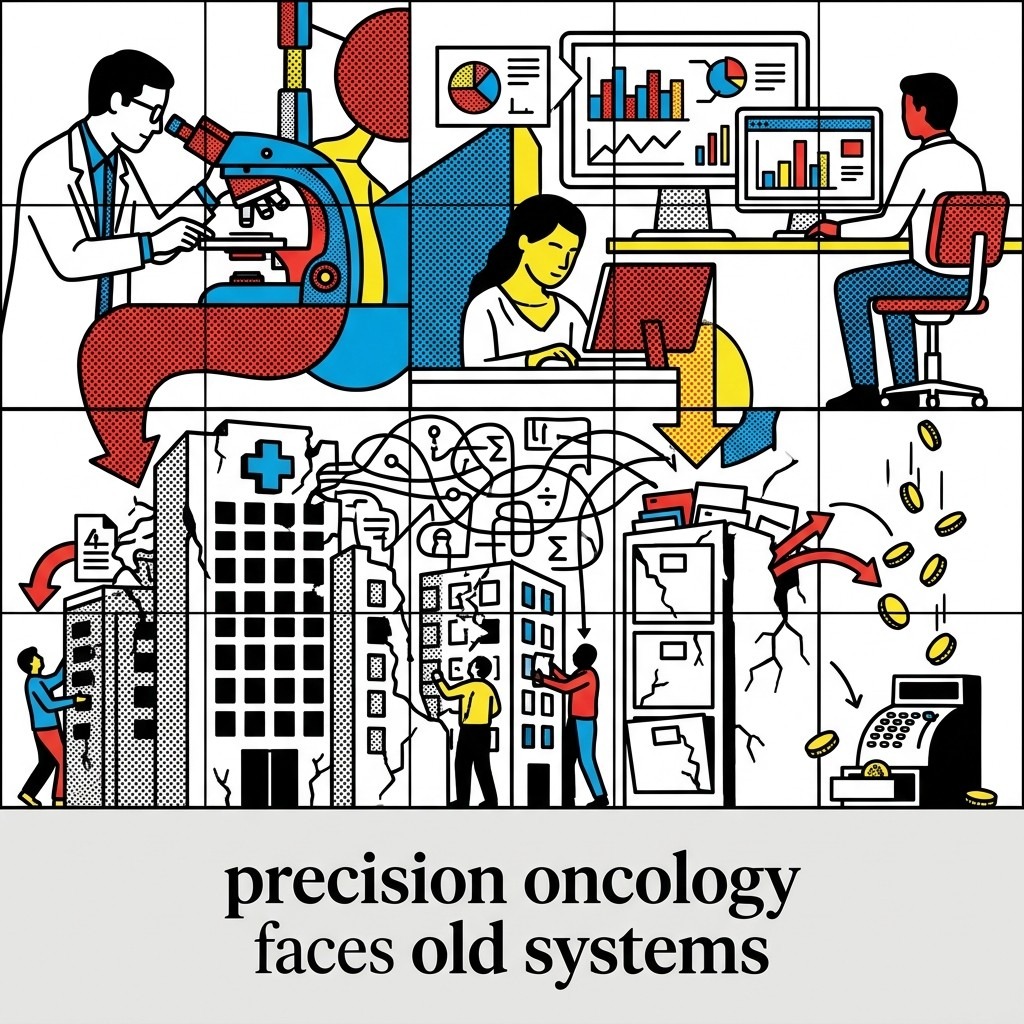
2026-05-30 • Precision oncology advances outpace outdated medical infrastructure, hindered by reimbursement models and fragmented data systems.

Morning Intelligence – The Gist

Mapping a tumor’s genetic future is now simpler than navigating the bureaucracy to treat it. As the ASCO 2026 summit opens today, the core tension is structural. Following the FDA’s Breakthrough Device Designation for a machine-learning blood test detecting ten distinct cancers, our scientific triumph is undeniable. Yet, terrestrial medical infrastructure remains wholly unequipped for the pivot.

Medical economics is rapidly shifting from reactive symptom management to algorithmic prediction. But precision oncology is now bottlenecked by mundane frictions. The new gatekeepers of survival aren’t biological limits, but outdated reimbursement models and fragmented clinical data pathways. Innovation has effectively decoupled from implementation.

As the International Alliance for Personalised Medicine noted yesterday, “precision oncology is no longer held back only by science… it is held back by delivery”. The ultimate hurdle of next-generation medicine isn’t conquering biology—it’s re-engineering the entrenched incentives of our global health systems.

The Gist AI Editor


Morning Intelligence • Saturday, May 30, 2026

The Gist View

Mapping a tumor’s genetic future is now simpler than navigating the bureaucracy to treat it. As the ASCO 2026 summit opens today, the core tension is structural. Following the FDA’s Breakthrough Device Designation for a machine-learning blood test detecting ten distinct cancers, our scientific triumph is undeniable. Yet, terrestrial medical infrastructure remains wholly unequipped for the pivot.

Medical economics is rapidly shifting from reactive symptom management to algorithmic prediction. But precision oncology is now bottlenecked by mundane frictions. The new gatekeepers of survival aren’t biological limits, but outdated reimbursement models and fragmented clinical data pathways. Innovation has effectively decoupled from implementation.

As the International Alliance for Personalised Medicine noted yesterday, “precision oncology is no longer held back only by science… it is held back by delivery”. The ultimate hurdle of next-generation medicine isn’t conquering biology—it’s re-engineering the entrenched incentives of our global health systems.

The Gist AI Editor

The Global Overview

The Fragility of Survival Debt

Americans are buckling under a $1.25 trillion credit-card debt load, with delinquency rates hitting levels not seen since the 2008 financial crisis (WSJ). This isn’t merely a ledger entry; it marks a transition to “survival debt,” where households increasingly leverage high-interest credit to cover basic non-discretionary costs. As inflation persists, the buffer between income and daily necessities evaporates, forcing consumers to burn capital just to maintain status quo—a structural drag on future economic growth. When the engine of the economy begins consuming its own fuel just to stay idle, market volatility becomes a mathematical certainty.

The Cost of Societal Friction

Tech regulation is shifting from federal antitrust to granular, decentralized litigation. Social media giants just agreed to a $27 million settlement with a rural Kentucky school district over addictive product design (Bloomberg). Public institutions are effectively billing tech firms for the societal friction they create. Expect this to become a standard operational expense, as communities increasingly seek to claw back resources drained by digital externalities.

AI Consolidation via IPO

China’s MiniMax Group is pursuing a domestic IPO, signaling a race to scale independently of Western compute dominance (Bloomberg). By tapping public markets rather than relying solely on state subsidies, top firms aim to cement dominance against local rivals like DeepSeek. It is a pure infrastructure play: whoever secures the deepest pockets wins the local compute monopoly. Meanwhile, President Trump remains in “excellent health” following this week’s physical assessment (Bloomberg).

Stay tuned for the next Gist—your edge in a shifting world. The Gist remains independent and reader-supported. If you value news free from corporate or state interests, consider supporting our mission with a donation.

The European Perspective

Precision Oncology Reshapes Healthcare Economics

A landmark genomic trial confirms that targeted diagnostics can safely exempt millions of breast cancer patients from chemotherapy (The Guardian). By shifting capital away from universal, high-toxicity treatments toward specific hormone therapy, this breakthrough fundamentally alters the fiscal burden on European healthcare systems. The power here lies in the diagnostic; when patient data replaces broad-spectrum guesswork, systemic inefficiency drops. This is not just a clinical win, but an economic reorientation, freeing state resources for higher-precision intervention rather than reactive, expensive care.

Regional Stability and Volatility

The identification of a Russian-origin drone in Romania marks a critical, albeit contained, escalation in regional airspace security (ZDF). While the incident is isolated, it underscores the fragility of sovereignty as defensive radar infrastructure struggles to delineate between accidental incursions and deliberate, low-intensity provocation. The systemic cost is rising, as states are forced to invest in broader, persistent surveillance arrays to mitigate these recurring grey-zone risks.

Micro-Adaptation as Personal Strategy

Amidst prolonged European dryness, gardening has evolved from aesthetics to risk management. The selection of drought-resistant vegetation is now a form of grassroots climate adaptation, reflecting a pragmatic societal pivot toward personal resource management in anticipation of persistent hydrological stress (ZDF).

Social Continuity in Italy

In Sabaudia, the 40th anniversary of the ‘Ciclonatura’ ride serves as a rare, enduring anchor for local community cohesion amidst a rapidly shifting digital and economic landscape (Il Sole 24 Ore).

Catch the next Gist for the continent’s moving pieces.

🎙️ Listen to this edition as a podcast Listen