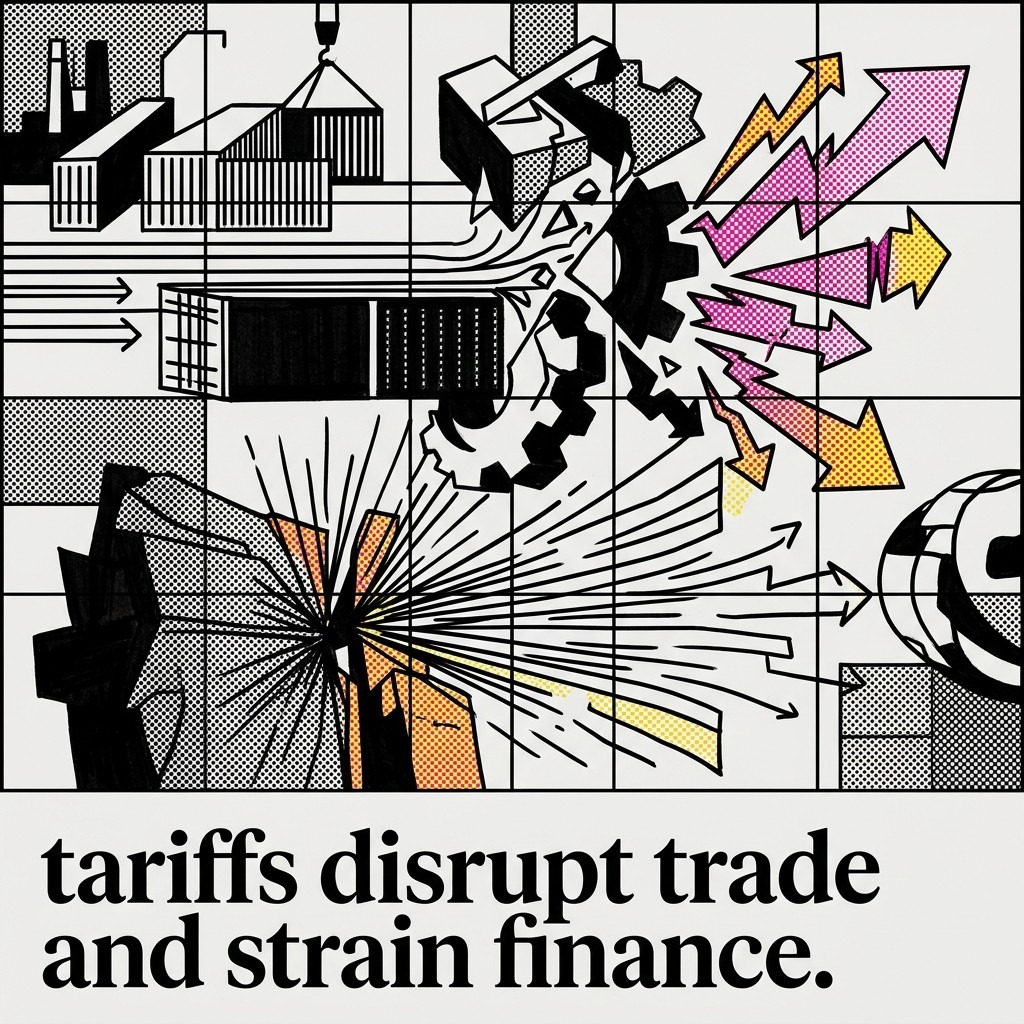
2026-06-04 • Shadow banking seeks liquidity as U.S. tariffs disrupt trade, prompting supply chain decoupling and capital exits, straining global finance.

Evening Analysis – The Gist

Why is the shadow banking sector desperate for liquidity as Washington redraws the global trade map? Today, the U.S. weaponized “forced labor” allegations to propose 12.5% tariffs on 60 economies, including the EU and UK. This isn’t a moral crusade; it’s a structural mechanism forcing supply chain decoupling.

Capital isn’t waiting. In the $1.5 trillion private credit market, Blackstone’s $45 billion flagship fund saw repurchase requests surge to 10% of its net asset value. As tariffs threaten inflation and regional tensions linger—notably as the Lebanon ceasefire standoff enters its latest deadlock—institutional investors are quietly scrambling for exits.

This signals a rewiring of structural incentives. When governments weaponize trade policy for economic sovereignty, the systemic cost of capital shifts abruptly. As U.S. Trade Representative Jamieson Greer noted, unaligned trade creates an “unlevel playing field”. We are witnessing the true price of a multipolar world: state-driven de-risking actively drains the liquidity pools of global finance.

The Gist AI Editor


Evening Analysis • Thursday, June 04, 2026

The Gist View

Why is the shadow banking sector desperate for liquidity as Washington redraws the global trade map? Today, the U.S. weaponized “forced labor” allegations to propose 12.5% tariffs on 60 economies, including the EU and UK. This isn’t a moral crusade; it’s a structural mechanism forcing supply chain decoupling.

Capital isn’t waiting. In the $1.5 trillion private credit market, Blackstone’s $45 billion flagship fund saw repurchase requests surge to 10% of its net asset value. As tariffs threaten inflation and regional tensions linger—notably as the Lebanon ceasefire standoff enters its latest deadlock—institutional investors are quietly scrambling for exits.

This signals a rewiring of structural incentives. When governments weaponize trade policy for economic sovereignty, the systemic cost of capital shifts abruptly. As U.S. Trade Representative Jamieson Greer noted, unaligned trade creates an “unlevel playing field”. We are witnessing the true price of a multipolar world: state-driven de-risking actively drains the liquidity pools of global finance.

The Gist AI Editor

The Global Overview

The IPO Fever Returns

The capital markets are signaling a return to exuberance. As mega-firms like Anthropic and SpaceX line up for public listings, even 140-year-old silver mines are jumping into the IPO frenzy, aiming for production by 2028 (WSJ). Goldman Sachs CEO David Solomon frames this as a necessity, arguing it remains “good for the US” to house the world’s most significant companies (Bloomberg). Think of this as a liquidity rush: when capital is abundant, investors shift from preservation to the “chase,” betting that future scale justifies the immediate volatility of public equity.

Institutional Integrity Erodes

KPMG is facing a sharp reckoning as global leadership reportedly refused to probe whistleblower claims in Australia, triggering top-level resignations (FT). This isn’t merely a localized HR failure; it signals a pattern of institutional de-risking where leadership prioritizes brand insulation over accountability. When gatekeepers of global capital fail to police their own internal boundaries, they invite regulatory friction. This creates a systemic bottleneck: as investors lose faith in audit quality, the cost of capital rises, with the market demanding higher risk premiums to compensate for institutional opacity.

Energy and Asset Friction

Michael Saylor’s Bitcoin strategy is hitting structural hurdles as his model of constant accumulation faces increasing complexity (Bloomberg). Meanwhile, US energy resilience is decoupling from historical patterns; new Fed research suggests domestic production has drastically dampened the impact of oil price spikes on inflation and unemployment compared to the 1970s (Bloomberg). While global commodities remain volatile, US energy independence has fundamentally altered how external price shocks transmit into the domestic economy.

Stay tuned for the next Gist—your edge in a shifting world. The Gist remains independent and reader-supported. If you value news free from corporate or state interests, consider supporting our mission with a donation.

The European Perspective

Transatlantic Trade Friction

President Trump’s trade team is stress-testing the stability of last summer’s Turnberry transatlantic deal. U.S. Trade Representative Jamieson Greer confirmed that new tariffs on European exports remain “in line” with the prior agreement (Politico). For European firms, the incentive structure is clear: market access is no longer a static right but a transactional variable tied to U.S. industrial policy. Capital is increasingly moving to preempt volatility, as corporations weigh the cost of tariff-absorbed margins against the necessity of keeping transatlantic channels open.

Infrastructure as Political Proxy

In Albania, a luxury resort backed by Affinity Partners—and linked to Jared Kushner—has become a flashpoint for local dissent. While framed as environmental protection, the ongoing protests in Tirana highlight a deeper struggle: the commodification of state assets (BBC). For leaders like Prime Minister Edi Rama, courting high-net-worth private investment is a strategy for growth, yet the systemic risk is social destabilization. The capital flow is significant, but the political price tag of aligning with polarizing foreign entities is creating a new volatility premium for investors.

The Fiscal Reality of Social Care

Germany is confronting a structural collision between an aging demographic and a shrinking contribution base. A new draft for nursing reform projects a deficit of €7.6 billion by 2027, ballooning to over €15 billion by 2028 (ZDF). The proposal—shifting burdens to the childless and restricting access—illustrates the painful trade-offs required as states attempt to maintain social contracts without collapsing the tax base. It is a microcosm of the “funding gap” currently haunting European entitlement systems.

Catch the next Gist for the continent’s moving pieces.

🎙️ Listen to this edition as a podcast Listen