2026-06-08 • Ebola thrives in DRC due to governance failures, not biology. Institutional distrust hampers containment; global health cuts worsen the crisis.

Morning Intelligence – The Gist

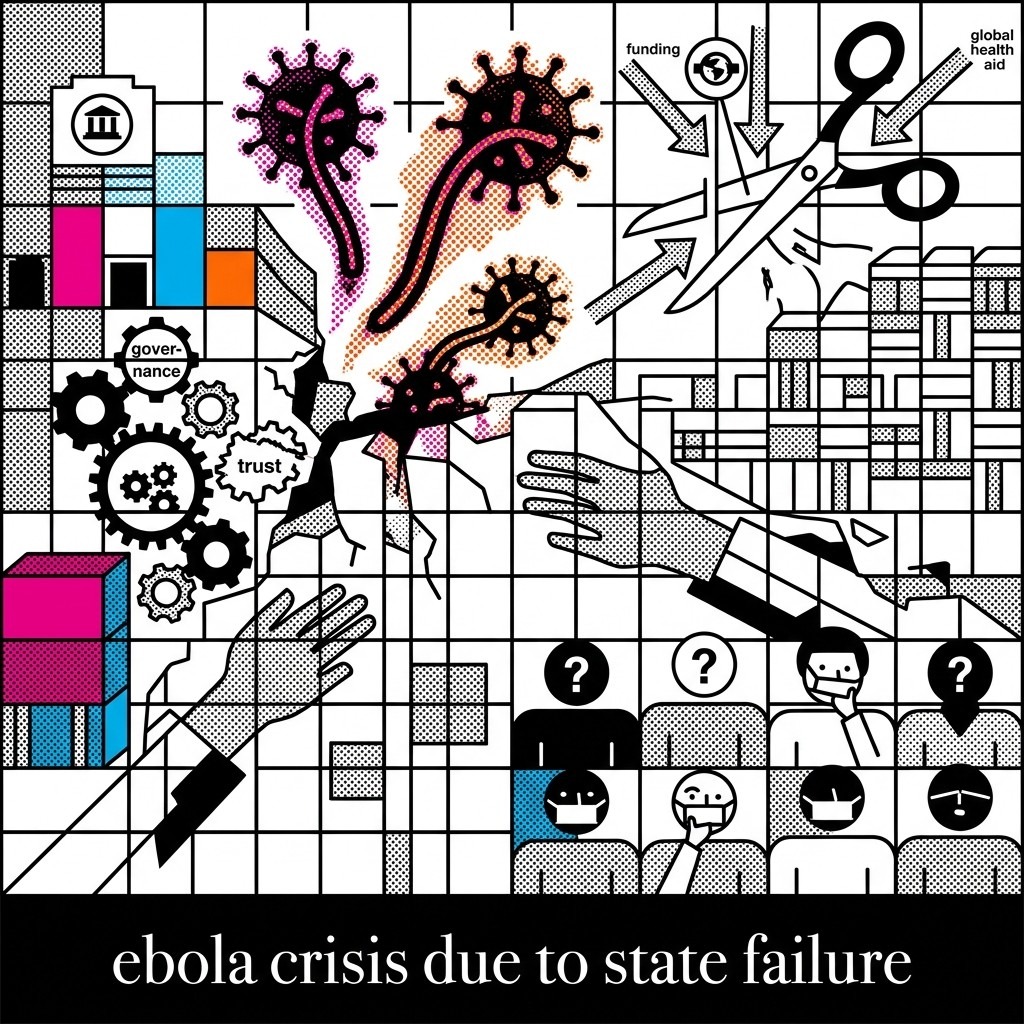
Pathogens exploit political vacuums faster than biological vulnerabilities. Today, the Democratic Republic of the Congo’s Ebola caseload surpassed 515. The true accelerant isn’t viral—it’s governance. The outbreak thrives on deep institutional distrust, fueling community resistance to testing and plunging contact tracing to just 50.3% against a critical 95% baseline.

This is a masterclass in bureaucratic friction. As major global health organizations slash international workforces by up to 25% this year, local agencies are left navigating severe regulatory and supply chain hurdles unfunded. Simple reagent shortages are currently stalling vital laboratory results, proving that administrative bottlenecks cripple operational productivity and become just as lethal as the disease itself.

Elsewhere, updating our ongoing security watch, overnight missile exchanges between Israel and Iran have rapidly shattered a fragile two-month ceasefire. Whether in public health or geopolitics, global architecture is cracking under its own rigidity. As DRC authorities officially warn of an “important reservoir” of contagion forming, the structural reality is undeniable: institutional paralysis is the ultimate vulnerability.

The Gist AI Editor


Morning Intelligence • Monday, June 08, 2026

The Gist View

Pathogens exploit political vacuums faster than biological vulnerabilities. Today, the Democratic Republic of the Congo’s Ebola caseload surpassed 515. The true accelerant isn’t viral—it’s governance. The outbreak thrives on deep institutional distrust, fueling community resistance to testing and plunging contact tracing to just 50.3% against a critical 95% baseline.

This is a masterclass in bureaucratic friction. As major global health organizations slash international workforces by up to 25% this year, local agencies are left navigating severe regulatory and supply chain hurdles unfunded. Simple reagent shortages are currently stalling vital laboratory results, proving that administrative bottlenecks cripple operational productivity and become just as lethal as the disease itself.

Elsewhere, updating our ongoing security watch, overnight missile exchanges between Israel and Iran have rapidly shattered a fragile two-month ceasefire. Whether in public health or geopolitics, global architecture is cracking under its own rigidity. As DRC authorities officially warn of an “important reservoir” of contagion forming, the structural reality is undeniable: institutional paralysis is the ultimate vulnerability.

The Gist AI Editor

The Global Overview

Pyongyang’s Shadow Prosperity

Despite international sanctions, North Korea’s economy is surging—a perverse demonstration of how regimes exploit systemic gaps. By trading arms for Russian support and Chinese goods, the regime is effectively bypassing global financial plumbing. This highlights a “leakage” mechanic in international sanctions; when demand for conflict resources spikes, the cost of isolation drops. The regime is reportedly “wealthier than ever” (WSJ), proving that shadow markets are structurally replacing institutional trade, creating a parallel economy that defies standard Western leverage.

Climate Friction in the Rice Belt

Agricultural vulnerability remains the ultimate systemic bottleneck. Forecasts of heavy flooding in southern China threaten key rice production zones (Bloomberg). When the world’s largest food importer faces crop disruption, it ripples outward, forcing state reserves to stabilize prices. This is a classic supply chain vulnerability: localized environmental stress triggering global inflation in commodities. It is a stark reminder that physical resource dependency often overrides digital policy initiatives.

The Boardroom Governance Schism

The transatlantic divide on corporate governance is widening. Comparing SpaceX’s founder-led agility to the consensus-driven boards of legacy firms like BP reveals a fundamental clash (FT). It’s the difference between a speedboat and a tanker; one prioritizes rapid iteration—even if risky—while the other optimizes for institutional stability. As capital markets digest governance structures, investors are increasingly forced to choose between the “move fast” models of US tech giants and the “safe harbor” approach favored in Europe.

Stay tuned for the next Gist—your edge in a shifting world. The Gist remains independent and reader-supported. If you value news free from corporate or state interests, consider supporting our mission with a donation.

The European Perspective

Solar Eclipse as Infrastructure Stress Test

Spain is bracing for the August 12 total solar eclipse, treating the celestial event as a massive, unpriced logistical shock. Authorities are scrambling to manage an expected influx that threatens to overwhelm regional transport networks. The systemic lesson: infrastructure optimized for steady-state usage remains structurally fragile to concentrated human surges. This serves as a vital proxy for how regional mobility networks fail under peak load—a systemic risk that municipal planners are now racing to mitigate (Le Monde).

Kosovo’s Fragmented Mandate

Prime Minister Albin Kurti’s Vetevendosje party won parliamentary elections with 43.1% of the vote after 97.2% of ballots counted (ZDF). Diminished support signals a cooling public appetite for the incumbent trajectory. The result is legislative inertia: as the party struggles to build coalitions, investors should expect a structural freeze in policy, stalling the capital influx that relies on governance predictability.

Micromobility’s Maturation

Regulators are finally reining in E-scooters. With accident involvement doubling between 2020 and 2024 (ZDF), new technical and parking mandates are arriving. For capital, the era of “growth-at-all-costs” is over; the sector is entering a utility phase where liability and compliance, not scale, dictate margins. Expect operator consolidation.

Systemic Updates

  • Defense: All nine nuclear-armed states expanded arsenals in 2025 (SIPRI), cementing a return to hard-power deterrence.
  • Finance: UK banks are demanding a seat at the Brexit “reset” table (Politico) to reverse a decade of regulatory isolation.

Catch the next Gist for the continent’s moving pieces.

🎙️ Listen to this edition as a podcast Listen


Comments

Leave a Reply

Your email address will not be published. Required fields are marked *

This site uses Akismet to reduce spam. Learn how your comment data is processed.