Armenia Embraces Europe as Pashinyan’s Party Secures 49.8%

Evening Analysis – The Gist


Evening Analysis • Tuesday, June 09, 2026

The Gist View

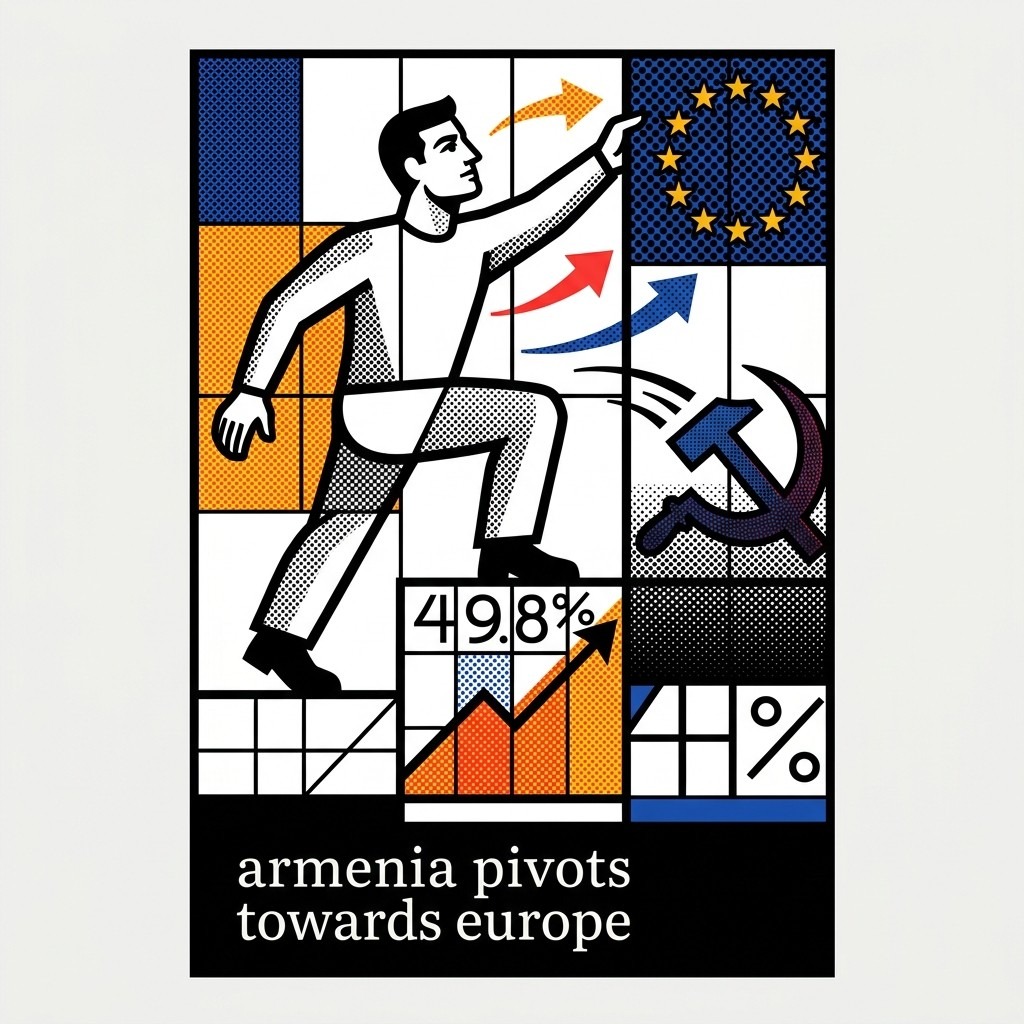
Geopolitical divorces are rarely finalized in boardrooms; they are ratified at the ballot box. This weekend, Armenia provided a masterclass in structural decoupling. Prime Minister Nikol Pashinyan’s party secured 49.8% of the parliamentary vote, formalizing a seismic pivot away from Moscow toward European integration.

This is pragmatic calculation, not idealism. Following recent regional trauma, voters recognized the hollowness of their legacy security guarantor. By decisively rejecting the Kremlin-backed opposition—which captured just 23.3%—the electorate absorbed immense coercion to trade an unreliable military umbrella for Western economic alignment.

As the EU praises Yerevan’s “democratic resilience”, Wall Street executes its own quiet pivot. Building on recent AI restructuring coverage, investment banks are leveraging new agent clusters to slash entry-level analyst hiring by nearly 30%. Across geopolitics and global finance, the structural reality is clear: power flows to new systems whenever “unprecedented interference” fails to suppress the demand for future-facing alternatives.

The Gist AI Editor

The Global Overview

Algorithmic Arbitrage

Magnetar Capital is replacing human analysts with AI bots for its $18 billion fund (Bloomberg). This move marks a structural retreat from high-cost human talent toward scalable, compute-based cognition. By eliminating the “key person risk” and inherent emotional bias of a trading desk, Magnetar is transforming portfolio management into a pure utility. Here, the primary barrier to entry shifts from professional networks to data architecture, signaling a future where alpha is derived from model quality rather than individual intuition.

Gaming as Sovereign Leverage

Russia’s potential unblocking of Roblox suggests a pivot in how the state manages information flow (Bloomberg). Rather than enforcing a polarizing blockade that alienates its youth, the Kremlin appears to be co-opting foreign digital ecosystems as a social safety valve. It is a calculated trade-off: allow access to a popular digital utility to maintain internal engagement, treating gaming platforms as a release for domestic frustration rather than a vector for subversion.

The AI Growth Reality Check

The Nasdaq’s 3% slide marks a sharpening investor skepticism toward AI-linked valuations (FT). Markets are finally pivoting from speculative “AI growth” narratives to demanding tangible return on investment. This repricing forces tech firms to accelerate monetization strategies or risk being starved of the liquidity required to fuel their next-generation models, effectively ending the era of subsidized hype.

Deleveraging the Debt Hangover

JPMorgan’s plan to offload $5.3 billion in Qualtrics financing signals a critical institutional housekeeping phase (Bloomberg). Banks are prioritizing liquidity over holding stagnant assets, actively clearing their balance sheets to insulate against tightening credit environments. In this climate, credit is no longer treated as a long-term hold; it is a perishable good that institutions are racing to shed.

Stay tuned for the next Gist—your edge in a shifting world. The Gist remains independent and reader-supported. If you value news free from corporate or state interests, consider supporting our mission with a donation.

The European Perspective

France’s Structural Deadlock

The 2027 French election cycle is already creating a structural “tripartition” in Parliament, moving beyond standard electoral contestation into a chronic endurance test. Power is shifting from the presidency to the mechanics of opaque coalition negotiation, creating a vulnerability that threatens to paralyze sovereign decision-making. This isn’t mere political theater; it is a systemic shift where the executive’s mandate is being eroded by the structural inability to form stable legislative majorities (Politico).

The Digital-AI Displacement

European reliance on US tech stacks—now increasingly tied to automated, AI-driven infrastructure—is reaching a breaking point. As firms pivot toward AI to manage financial and consumer labor, the cost of being “digitally locked-in” is rising. When legacy utilities like BT force shifts to “Digital Voice,” they expose the fragility of European care-networks; in one instance, an elderly user faced >2 months of service isolation (The Guardian). It signals that the rapid adoption of proprietary AI-labor models is outpacing the resilience of the essential services they replace.

The Cultural Realignment

European political discourse is actively importing US-style “culture war” frameworks as a core governing strategy. This is a deliberate pivot toward identity-based policymaking, expected to deepen in post-Orban realignments (Le Monde). The incentive is clear: in a fragmented electorate, high-engagement polarization is replacing traditional policy consensus. Meanwhile, tech-financiers like Peter Thiel are layering this with apocalyptic theology, framing market disruption as existential engineering rather than fiscal growth (ZDF).

Defense Update

European defense cohesion remains fractured: the FCAS jet project has collapsed, spawning an 8-firm alternative alliance, while the UK weighs “eye-watering” public sector cuts to sustain defense spending (ZDF, Politico).

Catch the next Gist for the continent’s moving pieces.

🎙️ Listen to this edition as a podcast Listen


The Gist is an independent daily digest: AI-curated, human-directed, unapologetically liberal (how it’s made). Hundreds of sources, only what matters. Subscribe free or listen to the podcast.


Comments

Leave a Reply

Your email address will not be published. Required fields are marked *

This site uses Akismet to reduce spam. Learn how your comment data is processed.