Saudi Arabia Invests $4B in Argentine Land for Food Security

Morning Intelligence – The Gist


Morning Intelligence • Sunday, June 14, 2026

The Gist View

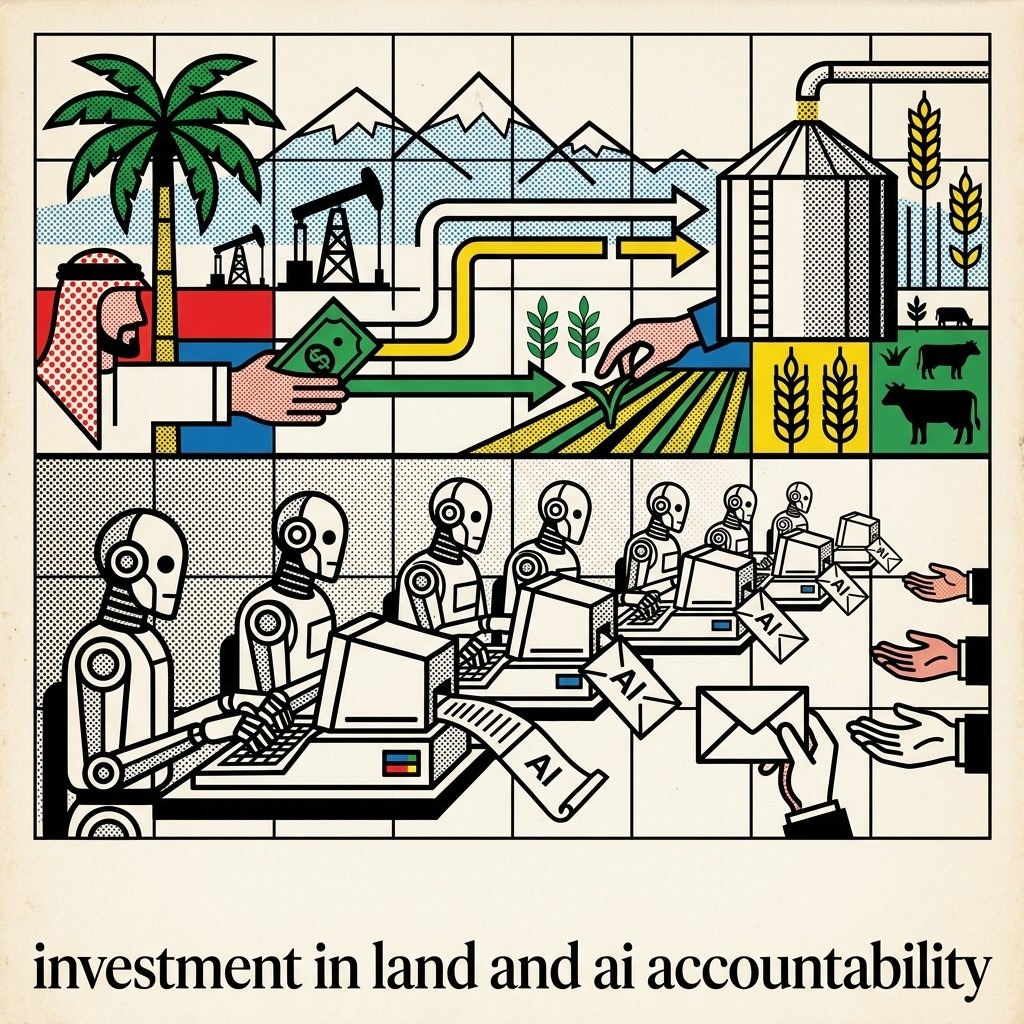
Saudi Arabia’s Public Investment Fund deployed $4 billion into Argentine arable land yesterday, ignoring software multiples for physical yield. Riyadh buys because it gains food security, swapping petrodollars for guaranteed grain over a 20-year horizon. Asset managers now reward emerging markets that upgrade property rights to monetize fundamental constraints.

While the Global South secures hard assets, the European Commission hollows out its democratic core. Brussels confirmed Saturday it outsources 60% of citizen correspondence to artificial intelligence. The Commission decides to automate messaging to mask bureaucratic bloat, paying licensing fees to US tech monopolies; consequently, voters interact with algorithms rather than accountable officials.

‘Investors buy hectares when they trust the deed, but sell currency when governments automate their thinking,’ notes a Friday BlackRock risk advisory.

The Gist AI Editor

The Global Overview

The Strategic Premium on Physical Reality

Capital is quietly re-rating emerging markets, pivoting from speculative tech bets toward hard physical limits. Brazil’s massive, underutilized arable land—the ultimate hedge against a world where food scarcity will define sovereignty—is emerging as a core structural asset (Marginal Revolution). Simultaneously, South Korea is accelerating its push for MSCI developed-market status (Bloomberg), which would cement its transition into a global institutional stronghold. This bifurcation reveals a shifting mandate: investors are favoring regions offering either undeniable physical essentials or major institutional upgrades. In an era of shrinking resources, Brazil’s “calories per acre”—a measure of agricultural yield potential that Wall Street often ignores—may eventually outvalue many of today’s software darlings.

The Institutional Shortcuts of the AI Era

As Wall Street absorbs record fundraising for AI infrastructure (FT), a silent, more troubling trend emerges: the European political class is outsourcing core democratic functions, like policy drafting, to these same algorithms. While capital markets treat AI as a monumental industrial build-out, politicians use it as a mundane bureaucratic shortcut. This normalization invites an acute accountability crisis; when rhetoric is machine-generated, the link between political intent and legislative output dissolves. Europe’s reliance on US digital stacks has migrated from mere infrastructure to the very heart of its political expression.

The Asymmetric Iran Stalemate

As Trump pushes for an Iran deal and Tehran stalls, this diplomatic theater continues to sustain elevated oil prices. While G7 leaders eye a “timely” role in potential ceasefires (Politico), markets remain wary of the duration of the stalemate. Geopolitical brinkmanship has become a permanent tax on global stability, further complicating the central bank calculus for the Fed and BoE as they weigh persistent inflation risks against cooling growth (Bloomberg).

Stay tuned for the next Gist—your edge in a shifting world. The Gist remains independent and reader-supported. If you value news free from corporate or state interests, consider supporting our mission with a donation.

The European Perspective

The Algorithmic Politician

German Digital Minister Karsten Wildberger’s admission that he employs AI to draft political speeches signals a dangerous structural abdication of democratic accountability (ZDF). If a leader’s rhetoric is synthesized by a US-trained Large Language Model rather than their own intellect, the electorate is essentially choosing a prompt engineer, not a decision-maker. This normalization confirms that Europe’s uncritical reliance on US tech stacks has migrated from mundane infrastructure into the core of political legitimacy, severing the vital link between original thought and public office.

Asymmetric Diplomatic Theater

President Trump’s announcement of an imminent Iran deal clashes sharply with Tehran’s stall tactics, signaling a shift toward asymmetric diplomatic theater (Le Monde). Despite the President’s optimistic framing regarding the Strait of Hormuz, the lack of confirmation from Tehran reinforces our thesis: brinkmanship remains the primary mechanism keeping oil prices at a high, volatile floor rather than moving toward resolution (Le Monde).

Capital’s Quality Control

Data confirms that not all foreign exchange reserves provide equal stability (CEPR). Reserves accumulated via private inflows reliably tighten sovereign spreads, whereas debt-financed buffers offer no real systemic protection (CEPR). Emerging markets utilizing public borrowing to mask weakness are merely postponing inevitable credit re-ratings.

The Friction of Exhaustion

Russia’s war economy is reaching its terminal phase; the national wealth fund is depleted, and hidden state debt funneled through the banking system has reached 50% of GDP (Politico). The shell game of internal subsidies is failing, signaling imminent systemic contraction.

Catch the next Gist for the continent’s moving pieces.

🎙️ Listen to this edition as a podcast Listen


The Gist is an independent daily digest: AI-curated, human-directed, unapologetically liberal (how it’s made). Hundreds of sources, only what matters. Subscribe free or listen to the podcast.


Comments

Leave a Reply

Your email address will not be published. Required fields are marked *

This site uses Akismet to reduce spam. Learn how your comment data is processed.