SpaceX’s $75B Offering Shifts Focus to US Infrastructure

Morning Intelligence – The Gist


Morning Intelligence • Monday, June 15, 2026

The Gist View

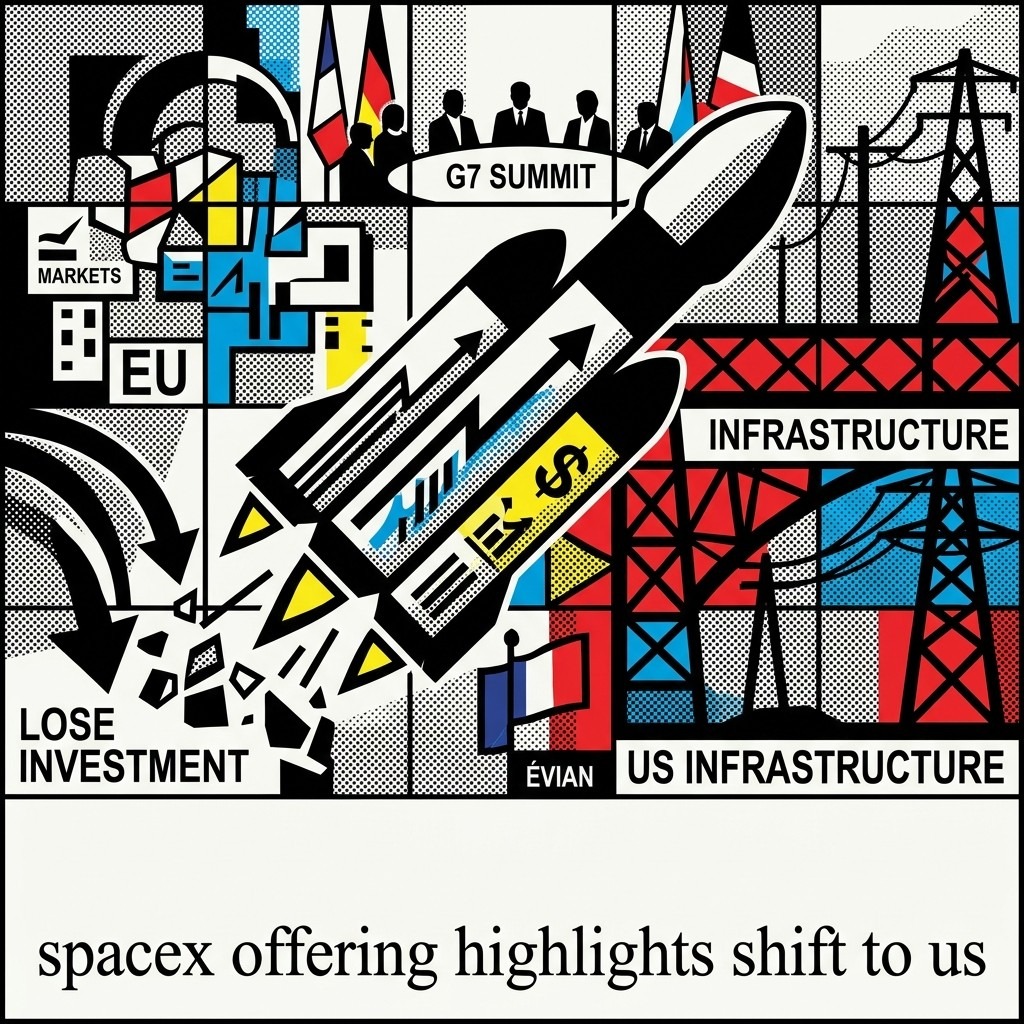
As France opened the 52nd G7 summit in Évian today, SpaceX raised $75 billion in its public offering. The contrast is stark: private capital flees to strategic American infrastructure, while European markets hemorrhage investment.

National cabinets across the G7 face collapse, rendering this gathering a lame-duck spectacle. The European Union stalls on market integration because its leadership gains electoral survival by protecting uncompetitive national champions. Consequently, institutional investors seek stable regulatory environments elsewhere. As we noted regarding US-Iran brinkmanship, geopolitical volatility exacerbates borrowing costs for these fragile economies.

G7 leaders cannot project global authority without domestic leverage. When Évian last hosted this summit in 2003, member states commanded over 60 percent of global GDP; today, that share rests below 44 percent, according to UNCTAD.

The Gist AI Editor

The Global Overview

Macron’s Procedural Gambit at G7

As President Macron hosts the G7 in Évian, his strategy for managing Donald Trump shifts from persuasion to structural constraint. Rather than debating worldviews, Macron is constructing “procedural tripwires”—formalizing collaborative frameworks on Ukraine and Iran that make American unilateralism administratively and economically costly to execute (Politico). It is a final, fragile attempt to institutionalize Western defense before domestic political decay erodes European leverage. This confirms our tracking of European security vulnerability: while Poland scrambles jets against Russian strikes, the UK’s defense ministry remains paralyzed by internal instability.

Capital Flees European Friction

Corporate boardrooms are aggressively repricing sovereign risk. Sigma Healthcare’s abandonment of its $10bn bid for the retailer Boots signals a definitive retreat from stagnant, regulatory-heavy European markets (FT). Contrast this with Lubrizol, which expects to double its revenue in India over the next five years (Bloomberg). Capital is voting with its feet, favoring the high-velocity structural growth of emerging economies over the bureaucratic inertia of the G7 core.

Populism Hits the Ledger

French front-runner Jordan Bardella is shifting from rhetoric to balance sheets, pledging to halve France’s contribution to the EU budget (Politico). Nationalist movements are evolving: they are no longer merely cultural agitators, but are now actively targeting the fiscal architecture that sustains international blocs. As domestic cabinets across the West fracture, these moves threaten to dismantle the funding streams that bind regional alliances.

Stay tuned for the next Gist—your edge in a shifting world. The Gist remains independent and reader-supported. If you value news free from corporate or state interests, consider supporting our mission with a donation.

The European Perspective

The Institutional Fracture

The resignation of the UK’s defense secretary at the onset of the G7 summit exposes a hollowed-out institutional core. As Starmer arrives in the French Alps, the cabinet implosion neutralizes London’s deterrence credibility precisely when European coordination is critical (Politico). The non-obvious cost isn’t just polling; it is operational. Allies are visibly stressed because changing defense leadership during active continental warfare breaks the continuity of military intelligence sharing, rendering collective strategic action on Ukraine and Iran effectively paralyzed.

Security Realignment

Our standing warning on European security vulnerability holds: while London implodes, the periphery secures itself. Poland scrambled fighter jets today in response to intensified Russian airstrikes on Ukraine, while preparing radar and air defense systems (ZDF). This creates a structural split in the NATO alliance. Frontline states are shifting to autonomous deterrence postures, acknowledging that the administrative fragility in core G7 capitals makes waiting for collective defense strategy a structural risk.

Algorithmic Insurgency

Digital populism has moved from the fringes to the center of fiscal policy. Analysis of 11,000 TikTok posts reveals that insurgent voices like Nigel Farage are dominating the engagement landscape, vastly outpacing establishment rivals (Politico). Simultaneously, France’s Jordan Bardella is leveraging similar momentum to propose halving France’s EU budget contribution. Populism is no longer performative; it is aggressively targeting the mechanics of sovereign capital flows.

Tactical Respite

Away from the policy gridlock, the FIFA World Cup provides a brief reprieve. The Netherlands were held to a draw by Japan in a late-stage tactical shift, while Sweden dominated Tunisia in Monterrey (ZDF). These events offer a stark, apolitical contrast to the stalled strategic maneuvering defining the current G7 environment.

Catch the next Gist for the continent’s moving pieces.

🎙️ Listen to this edition as a podcast Listen


The Gist is an independent daily digest: AI-curated, human-directed, unapologetically liberal (how it’s made). Hundreds of sources, only what matters. Subscribe free or listen to the podcast.


Comments

Leave a Reply

Your email address will not be published. Required fields are marked *

This site uses Akismet to reduce spam. Learn how your comment data is processed.