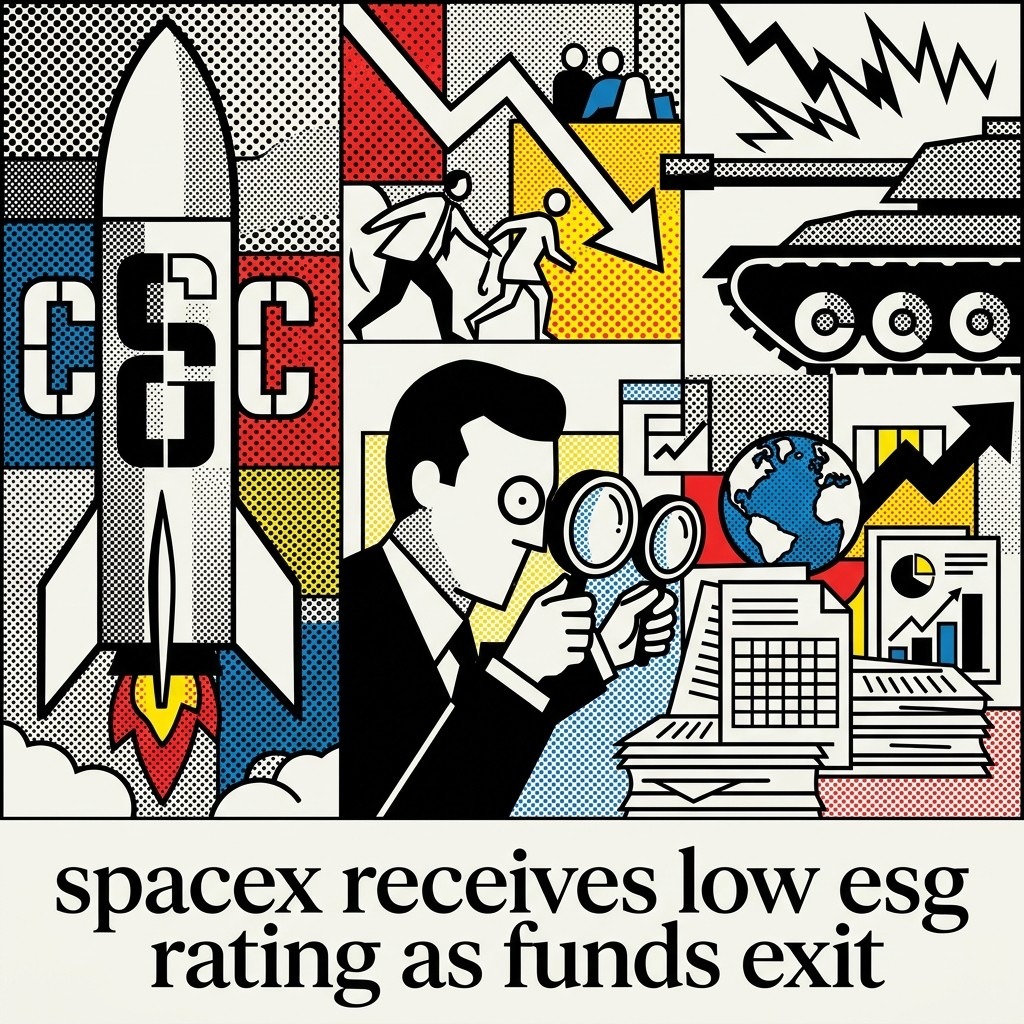
SpaceX Gets ‘Triple C’ ESG Rating, Investors Exit Funds

Morning Intelligence – The Gist


Morning Intelligence • Sunday, June 21, 2026

The Gist View

MSCI, the global finance index provider, assigned SpaceX — Elon Musk’s dominant commercial launch provider — a ‘Triple C’ ESG rating, its lowest possible tier. This score places the operator of the Starlink satellite internet constellation exactly on par with the sovereign rating MSCI assigned to Russia following its 2022 invasion of Ukraine.

The rating exposes an accelerating clash between top-down bureaucratic frameworks and material reality. Rating agencies issue these scores because they profit by selling standardized compliance audits to asset managers, not by evaluating planetary-scale engineering. By weighting reporting paperwork over actual technological capability, ESG systems function strictly as administrative filters rather than accurate measures of global impact.

Asset managers ultimately ignore matrices that cannot distinguish between orbital infrastructure and a sanctioned state. Investors pulled a record $5.1 billion from US sustainable funds in the final quarter of 2023, abandoning bureaucratic scoring for financial reality (Morningstar).

The Gist AI Editor

The Global Overview

ESG Frameworks Detached from Material Reality

MSCI has assigned SpaceX a ‘Triple C’ ESG rating, its lowest possible tier—effectively equating the premier aerospace innovator with sanctioned pariah states (FT). This illustrates the intellectual collapse of top-down scoring matrices: they prioritize rigid bureaucratic compliance over material utility. While global capital markets penalize orbital infrastructure via these metrics, European regulators are simultaneously forced to retroactively brand artillery as ‘sustainable’ just to unfreeze defense investment. These taxonomies function less as accurate impact measures and more as disconnected compliance tests, failing to recognize that SpaceX’s deployment of satellite constellations is a foundational pillar of modern global connectivity and logistics.

Swiss Pragmatism and Regional Realignment

As US-Iran ceasefire talks open in Switzerland, early polling indicates Swiss voters will likely reject proposals to harden their traditional neutrality (Bloomberg). This signals a pivot away from rigid isolationism toward a more pragmatic geopolitical alignment. Markets are already pricing in this stability, with holiday bookings rebounding across the eastern Mediterranean as travellers reassess conflict proximity (FT).

Capital Rotating Toward Climate Resilience

Investors are actively rotating portfolios to navigate a rare ‘Super El Niño,’ shifting capital away from speculative software toward physical agriculture and insurance assets (Bloomberg). This confirms our thesis that the global market is de-risking: capital is fleeing general-purpose tech for hard infrastructure, much like Spain’s decision to reframe meteorite crater drilling from simple geological data to a strategic planetary science asset. Markets are currently valuing tangible, climate-adaptive capacity over abstract, algorithmic growth.

Stay tuned for the next Gist—your edge in a shifting world. The Gist remains independent and reader-supported. If you value news free from corporate or state interests, consider supporting our mission with a donation.

The European Perspective

Asymmetric Tech Reshapes War Economics

Ukraine’s strike on the Tyumen refinery—2,000 kilometers deep within Russia—utilizing Fire Point’s domestic long-range drones, signals a permanent shift in conflict geography (The Guardian; Ukrainska Pravda). By developing hardware with a 3,000-kilometer reach, Kyiv has neutralized the strategic leash held by Western allies. Washington and Brussels no longer dictate the conflict’s depth via missile supply constraints; Kyiv’s homegrown innovation forces a reality where Russia’s energy-heavy heartland is perpetually exposed.

The ESG Taxonomy Collapse

Top-down ESG frameworks are failing. While MSCI’s ‘Triple C’ rating absurdly treats aerospace innovators like SpaceX as laggards, EU regulators are pivoting, retroactively classifying the defense sector as a ‘sustainable investment’ to reverse capital flight (Le Monde). This realignment marks a structural shift: in an era of kinetic instability, abstract “non-financial” metrics are yielding to industrial pragmatism, forcing a capital rotation toward hard infrastructure.

Strategic Resource Shifts

Spain’s meteorite crater drilling is now categorized as a strategic planetary science resource rather than mere geological exploration. This reinforces the broader rotation where capital prioritizes tangible supply chain resilience over speculative software.

Structural Health Trends

Sudden cardiac arrest is emerging as a critical, unaddressed public health burden for young adults (The Guardian). As data identifies this as a leading cause of mortality, the focus shifts from treatment to urgent diagnostic infrastructure build-out.

Catch the next Gist for the continent’s moving pieces.

🎙️ Listen to this edition as a podcast Listen


The Gist is an independent daily digest: AI-curated, human-directed, unapologetically liberal (how it’s made). Hundreds of sources, only what matters. Subscribe free or listen to the podcast.


Comments

Leave a Reply

Your email address will not be published. Required fields are marked *

This site uses Akismet to reduce spam. Learn how your comment data is processed.