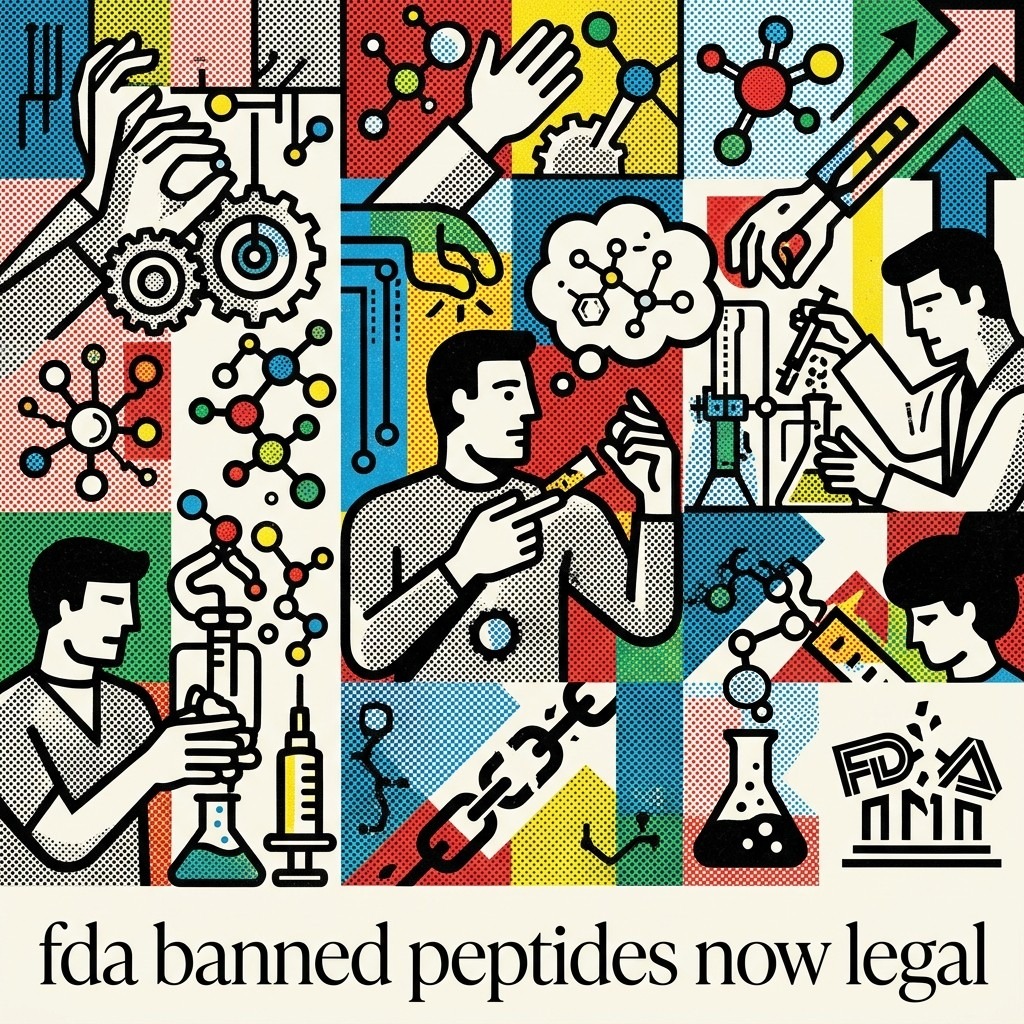
2026 FDA Approves 14 Previously Banned Peptides

Evening Analysis – The Gist


Evening Analysis • Sunday, June 21, 2026

The Gist View

In February 2026, US Health and Human Services Secretary Robert F. Kennedy Jr. stated that 14 of 19 peptides—short chains of amino acids sold in grey markets for anti-aging—banned by the FDA in 2023 will return to legal compounding status. As centrist managerialism collapses in the UK, decentralized populist movements are successfully overriding institutional gatekeepers.

The push to legalize compounds like BPC-157, a synthetic peptide popular for tissue healing, isn’t driven by pharmaceutical lobbying, but by biohackers. This DIY optimization movement weaponizes social media to bypass clinical trials. Politicians champion this because they gain immediate voter loyalty by attacking federal guardrails under the ‘Make America Healthy Again’ banner. Yet the pressure has a rational basis: many restricted peptides carry low adverse-event profiles, and the FDA’s rigid requirements actively suppress preventative health innovation and bodily autonomy.

The FDA will hold a public meeting in July 2026 to review easing compounding restrictions on unapproved peptide injections (AP News).

The Gist AI Editor

The Global Overview

FDA Reviews Peptide Bans Amid Populist Pressure

The FDA’s July 2026 meeting to reconsider 2023 peptide bans—short chains of amino acids used for targeted physical repair—signals a sharp shift in institutional health policy. With HHS Secretary Robert F. Kennedy Jr. moving to restore 14 of 19 restricted compounds to legal status, the FDA is bowing to the ‘Make America Healthy Again’ coalition. This is not corporate lobbying; it is biohackers—a community actively bypassing traditional medical pathways to optimize biology—weaponizing public demand to force regulatory realignment. Like the crumbling of centrist managerialism in the UK, where elite consensus fails to contain fiscal friction, centralized medical gatekeeping is buckling under decentralized pressure. Proponents argue that experimental tools like BPC-157, now slated for review, offer critical innovation where rigid clinical trials have stalled.

Australia’s $155bn Hyperscale Datacentre Pipeline

A $155bn datacentre pipeline in Australia confirms that global capital is aggressively rotating out of general-purpose AI software and into the physical infrastructure required to sustain it. This shift toward tangible, asset-heavy investment—the ‘hard tech’ reality that underpins digital promises—signals a market maturity where sovereign stability outweighs abstract software speculation. Institutional liquidity is increasingly prioritizing the power and server capacity needed for industrial-scale computing.

FIFA’s Aramco Sponsorship and the Limits of Activism

Aramco’s major FIFA sponsorship underscores the decisive victory of capital alignment over performative climate activism. Despite years of intense campaigns to divest sporting bodies from fossil fuel entities, institutional pragmatism is reasserting itself. The financial scale required to host global events necessitates deep-pocketed partners, rendering ESG (environmental, social, and governance) mandates—often focused on compliance rather than tangible impact—insufficient to sway billion-dollar commercial realities.

Stay tuned for the next Gist—your edge in a shifting world. The Gist remains independent and reader-supported. If you value news free from corporate or state interests, consider supporting our mission with a donation.

The European Perspective

Starmer’s Imminent Exit

PM Keir Starmer faces pressure to resign by Monday, signaling the collapse of European managerial centrism (Politico). While Labour factionalism is the immediate cause, the structural failure is fiscal: Starmer could not reconcile rigid net-zero energy goals with the need for cheap baseload power, creating a political vacuum. He is set to become the seventh prime minister in a decade, highlighting extreme governance volatility (Politico). Donald Trump is already signaling that North Sea oil extraction is the price of U.K. stability, illustrating how bond markets and external actors dictate policy over domestic ideology (Politico).

Die Linke’s Eastern Struggle

Germany’s Die Linke is fighting to claw back eastern voters from surging populist movements. Co-leader Ines Schwerdtner’s re-election masks internal instability: co-chair Luigi Pantisano scraped by with only 53% support, underscoring a party deeply at odds with itself (ZDF). They are attempting to re-center on economic grievances, but currently failing to capture the populist energy bleeding away from institutional leftism.

The Dopamine Tax

TikTok’s design is a structural play for human attention, not just entertainment. Algorithms are engineered to hijack the brain’s pleasure circuits, turning time into a monetizable, addictive commodity (DW). This “knife fight for attention” imposes a hidden societal cost: the long-term degradation of collective cognitive infrastructure.

Catch the next Gist for the continent’s moving pieces.

🎙️ Listen to this edition as a podcast Listen


The Gist is an independent daily digest: AI-curated, human-directed, unapologetically liberal (how it’s made). Hundreds of sources, only what matters. Subscribe free or listen to the podcast.


Comments

Leave a Reply

Your email address will not be published. Required fields are marked *

This site uses Akismet to reduce spam. Learn how your comment data is processed.