EU May Revoke US Debt Status, Cutting $200B Demand

Evening Analysis – The Gist


Evening Analysis • Tuesday, June 23, 2026

The Gist View

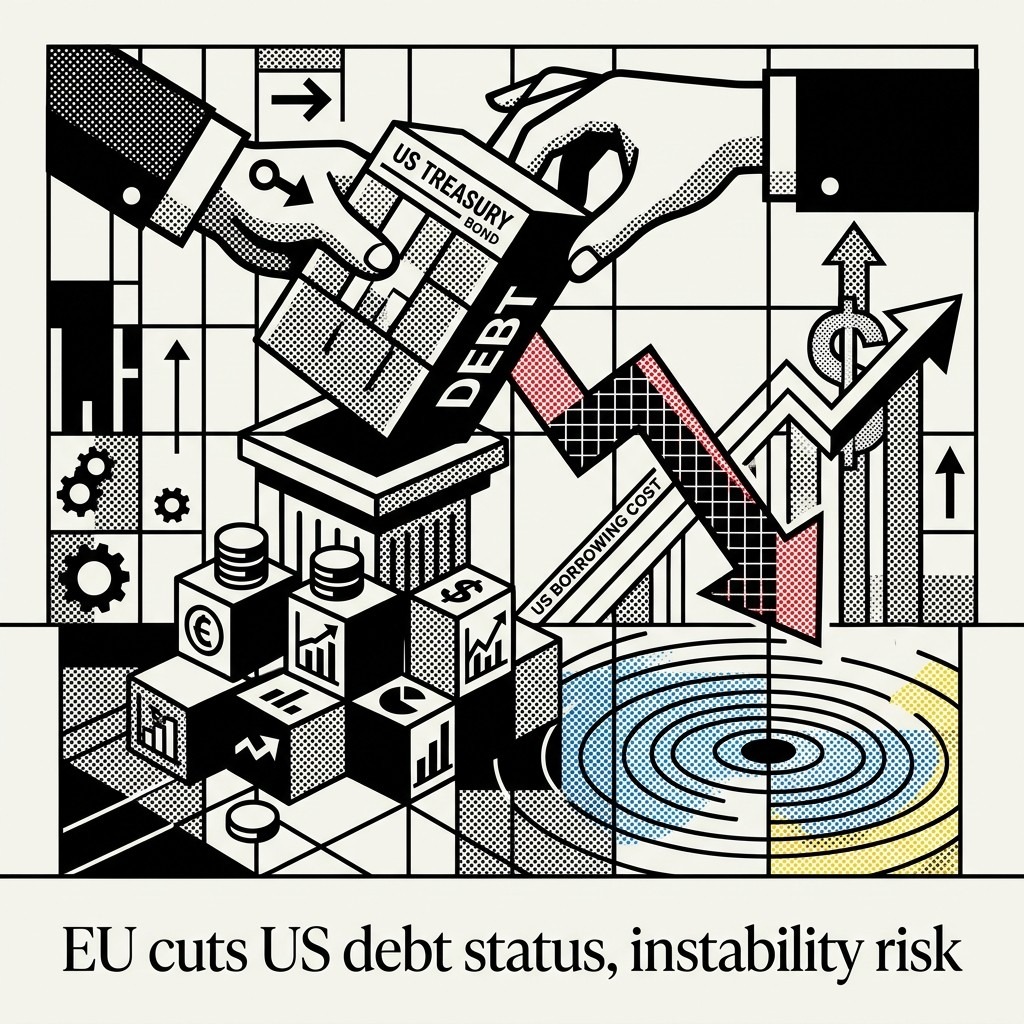
Brussels is threatening to strip US government debt of its privileged regulatory status in European banks, a move designed to cut demand for Treasuries by $200 billion over a decade. By shifting transatlantic retaliation from import quotas to sovereign bond demand, the European Union turns banking oversight into frontline trade warfare, making American fiscal costs vulnerable to foreign regulators.

European officials pivot to this strategy because weaponizing capital requirements allows them to squeeze Washington’s budget without passing import taxes directly to domestic consumers. Yet the maneuver invites immediate blowback: penalizing US Treasuries risks domestic financial instability by artificially restricting European lenders from holding the world’s most liquid safe asset.

The Kiel Institute, a prominent German economic research institute focusing on global markets, calculates this penalty would force yields higher—adding $42 billion annually to US borrowing costs. — Bloomberg.

The Gist AI Editor

The Global Overview

Europe’s Financial Leverage

Threatening to strip US debt of its privileged status shifts European defense from tariffs to weaponizing financial plumbing. The Kiel Institute, a prominent German economic research center, found this move could cut European demand for US Treasuries by $200 billion over a decade, adding $42 billion annually to US borrowing costs (Bloomberg). This turns regulators into geopolitical actors, though penalizing Treasuries risks domestic instability by restricting access to a vital safe asset. Like targeting yuan undervaluation, Europe is now attacking the macroeconomic foundations of rival superpowers.

Geopolitics of British Rates

The cost of London capital is now tethered to Middle Eastern stability. Alan Taylor of the Bank of England’s MPC—the Monetary Policy Committee—called for holding the 3.75% base rate, estimating it sits 0.75 points above neutral (WSJ). Despite recent waivers temporarily unblocking the Strait of Hormuz, Taylor cited conflict uncertainty as the reason to pause cuts. Like keeping floodgates raised against a distant storm, the bank absorbs economic drag to shield against potential energy shocks.

Tethering Iranian Capital

President Donald Trump announced unfrozen Iranian funds will be strictly “controlled by the U.S.A.” for US food and medical purchases (Bloomberg). Operating like a restricted corporate expense account, Washington directs the resource flow—easing humanitarian strain without financing Tehran’s military footprint.

Stay tuned for the next Gist—your edge in a shifting world. The Gist remains independent and reader-supported. If you value news free from corporate or state interests, consider supporting our mission with a donation.

The European Perspective

UK Defence Procurement Paralysis

Outgoing Prime Minister Keir Starmer aims to publish the UK’s Defence Investment Plan (DIP)—a strategic outline for military funding—before the July 7-8 NATO summit in Ankara. Successor Andy Burnham demands a halt to review it, following Defence Secretary John Healey’s June 11 resignation over missing a 3.5% of GDP target by 2035 (Politico). Caretaker transitions inherently freeze collective security commitments. Allies and defense contractors must now price in political risk stemming from internal succession delays that stall multi-billion-pound procurement pipelines. While Starmer retains executive authority to advance policy and fulfill state continuity, capital requires certainty.

EU Challenges Chinese Yuan Valuation

The EU’s goods trade deficit with China hit roughly €360 billion in 2025 (Euronews). Ahead of Brussels talks with Chinese Commerce Minister Wang Wentao, German Chancellor Friedrich Merz argued the yuan is undervalued by up to 30%. Europe is pivoting from reactive tariffs to targeting the macroeconomic currency levers structurally subsidizing Chinese exports.

EU and Taliban Deportation Talks

EU officials hosted Taliban representatives for “technical level” Brussels talks on deportation protocols; an EU spokesperson clarified this avoids diplomatic recognition (ZDF). Domestic pressure to deport security risks overrides ideological friction, forcing Brussels to prioritize border enforcement.

Catch the next Gist for the continent’s moving pieces.

🎙️ Listen to this edition as a podcast Listen


The Gist is an independent daily digest: AI-curated, human-directed, unapologetically liberal (how it’s made). Hundreds of sources, only what matters. Subscribe free or listen to the podcast.


Comments

Leave a Reply

Your email address will not be published. Required fields are marked *

This site uses Akismet to reduce spam. Learn how your comment data is processed.