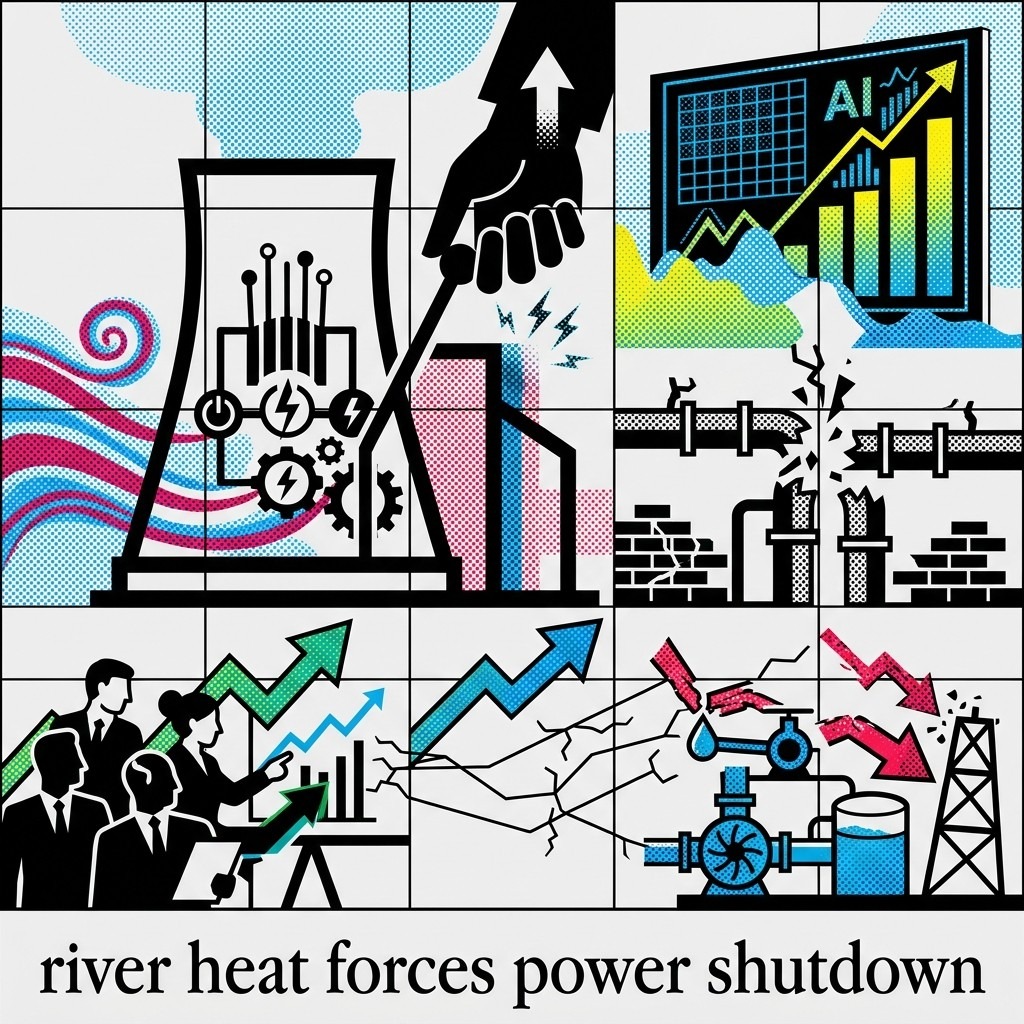
EDF Reactor Shutdown Reveals Forecast-Infrastructure Gap

Evening Analysis – The Gist


Evening Analysis • Wednesday, June 24, 2026

The Gist View

On June 23, 2026, Électricité de France, the state-owned French multinational electric utility company, shut down a reactor at France’s Golfech nuclear power plant after the Garonne River exceeded a 28°C cooling threshold. The closure exposes a flaw in global risk pricing: digital forecasting tools outpace the infrastructure required to power them. Insurers increasingly deploy AI to push past the limits of traditional physics-based models, straining the very river-cooled reactors crippled by the warming climate they calculate.

AI catastrophe models do help underwriters allocate capital efficiently, providing rapid adaptation while physical upgrades inevitably lag. Yet substituting software innovation for hardware resilience creates an illusion of control. Financial firms gain precise pricing, but their servers draw massive energy from baseload grids shutting down during the exact extreme weather simulated.

The physical reality of warming now disrupts the climate sector itself. Record-breaking heat forced London Climate Action Week to move its events online after temperatures suppressed physical attendance, the Financial Times reports.

The Gist AI Editor

The Global Overview

European Extreme Heat and AI Catastrophe Modeling
Insurers use AI to calculate disaster risk, masking grid constraints (FT, Wired). On June 23, 2026, Électricité de France—the state-owned French multinational electric utility company—shut its Golfech reactor as the Garonne River breached 28°C. Heat even pushed London Climate Action Week online. Energy-intensive AI paradoxically strains the offline reactors modeling our warming climate. Yet, AI helps efficiently allocate recovery capital, providing adaptation while infrastructure lags.

SpaceX Post-IPO Volatility
SpaceX went public June 12, 2026, raising $75 billion at $135 per share, but fell below its $150 opening. Unease over a $60 billion all-stock acquisition of AI startup Cursor exposes investor resistance to diluting physical aerospace assets for digital integration.

US Macroeconomic Capex Boom
AI drives a historic capital expenditure boom (Bloomberg). Carlyle’s Jason Thomas notes US nominal GDP growth is heavily propped up by inflation, meaning holding Federal Reserve rates steady currently qualifies as dovish, sustaining long-term infrastructure investment.

US Democratic Party Centrist Shift
Following Bronx congressional primaries, Mayor Zohran Mamdani acknowledged moderates Talarico and Platner successfully outflanked progressives (WSJ). Institutional leverage is rotating from ideological disruption back toward operational baseline stability.

Stay tuned for the next Gist. The Gist remains independent and reader-supported. If you value news free from corporate or state interests, consider supporting our mission with a donation.

The European Perspective

Italy’s €20 Billion Building Bonus Fraud

On June 24, 2026, Italy announced the Guardia di Finanza—the state’s militarized financial police—uncovered €20 billion in green building fraud, seizing €10 billion (Il Sole 24 Ore). This exposes the flaw in state market stimulation: prioritizing the speed of capital deployment structurally advantages sophisticated rent-seeking networks capable of rapid compliance-gaming. Still, the scheme achieved its primary macroeconomic goal by violently stimulating construction to prevent a deeper post-pandemic recession.

Europol Sovereign Cloud Expansion

The European Commission proposed a €180 million sovereign cloud initiative (Politico). This enables Europol—the European Union’s law enforcement agency—to process cross-border digital crime data without relying on commercial platforms. This confirms our tracking of Europe’s push for digital independence, moving beyond market regulation into physically insulating core state security infrastructure.

Germany Youth Social Media Limits

Germany’s Family Minister proposed banning social media for children under 13, but an expert commission pushed back, urging an EU-wide framework instead (ZDF). National regulators favor localized bans to project immediate political responsiveness, but domestic digital borders resemble fences built to stop weather systems; tech capital flows require supranational oversight.

AfD Historical Revisionism Controversy

A 2020 photo shows Martin Reichardt, a Bundestag member for the AfD—Alternative for Germany, a right-wing populist party—performing a Hitler salute (Politico). Such overt extremist signaling forces center-right factions to continually calculate the reputational cost of regional alliances, maintaining a hard structural barrier against the party’s institutional integration.

Catch the next Gist for the continent’s moving pieces.

🎙️ Listen to this edition as a podcast Listen


The Gist is an independent daily digest: AI-curated, human-directed, unapologetically liberal (how it’s made). Hundreds of sources, only what matters. Subscribe free or listen to the podcast.


Comments

Leave a Reply

Your email address will not be published. Required fields are marked *

This site uses Akismet to reduce spam. Learn how your comment data is processed.