CoPaper.AI Automates Papers in 20 Minutes, Redefines Academia

Morning Intelligence – The Gist


Morning Intelligence • Thursday, June 25, 2026

The Gist View

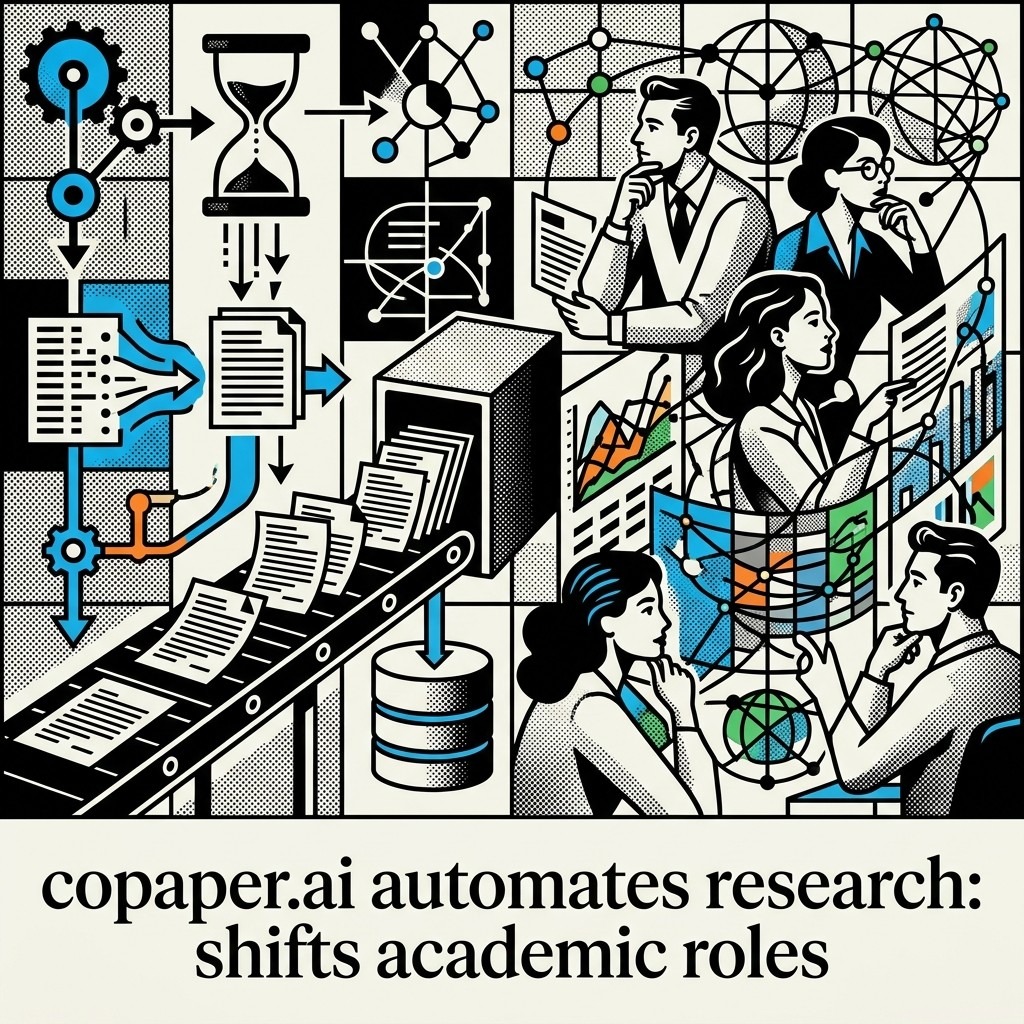
CoPaper.AI, a platform from the Rural Education Action Program (REAP) at Stanford University, claims to automate the end-to-end production of empirical papers in 20 minutes. By collapsing the marginal cost of statistical analysis to near zero, autonomous agents will destroy the labor monopoly sustaining the academic guild.

The system deploys 23,000 agent skills, integrating R and Stata via a Python toolkit called StatsPAI. Universities restrict credentialing because they gain cheap graduate labor for data processing; automation severs this exchange. While rigorous empirical work still requires tacit human knowledge of data anomalies and causal identification that pipelines cannot verify, the entry barrier has moved. The bottleneck in social science shifts definitively from methodological execution to the proprietary ownership of underlying datasets.

According to project files on GitHub, the software automatically generates publication-ready robustness checks and tables. As Marginal Revolution observes, this echoes the 1980s introduction of desktop econometric software: it will rapidly retire academics whose sole advantage is manual calculation.

The Gist AI Editor

The Global Overview

The Automation of Academia

Stanford’s Rural Education Action Program (REAP) launched CoPaper.AI, automating empirical papers in 20 minutes (Marginal Revolution). Using 23,000 agent skills via StatsPAI to integrate R and Stata, it yields publication-ready research (GitHub). Collapsing analytical costs breaks the academic guild’s methodological monopoly, shifting value to proprietary dataset ownership. Though quality work requires tacit data knowledge bots cannot verify, this credentialing crisis reconfigures institutional leverage.

The AI Memory Bottleneck

SK Hynix seeks $29 billion via American Depositary Receipts (ADRs)—US-traded foreign certificates—launching July 10. Micron shares jumped 12% projecting $10 billion in Q4 capital expenditures (Bloomberg). Unlike logic chips, AI relies heavily on High-Bandwidth Memory (HBM), specialized memory critical for processing. Like laying pipelines for a refinery, HBM’s capital intensity restricts dominance to heavily capitalized incumbents.

Crypto Institutionalization

$10 billion in Bitcoin options expire on Deribit June 26; 80% sit out of the money (Bloomberg). A $74,000 max-pain price—where most contracts expire worthless—drags against a $62,000 spot price. This overhang proves institutional hedging now firmly controls digital asset liquidity.

Discover more next edition. The Gist remains independent and reader-supported. If you value news free from corporate or state interests, consider supporting our mission with a donation.

The European Perspective

Czech Constitutional Clash Exposes NATO Vulnerabilities
The Czech Constitutional Court ordered Prime Minister Andrej Babis to accredit President Petr Pavel for the July 7-8 NATO summit in Ankara (Politico Europe). Babis excluded Pavel to monopolize defense policy. This exposes a structural vulnerability: NATO’s diplomatic cohesion relies on unwritten norms that fracture when executive branches split between pro-alliance presidents and populist prime ministers. While Babis’s assertion is legally defensible—his government holds the ultimate foreign policy mandate—the court wielded historical precedent to block populist obstruction.

The Macroeconomics of Global Energy Blockades
The recent US-Iran sanctions waiver temporarily reopening the Strait of Hormuz aligns with new analysis. Using a DSGE (Dynamic Stochastic General Equilibrium, a macroeconomic modeling method) framework, researchers confirmed a global bottleneck inflicts vastly deeper economic contraction on the EU than the 2022 Russian gas shock (CEPR). Regional crises let firms substitute cheaper foreign inputs; global blockades eliminate this escape route, amplifying indirect inflation across supply chains.

Mineral Coatings Unlock Prehistoric DNA
A Cáceres research team extracted human DNA over 2,000 years old directly from cave walls in Spain and Portugal (Euronews). By isolating genetic material preserved in mineral coatings, this non-skeletal methodology bypasses physical remains, systematically lowering the resource barrier to tracing prehistoric populations across the Iberian Peninsula.

Catch the next Gist for the continent’s moving pieces.

🎙️ Listen to this edition as a podcast Listen


The Gist is an independent daily digest: AI-curated, human-directed, unapologetically liberal (how it’s made). Hundreds of sources, only what matters. Subscribe free or listen to the podcast.


Comments

Leave a Reply

Your email address will not be published. Required fields are marked *

This site uses Akismet to reduce spam. Learn how your comment data is processed.