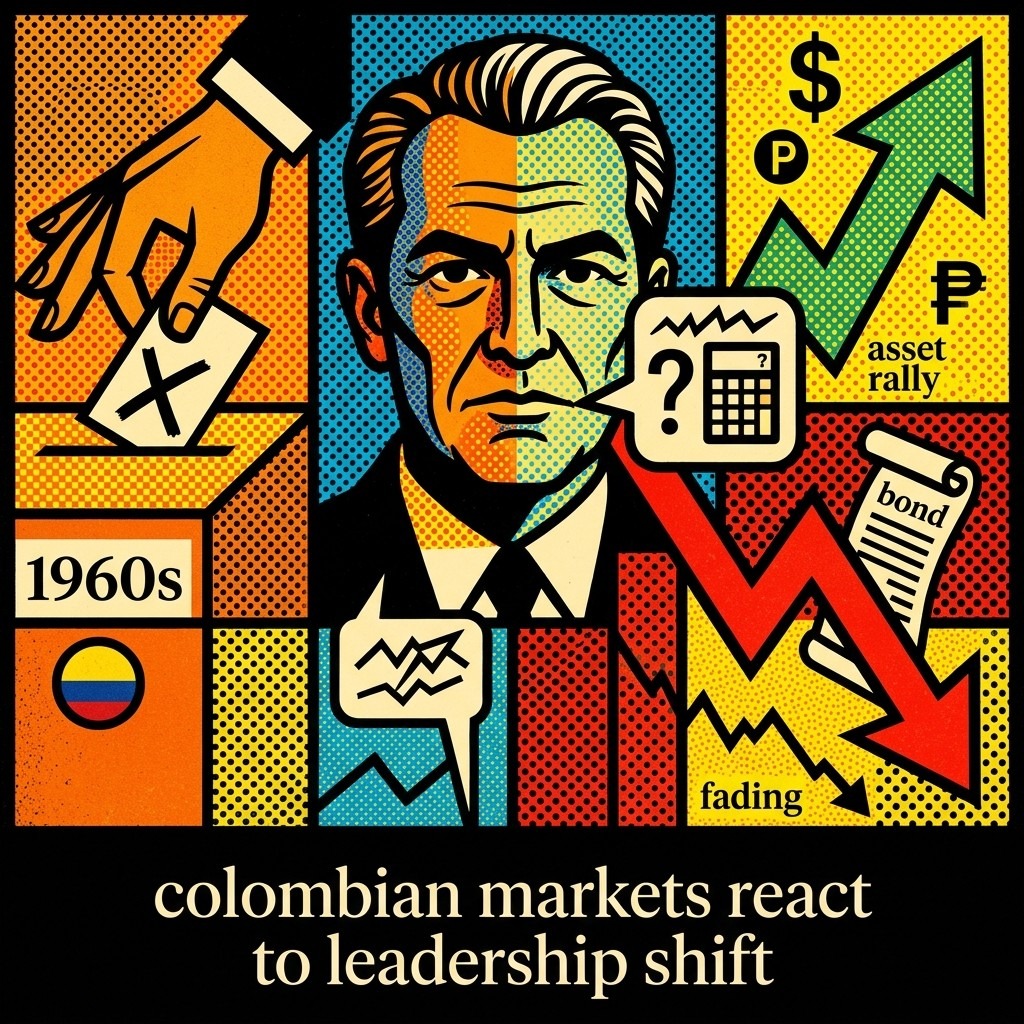
Abelardo de la Espriella Wins Colombia Presidency, Markets React

Evening Analysis • Friday, June 26, 2026

The Gist View

On June 21, 2026, far-right candidate Abelardo de la Espriella defeated left-wing senator Iván Cepeda in Colombia’s presidential runoff, sparking a brief asset rally dubbed the ‘Tiger Trade’. That enthusiasm is already fading, demonstrating that global bond markets are ruthlessly indifferent to ideological victories. Sovereign investors act as an immediate institutional check on new populist governments the moment ballot counting stops.

The incoming administration does not officially take office until August 7, 2026, and has yet to name an economic cabinet, making premature market jitters a poor proxy for long-term fiscal policy. Yet creditors refuse to wait. Bondholders demand concrete fiscal repair plans because their yields depend on balance-sheet mathematics, not campaign rhetoric. This pivot from cheering a leftist defeat to scrutinizing the national ledger shrinks the populist honeymoon to near-zero.

Colombian dollar bonds executed a similar immediate repricing following the June 2022 election of outgoing leftist president Gustavo Petro, as Bloomberg notes.

The Gist AI Editor

The Global Overview

Colombia’s Sovereign Debt Correction

Far-right candidate Abelardo de la Espriella defeated left-wing senator Iván Cepeda in Colombia’s June 21, 2026 runoff election (Bloomberg; The Guardian). By immediately demanding fiscal repair, sovereign bond investors are acting as the most effective institutional check on right-wing populism. The initial market rally—dubbed the ‘Tiger Trade’ in honor of the president-elect’s nickname—is fading as investors await concrete plans to repair strained public finances. The market’s pivot from cheering a left-wing defeat to scrutinizing the new administration’s balance sheet happens faster than the formal transition of power, shrinking the timeframe for investor leniency to near-zero. However, the incoming administration has not yet taken office or named a full economic cabinet, making premature market jitters a poor proxy for long-term fiscal policy; de la Espriella is scheduled to officially assume the presidency on August 7, 2026.

Saudi Terminal Resumes Operations

Two supertankers began loading crude Thursday at a Gulf terminal operated by Aramco, Saudi Arabia’s state-owned oil and gas company, after a nearly four-month halt (WSJ). Kpler, a global data and analytics firm tracking commodity markets, indicates a third vessel may also be preparing to load. This resumption adds immediate supply relief to an energy sector stabilizing from recent Hormuz Strait tensions.

South African Private Enforcement

South African businesses have pledged to supply police with drones and helicopters to enforce the departure of undocumented migrants (Bloomberg). This private logistical support directly aligns with an impending deadline explicitly set by domestic anti-immigrant groups, demonstrating how commercial entities are actively subsidizing state operations to accelerate border enforcement.

Discover the structural mechanics driving tomorrow’s markets in the next edition. The Gist remains independent and reader-supported. If you value news free from corporate or state interests, consider supporting our mission with a donation.

The European Perspective

Volkswagen Factory Closures

Volkswagen CEO Oliver Blume reportedly plans cutting 100,000 jobs, doubling prior targets of 50,000 by 2030 (Manager Magazin). Following a 14.3% drop in Q1 2026 operating profit to €2.46 billion, the move shutters four German factories: Hanover, Zwickau, Emden, and Audi’s Neckarsulm site (Politico). The proposed spin-off of the core VW brand signals that the conglomerate’s historic scale has become a liability rather than a strategic bulwark in the electric vehicle transition. Protectionist tariffs cannot shield legacy European manufacturing from the structural cost advantages of agile Chinese competitors. However, shrinking domestic production surrenders European industrial sovereignty precisely when geopolitical fragmentation makes localized supply chains a strategic necessity.

Paris Heat Emergency Response

With temperatures reaching 40°C in Paris, Alexandre Bompard, CEO of Carrefour—a French retail multinational—confirmed donating four tons of ice to local firefighters (Politico). The city requested this unprecedented donation to treat severe heat stroke as emergency supplies depleted. Firefighters relying on donated supermarket ice physically confirms our view that municipal emergency infrastructure is failing under accelerating climate extremes.

Ukraine Winter Energy Preparations

Maksym Timchenko, CEO of DTEK—Ukraine’s largest private power provider—announced the utility sector is applying lessons from previous infrastructure strikes to physically prepare the grid for the upcoming war-winter (ZDF).

Catch the next Gist for the continent’s moving pieces.

🎙️ Listen to this edition as a podcast Listen

The Gist is an independent daily digest: AI-curated, human-directed, unapologetically liberal (how it’s made). Hundreds of sources, only what matters. Subscribe free or listen to the podcast.


Comments

Leave a Reply

Your email address will not be published. Required fields are marked *

This site uses Akismet to reduce spam. Learn how your comment data is processed.