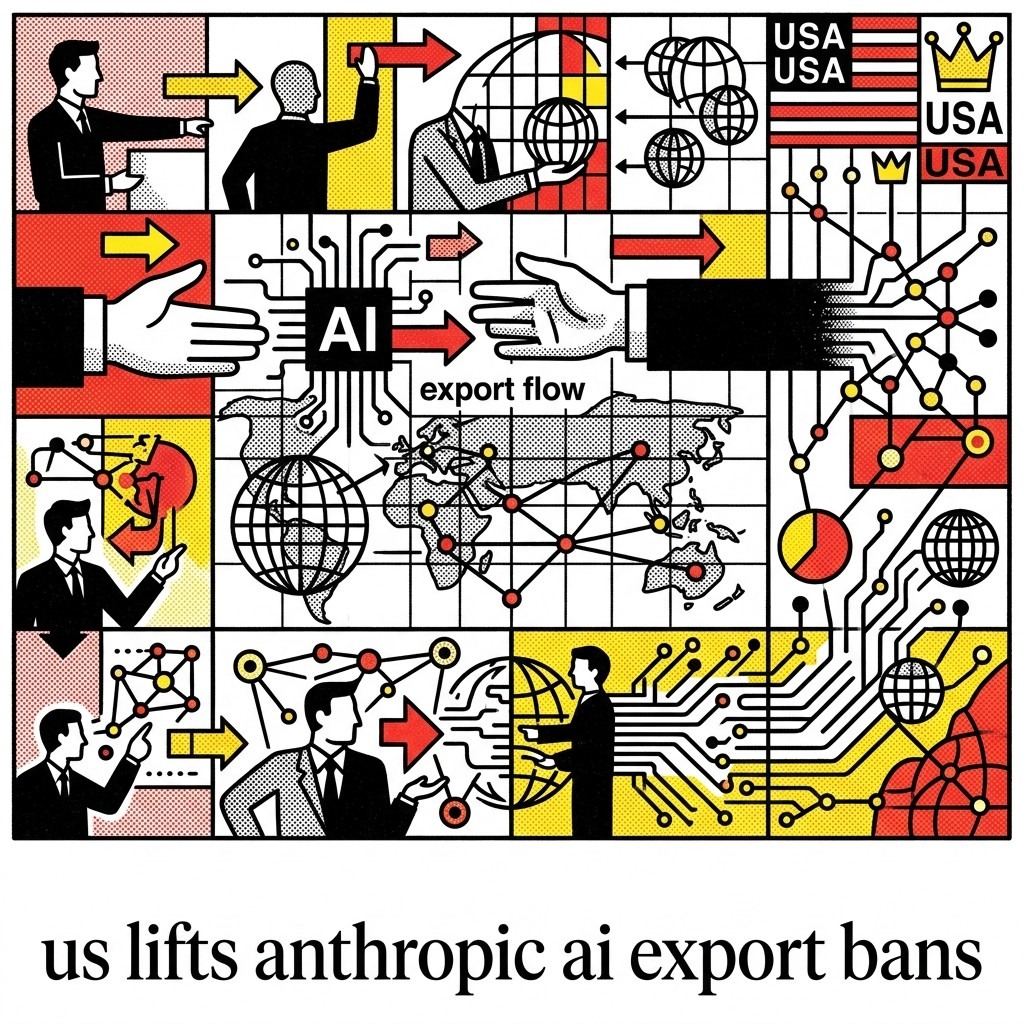
US Lifts Export Bans on Anthropic AI for Global Dominance

Morning Intelligence • Wednesday, July 01, 2026

The Gist View

Just weeks after ordering a suspension of foreign access, the White House is lifting export restrictions on Mythos and Fable, the most advanced artificial intelligence models from San Francisco-based research company Anthropic. The sudden reversal pivots American geopolitical strategy: aggressively flooding the global market secures technological supremacy far better than futile software containment.

Embargoes on digital goods usually backfire by forcing adversaries to fund native alternatives. By letting Anthropic deploy globally, US policymakers ensure international developers build on American infrastructure, actively crowding out rival investments. Washington accepts a severe trade-off: unrestricted access to Mythos allows geopolitical rivals to fine-tune American models for cyber warfare or advanced weapons systems. Yet the administration profits more by establishing the global standard than by hiding its code.

The move mirrors the 1990s encryption wars, when, as Wired notes, Washington finally declassified web cryptography as a munition in 1999 after realizing export bans only enriched European competitors.

The Gist AI Editor

The Global Overview

US Eases Controls on Anthropic AI Models

The White House is easing export restrictions on Mythos and Fable, advanced models from Anthropic, a prominent artificial intelligence research company based in San Francisco (Wired). Weeks after ordering the company to suspend foreign access, policymakers are prioritizing global market dependency over containment. Embargoes accelerate adversaries’ funding for native alternatives; flooding the market with US models crowds out rival investments. However, unrestricted access lets rivals fine-tune American AI for weapons.

Donald Trump Reports $1.4B Crypto Earnings

US President Donald Trump reported $1.4 billion in 2025 income, yielding $800 million from World Liberty Financial, a cryptocurrency venture co-founded by Donald Trump and his family, alongside $635 million from meme coins (WSJ). This follows his pivot to crypto-friendly regulations.

Reserve Bank of India Defends Rupee

The Reserve Bank of India, the country’s central bank, grew its short dollar book to $106.7 billion in May 2026 (Bloomberg). It used these derivatives—selling borrowed dollars—to defend the rupee against market pressures.

Nike Sales Drop Amid Global Disruption

Nike reported global sales declines amid consumer weakness in China (WSJ). Separately, a US-Saudi interceptor dispute confirms the months-long Hormuz standoff remains a persistent structural disruption to global stability (WSJ).

Stay tuned for the next Gist—your edge in a shifting world. The Gist remains independent and reader-supported. If you value news free from corporate or state interests, consider supporting our mission with a donation.

The European Perspective

EU Diplomatic Centralization

Josep Borrell warns the European Commission is creating ‘quite a mess’ by exceeding treaty powers. Borrell, who led the European External Action Service (EEAS)—the EU’s official diplomatic arm—until late 2024, stated ‘the Commission represents only the Commission’ (Politico). Ursula von der Leyen’s centralization bypasses formal structures for executive agility. Acting without European Council backing creates a diplomatic vulnerability foreign adversaries easily test, exposing internal divisions. Yet, the EEAS model frequently suffers paralysis via single-member vetoes, requiring executive decisiveness to remain globally relevant.

Swedish Defense Expansion

Saab will supply 16 Gripen E fighter jets to Ukraine for 24.6 billion Swedish kronor ($2.54 billion) (ZDF).

US Taxation Curtails Scientific Output

The 2025 US university endowment tax hike forces elite institutions to shrink doctoral cohorts. Graduates from these programs produce 60-75% more impact-weighted publications than comparable peers (CEPR); cutting these seats directly decelerates global scientific progression.

Russian Military Recruitment

Facing domestic resistance to mass mobilization, Russia targets foreign nationals with aggressive financial incentives to plug troop deficits (ZDF). Separately, extreme heat straining French infrastructure confirms our thesis: European climate adaptation remains fundamentally undercapitalized.

Catch the next Gist for the continent’s moving pieces.

🎙️ Listen to this edition as a podcast Listen

The Gist is an independent daily digest: AI-curated, human-directed, unapologetically liberal (how it’s made). Hundreds of sources, only what matters. Subscribe free or listen to the podcast.


Comments

Leave a Reply

Your email address will not be published. Required fields are marked *

This site uses Akismet to reduce spam. Learn how your comment data is processed.