AI Adoption by Doctors Hits 40% for Transcriptions

Morning Intelligence • Sunday, July 05, 2026

The Gist View

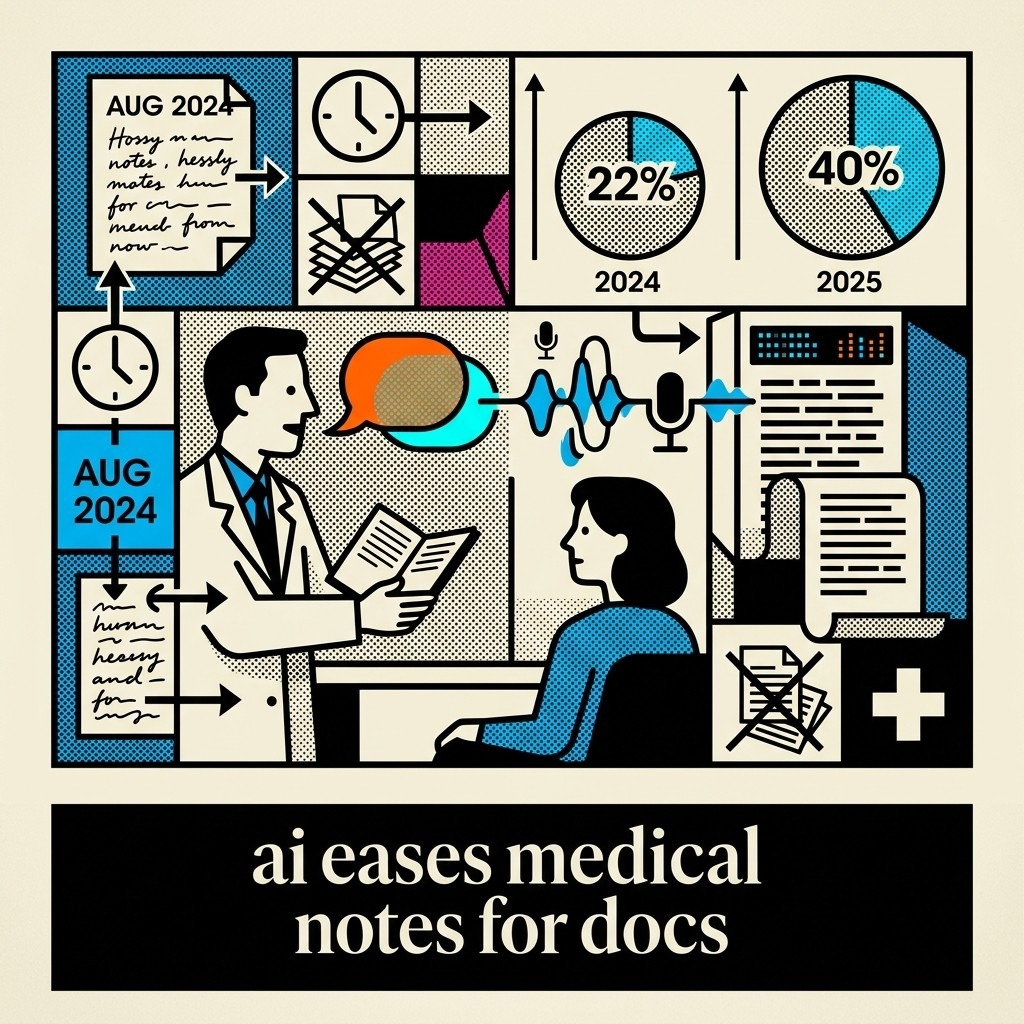
Between August 2024 and November 2025, the share of doctors using artificial intelligence to record and transcribe patient visits nearly doubled from 22% to 40%, according to the RACGP, the professional body for primary care physicians in Australia. Faced with crushing administrative burdens, physicians are adopting AI scribes to reclaim their schedules, proving that market demand for basic operational efficiency routinely outpaces sluggish regulatory guidance.

The primary driver of medical AI is not novel diagnostics, but a desperate need to automate routine bureaucratic paperwork. Unsustainable overhead gives doctors an overwhelming incentive to bypass cautious state advice and shoulder privacy risks. Government caution is entirely rational, as medical data is profoundly sensitive and third-party processors lack clear liability frameworks for software hallucinations or data breaches.

State officials are now issuing advisories to a workforce that has already deployed the technology. The federal health department warns that these active clinical tools still operate with “little oversight” and lack robust safeguards (The Guardian).

The Gist AI Editor

The Global Overview

Australian Doctors Bypass Regulators to Automate Paperwork

Faced with unsustainable administrative overhead, physicians are rapidly adopting AI scribes despite federal warnings. According to the Royal Australian College of General Practitioners (RACGP)—the professional body for primary care physicians in Australia—doctors’ use of tools that record, transcribe, and summarize patient conversations nearly doubled from 22% in August 2024 to 40% in November 2025 (The Guardian). The primary driver of AI adoption is automating bureaucratic paperwork, not pursuing novel diagnostics. Because third-party processors lack clear liability frameworks for data breaches or hallucinations, government caution is entirely rational. Still, the overwhelming incentive for operational efficiency causes doctors to voluntarily shoulder privacy risks, bypassing cautious state guidance.

Bending Spoons Completes Nasdaq Listing

Italian-founded technology firm Bending Spoons completed a Nasdaq listing after a decade of acquisitions (FT). The market debut solidifies its growth into a $23 billion global internet company built entirely on optimizing struggling brands.

Capital Rotates into Indian Equities

Investors are rotating capital into Indian equities to limit exposure to recent global market turbulence (Bloomberg). The shift follows high volatility and growing investor fatigue surrounding the global AI rally.

Extreme Heat Triggers Occupational Safety Crises

Agricultural workers, including Indian sugar cane laborers, are enduring extreme heat exceeding 39 degrees Celsius (102.2 F). This prolonged exposure triggers severe occupational safety crises, notably acute kidney damage and heart health deterioration (Yale Climate Connections).

Stay tuned for the next Gist—your edge in a shifting world. The Gist remains independent and reader-supported. If you value news free from corporate or state interests, consider supporting our mission with a donation.

The European Perspective

Pre-NATO Summit Diplomacy

US President Donald Trump held phone calls with Vladimir Putin and Volodymyr Zelenskyy, focusing on conflict resolution ahead of the NATO summit in Ankara (ZDF).

German Defense Coercion and Regional Wealth

The Bundeswehr, the armed forces of the Federal Republic of Germany, aims to station 4,800 soldiers and 200 civilians in Lithuania by 2027 (ZDF). Anticipating shortfalls, officials will obligate under 1,000 personnel to serve (Bild am Sonntag). Mandatory deployment functions as a highly concentrated tax: rather than raising general revenue to pay competitive wages, labor is extracted directly by force. Still, voluntary recruitment is mathematically unable to meet the acute security deadline. Concurrently, the Centre for Economic Policy Research (CEPR), a leading network of European academic economists, found across 1,011 regions that defense supply chains raise local incomes. The economic benefits of defense manufacturing are easily captured by local regions as monetary wealth, while the deployment of actual troops demands steep individual physical risks—a structural mismatch that explains why Europe’s arms industry booms while its militaries must resort to coercion to fill their ranks.

Ukrainian Deep-Strike Targets

Our prior coverage highlighted Russia’s escalating missile strikes in Kharkiv; today’s developments confirm the reciprocal expansion of the battlefield. Ukrainian forces launched long-range drone strikes on oil infrastructure near Kronstadt, a Russian port city and strategic naval base situated on an island near St. Petersburg (DW). Striking over 850 kilometers from the border systematically degrades direct revenue sources for the Russian war effort.

Catch the next Gist for the continent’s moving pieces.

🎙️ Listen to this edition as a podcast Listen

The Gist is an independent daily digest: AI-curated, human-directed, unapologetically liberal (how it’s made). Hundreds of sources, only what matters. Subscribe free or listen to the podcast.


Comments

Leave a Reply

Your email address will not be published. Required fields are marked *

This site uses Akismet to reduce spam. Learn how your comment data is processed.