China’s Factory-Gate Inflation Rises Amid Cooling CPI

Morning Intelligence • Thursday, July 09, 2026

The Gist View

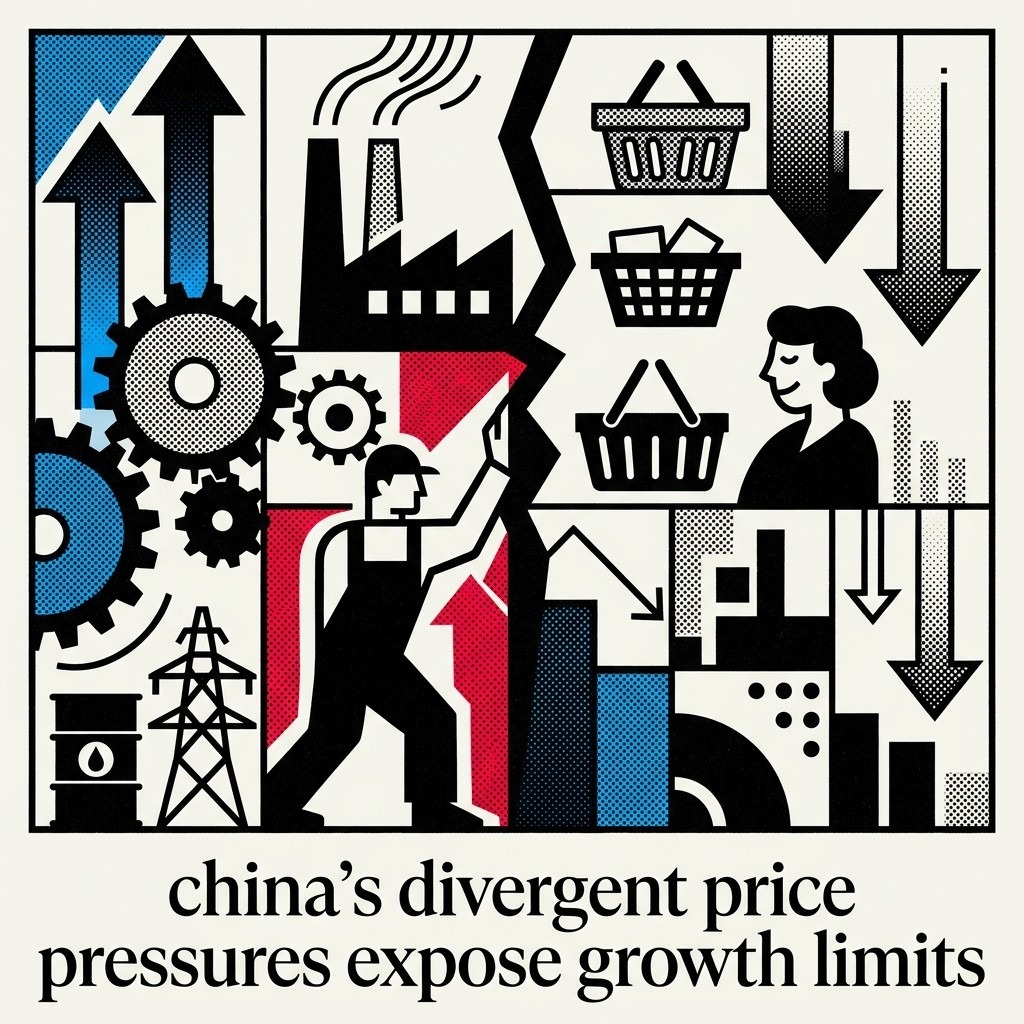
China’s factory-gate inflation—the price changes for goods at the wholesale level—accelerated in June as the Middle East conflict drove up imported energy costs. Domestic consumer-price gains cooled in the exact same period. This widening gap exposes the limits of Beijing’s state-directed growth: prioritizing industrial output over household wealth builds a rigid economy that absorbs global supply shocks but starves its own domestic market.

Beijing subsidizes heavy industry because it gains strategic autonomy, a doctrine aimed at reducing reliance on foreign supply chains. That focus built an export juggernaut, but leaves Chinese companies trapped today. Unable to pass rising costs to weakened domestic buyers, factories are eating the inflation and rapidly compressing their profit margins. The state secures its geopolitical resilience, while private manufacturers pay the bill.

When Beijing deployed its $586 billion stimulus during the 2008 financial crisis, it directed that capital entirely toward infrastructure, cementing the structural consumption deficit the Wall Street Journal tracks today.

The Gist AI Editor

The Global Overview

China’s Economic Divergence

In June, China’s factory-gate inflation—the measure of price changes for goods at the wholesale level, before they reach consumers—accelerated, while consumer-price gains cooled (WSJ). This gap forces Chinese companies to absorb rising imported energy costs, compressing domestic margins. Still, Beijing prioritizes strategic autonomy—a policy doctrine aimed at reducing reliance on foreign supply chains for critical goods and defense—over short-term domestic consumption.

Super Typhoon Bavi

Super Typhoon Bavi, the third category 5 tropical cyclone of 2026, brought 290-kilometer-per-hour winds across the U.S. Northern Mariana Islands and Guam on July 5 (NASA). Extreme weather directly constrains Asian supply chains, forcing capital out of economic expansion and into immediate infrastructure repair.

Nicotine Pouch Expansion

Tobacco companies are aggressively building plants to satisfy demand for Zyn, a popular brand of smoke-free nicotine pouches (NYT). Corporate capital funds this capacity expansion despite health experts issuing warnings about the products’ highly addictive nature, highlighting how investment pursues rapidly scaling consumer habits regardless of regulatory friction.

Strait of Hormuz Halts

Strait of Hormuz traffic ground to a near halt after the US military struck Iran for a second consecutive day, following President Trump’s declaration that the framework agreement failed (Bloomberg). This confirms diplomatic unraveling acutely chokes global oil supply.

Stay tuned for the next Gist. The Gist remains independent and reader-supported. If you value news free from corporate or state interests, consider supporting our mission with a donation.

The European Perspective

Western Europe Record Heat Escalates Infrastructure Adaptation
Western Europe recorded its hottest June, with temperatures 3.06C above average (Copernicus, the European Union’s Earth observation programme). Continual heatwaves since May 2026 force Europe to shift political capital from distant decarbonization to immediate infrastructure adaptation (Euronews). This normalizes disaster response, turning climate damages into a permanent, unbudgeted structural drain on budgets. Deep decarbonization is the only permanent fix; diverting capital to adaptation merely treats symptoms while allowing fossil fuel reliance to continue (The Guardian).

European Commission Elevates Livestock Status
The European Commission designated farm animals as ‘critical infrastructure’ (Politico). This frames cattle as essential for strategic autonomy—a policy doctrine aimed at reducing reliance on foreign supply chains for critical goods—complicating established emissions goals. Concurrently, a Paris court reduced Marine Le Pen’s political ban, allowing a 2027 presidential run under house arrest and returning institutional confrontation to electoral grounds.

Capital Rehabilitates Georgian Tea Plantations
Abandoned Soviet-era tea plantations in western Georgia are undergoing active rehabilitation (The Guardian). Growers are shifting focus from volume to quality, supplying luxury importers across Europe and the US.

Russia Condemns NATO Pledges
The Russian Foreign Ministry formally condemned NATO’s summit pledges to Ukraine as ‘irresponsible,’ claiming European member states are actively preparing for armed conflict (ZDF).

Catch the next Gist for the continent’s moving pieces.

🎙️ Listen to this edition as a podcast Listen

The Gist is an independent daily digest: AI-curated, human-directed, unapologetically liberal (how it’s made). Hundreds of sources, only what matters. Subscribe free or listen to the podcast.


Comments

Leave a Reply

Your email address will not be published. Required fields are marked *

This site uses Akismet to reduce spam. Learn how your comment data is processed.