Apple Sues OpenAI for Poaching 400+ Ex-Employees

Evening Analysis • Saturday, July 11, 2026

The Gist View

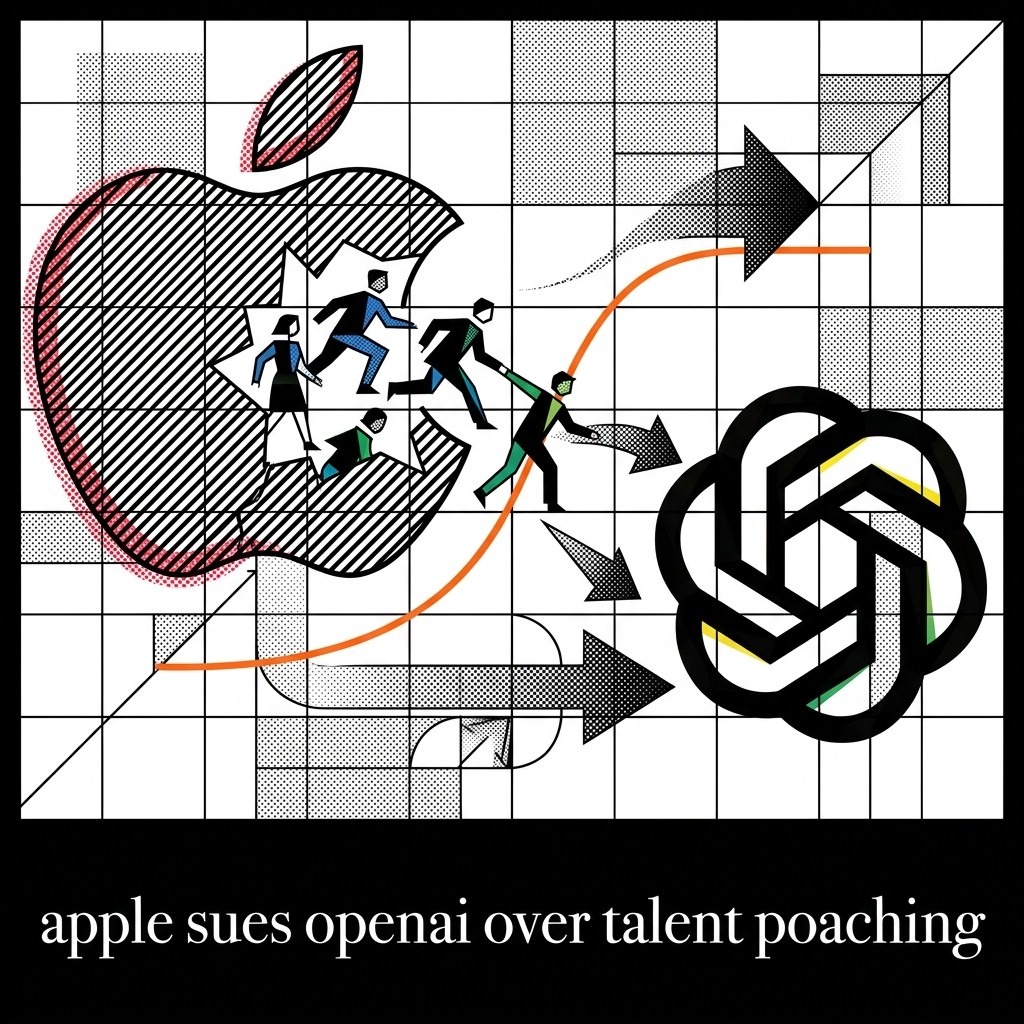
Apple filed a federal lawsuit accusing OpenAI of poaching over 400 former employees to steal confidential hardware designs. The litigation exposes a pivot in the artificial intelligence arms race: legacy hardware monopolies are weaponizing the courts to stall agile competitors. The transition toward proprietary consumer hardware turns former allies into existential threats.

The lawsuit targets physical products, not language models. OpenAI aims to bypass the iOS ecosystem entirely, advancing this strategy by paying $6.4bn in 2025 for a design studio led by former Apple executive Jony Ive. Admittedly, OpenAI aggressively recruited Tang Tan, Apple’s former head of hardware, explicitly directing him to extract unreleased product files—behavior that arguably crosses from talent acquisition into deliberate corporate espionage.

Apple litigates because delaying rival devices protects its App Store margins. Apple launched an identical patent war against Samsung in 2011; the litigation spanned years but failed to halt Android’s global expansion, the Financial Times notes.

The Gist AI Editor

The Global Overview

Apple Sues OpenAI Over Hardware Secrets

Apple filed a federal lawsuit accusing OpenAI of stealing confidential hardware designs (FT). Naming OpenAI’s head of hardware, Tang Tan, as directing the theft of unreleased files, the suit highlights OpenAI’s strategy to bypass the iOS ecosystem entirely through physical consumer devices (Washington Post). With 400 former Apple employees now at OpenAI and a 2025 $6.4bn acquisition of Jony Ive’s design studio, OpenAI arguably engaged in deliberate corporate espionage (WSJ). Still, this litigation exposes a structural shift: a legacy monopoly using the legal system to stall competitors building the next computing paradigm.

China Achieves Asteroid Rendezvous

On July 4, 2026, China’s Tianwen-2 spacecraft successfully rendezvoused with Kamo’oalewa, a near-Earth asteroid that orbits the Sun in sync with Earth (Wired). A planned 2027 surface sample return signals advancing Chinese operational capability and future structural leverage in deep-space logistics and extraterrestrial resource extraction.

Trump Snubs US Housing Legislation

A sweeping housing affordability package became law Saturday without President Trump’s signature (Bloomberg). By intentionally deriding the legislation as “a yawn,” the president undercuts the 2026 midterm messaging of the GOP—the US Republican Party. Concurrently, as we previously warned, new federal grant freezes and ideological reviews by the Trump administration confirm the ongoing structural hollowing out of the US scientific enterprise and academic institutional capacity.

Join us in the next edition of The Gist as we track these shifting global dynamics. The Gist remains independent and reader-supported. If you value news free from corporate or state interests, consider supporting our mission with a donation.

The European Perspective

Vasile Tofan Appointed Prime Minister of Moldova

On Saturday, President Maia Sandu nominated 44-year-old Vasile Tofan, managing partner at Horizon Capital—a private equity firm focusing on investments in Ukraine and Moldova—as Prime Minister (Politico). Replacing Alexandru Munteanu following his resignation over corruption scandals, Tofan targets a European Union accession treaty by the end of 2028 (Reuters). Elevating a financier signals that Moldova’s integration requires strict private-sector discipline. Tofan bypasses traditional patronage networks, forcing structural reforms directly onto the state apparatus. Yet, appointing an unelected technocrat risks fracturing pro-European support if his fiscal policies enforce severe austerity (Euractiv).

Russian Disinformation Targets Kyiv Cave Monastery

Following a Russian strike on a Kyiv UNESCO World Heritage cave monastery, AI-generated images circulated claiming Ukraine staged the damage (ZDF). Analysis confirmed the visuals were artificially generated to run interference for the site’s physical destruction, demonstrating how networks deploy synthetic media to reduce the geopolitical costs of targeting cultural infrastructure.

German Weather Service Records Structural Heat Shift

The German Weather Service recorded daytime temperatures reaching 37°C alongside structurally warmer nights (ZDF). This shift marks a sustained adaptation to extreme heat beyond isolated anomalies, forcing municipalities to immediately redirect capital toward physical infrastructure resilience.

Catch the next Gist for the continent’s moving pieces.

🎙️ Listen to this edition as a podcast Listen

The Gist is an independent daily digest: AI-curated, human-directed, unapologetically liberal (how it’s made). Hundreds of sources, only what matters. Subscribe free or listen to the podcast.