AI Analysis of Sears Catalogs Shows Inflation Metric Flaws

Evening Analysis • Friday, July 17, 2026

The Gist View

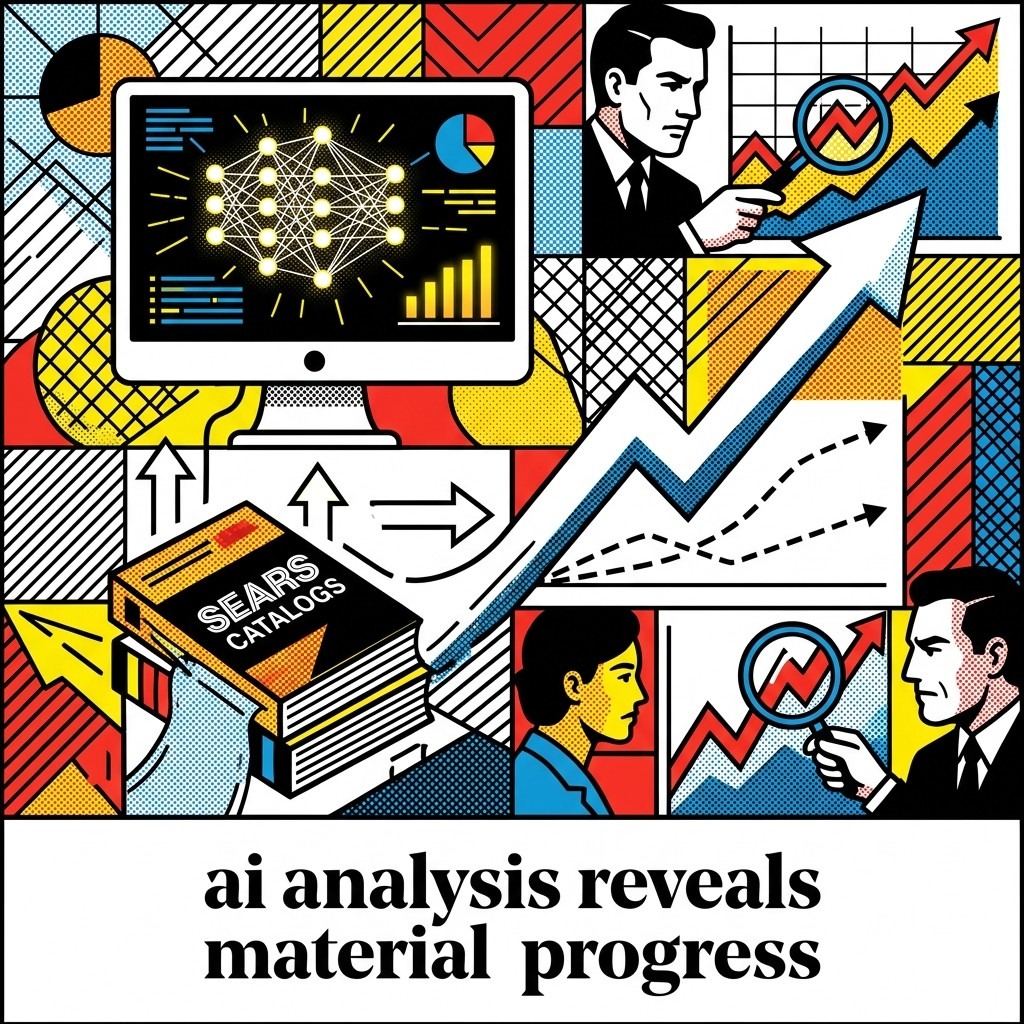
MIT economists Verónica Bäcker-Peral and Benjamin Wittenbrink applied a large language model—an artificial intelligence system trained to understand human language—to 5.1 million Sears catalog listings spanning 1900 to 1990. Their findings force a reassessment of capitalism’s historical track record: standard inflation metrics systematically blind us to the massive consumer surplus generated by market innovation.

Government statisticians rely on basic price deflators because they gain methodological consistency by avoiding expensive, subjective product quality adjustments. This bureaucratic trade-off hides immense wealth creation. The MIT index proves the gap between actual consumption and canonical deflators is largest before World War II, entirely contradicting the economic consensus that goods consumption accelerated primarily post-1945. Admittedly, the research relies exclusively on manufactured retail goods, omitting the skyrocketing relative costs of non-tradable services like housing, healthcare, and education.

The measurement error nonetheless rewrites our understanding of material progress. As highlighted by Marginal Revolution, standard government deflators record a 90-year goods consumption growth factor of only 10.3; the quality-adjusted index reveals the true factor was 39.

The Gist AI Editor

The Global Overview

MIT Economic Research

MIT researchers applied a large language model (LLM)—an artificial intelligence system trained to understand and generate human language—to 5.1 million Sears catalog listings from 1900 to 1990 (Marginal Revolution). Real goods consumption grew by a factor of 39, dwarfing the 10.3 factor measured by government deflators. This gap peaks before World War II, contradicting the consensus of post-1945 consumption acceleration. While proving market innovation generated greater wealth than official GDP figures suggest, the study omits rising costs of non-tradable services like housing.

Iran Conflict and Global Markets

Our warnings that Strait of Hormuz maritime disruptions would impose sustained macroeconomic drag are confirmed today, as Burberry specifically cites the Iran conflict for depressing Middle East retail revenues (FT). US Treasury yields slipped as markets weighed domestic indicators against geopolitical frictions (WSJ).

Artemis Accords Expansion

Mauritius became the 70th signatory to the Artemis Accords, a US-led international agreement outlining principles for responsible space exploration. Formalized Friday, Mauritius is the seventh African nation to join the framework.

Stay tuned for the next Gist—your edge in a shifting world. The Gist remains independent and reader-supported. If you value news free from corporate or state interests, consider supporting our mission with a donation.

The European Perspective

Andy Burnham Secures UK Prime Minister Role

Andy Burnham secured 379 of 403 Labour MP nominations on Friday to succeed Keir Starmer, becoming the seventh UK Prime Minister since 2016 on Monday (ZDF). This coronation bypassed the broader Labour membership, demonstrating how parliamentary insiders will rapidly consolidate behind a single figure to preempt factional battles during periods of plummeting government popularity. Burnham pledges to transfer structural power from Whitehall to local leaders while simultaneously increasing public control over key economic sectors. This devolution provides a clear check on Westminster’s centralized authority, though expanding public ownership risks simply transferring economic friction to local bureaucracies. However, the UK remains one of the most centralized economies in the developed world; empowering regional mayors is a necessary structural intervention to correct geographic inequalities that decades of top-down national planning have failed to resolve.

EU Extends Industrial Carbon Exemptions

The European Commission will revise the Emissions Trading System (ETS)—the EU’s carbon market that caps greenhouse gas emissions—to allow heavy industries to release planet-warming gases into the 2040s (Politico). By permitting industrial emitters to purchase external carbon offsets starting in 2036, the EU minimizes immediate capital expenditure requirements for corporate incumbents, drawing fierce opposition from member states including Sweden.

Franco-German Nuclear Integration

Two German Eurofighters—a multinational European multirole fighter aircraft—and two French Rafale jets completed a joint aerial refuelling operation on July 16 (Il Sole 24 Ore). The Franco-German Defence and Security Council is expected to formally approve German participation in French nuclear exercises this autumn, embedding German assets directly into France’s deterrence infrastructure and structuralizing independent European defense operations.

Italy Fines Olympic Parasitic Marketing

Italy’s antitrust authority issued €2.5 million in fines against companies including Harmont&Blaine and Il Gigante for unauthorized marketing ahead of the Milano Cortina Winter Olympics (Il Sole 24 Ore). The state is aggressively penalizing illicit commercial associations to protect the exclusive capital investments of authorized corporate partners.

Catch the next Gist for the continent’s moving pieces.

🎙️ Listen to this edition as a podcast Listen

The Gist is an independent daily digest: AI-curated, human-directed, unapologetically liberal (how it’s made). Hundreds of sources, only what matters. Subscribe free or listen to the podcast.


Comments

Leave a Reply

Your email address will not be published. Required fields are marked *

This site uses Akismet to reduce spam. Learn how your comment data is processed.