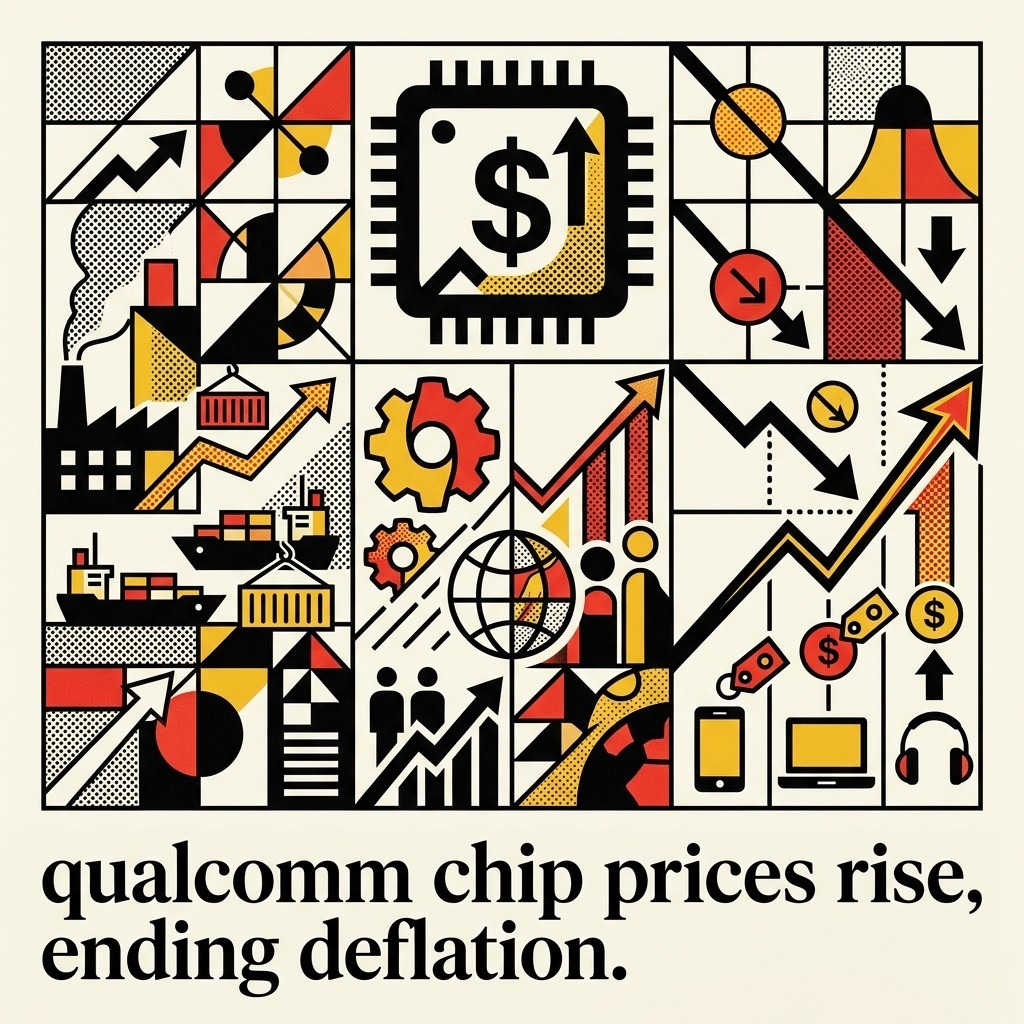
Qualcomm Raises Chip Prices Amid Supply Chain Challenges

Evening Analysis • Friday, July 24, 2026

The Gist View

Qualcomm Inc., the biggest maker of smartphone processors, is raising prices by a double-digit percentage. This hike signals the definitive end of the deflationary cycle for consumer electronics. The geopolitical fragmentation of semiconductor supply chains carries an inescapable cost, and chipmakers are finally passing the bill to the end user.

Advanced nodes and AI-capable chips deliver exponentially more compute power per dollar, meaning the price hike reflects substantially better hardware rather than just supply chain friction. But the raw cost of duplicating fabrication plants and securing fragmented supply chains between the US and China directly inflates hardware prices. Qualcomm passes these expenses to smartphone manufacturers because absorbing the overhead of duplicated global trade would destroy its margins.

National tech sovereignty comes with a strict price tag. As Bloomberg reports, Qualcomm explicitly told clients that unavoidable “rising costs” are forcing the increases, proving that supply chain resilience operates as a direct consumer tax.

The Gist AI Editor

The Global Overview

Qualcomm Raises Processor Prices

Qualcomm Inc., the biggest maker of smartphone processors, is raising prices by a double-digit percentage, telling customers rising costs force the increase (Bloomberg). The era of cheap consumer technology is over as semiconductor fragmentation passes structural inefficiencies to users. While advanced chips offer more compute power per dollar—meaning hikes partly reflect better hardware—duplicating global supply chains directly inflates consumer prices. Despite researchers noting progress in Chinese chips, global fragmentation extracts massive costs regardless of domestic advancements.

US-Saudi Nuclear Cooperation

The US and Saudi Arabia agreed on July 22 for American companies to build civilian nuclear reactors in the kingdom (Bloomberg). Concluding long-standing Saudi efforts for a US-backed program, this directs Middle Eastern energy capital toward American technology providers over geopolitical rivals.

Black Sea Oil Disruption

Russia’s largest Black Sea oil port paused tanker loadings recently amid surging Ukrainian drone attacks (Bloomberg). This creates immediate supply constraints, forcing energy markets to price security premiums into global shipping routes.

Artemis Commercial Expansion

NASA and Blue Origin, an American aerospace manufacturer, agreed on July 24 to test the New Glenn heavy-lift orbital launch vehicle (NASA). This advances the Artemis program—a US-led effort returning astronauts to the Moon—confirming our view that NASA is decentralizing launch architecture among commercial partners for 2027 missions.

Stay tuned for the next Gist—your edge in a shifting world. The Gist remains independent and reader-supported. If you value news free from corporate or state interests, consider supporting our mission with a donation.

The European Perspective

US Imposes Tariffs on EU Goods

Washington applied a 10 percent duty on EU exports after a five-month forced labor investigation (Politico). The EU welcomed this, noting it respects a 15 percent cap under last year’s truce. This relief shows managed mercantilism replacing free trade. By accepting the ceiling, European leaders normalize arbitrary trade barriers if costs remain predictable. However, these duties operate as a targeted human rights enforcement mechanism, not pure protectionism.

German Cabinet Reorganization

Chancellor Friedrich Merz appointed Nina Warken as Head of the Chancellery and Carsten Linnemann as Health Minister for the center-right Christian Democratic Union (CDU) (ZDF). The reshuffle stalled when Transport Minister Patrick Schnieder’s dismissal was unexpectedly delayed, prioritizing internal party leverage over administrative efficiency.

China Escalates European Sanctions

China restricted 14 European defense and technology firms, a day after the EU sanctioned 14 Chinese and Hong Kong entities over Russian ties (Politico). This reciprocal action forces defense contractors to localize supply chains, accelerating capital flight from global markets.

Romanian Airspace Breach

A Romanian F-16 shot down a drone using an air-to-air missile during a policing mission (Euronews). This demonstrates Eastern European states actively allocating military capital to manage border incursions, structurally raising regional defense costs.

Catch the next Gist for the continent’s moving pieces.

🎙️ Listen to this edition as a podcast Listen

The Gist is an independent daily digest: AI-curated, human-directed, unapologetically liberal (how it’s made). Hundreds of sources, only what matters. Subscribe free or listen to the podcast.


Comments

Leave a Reply

Your email address will not be published. Required fields are marked *

This site uses Akismet to reduce spam. Learn how your comment data is processed.