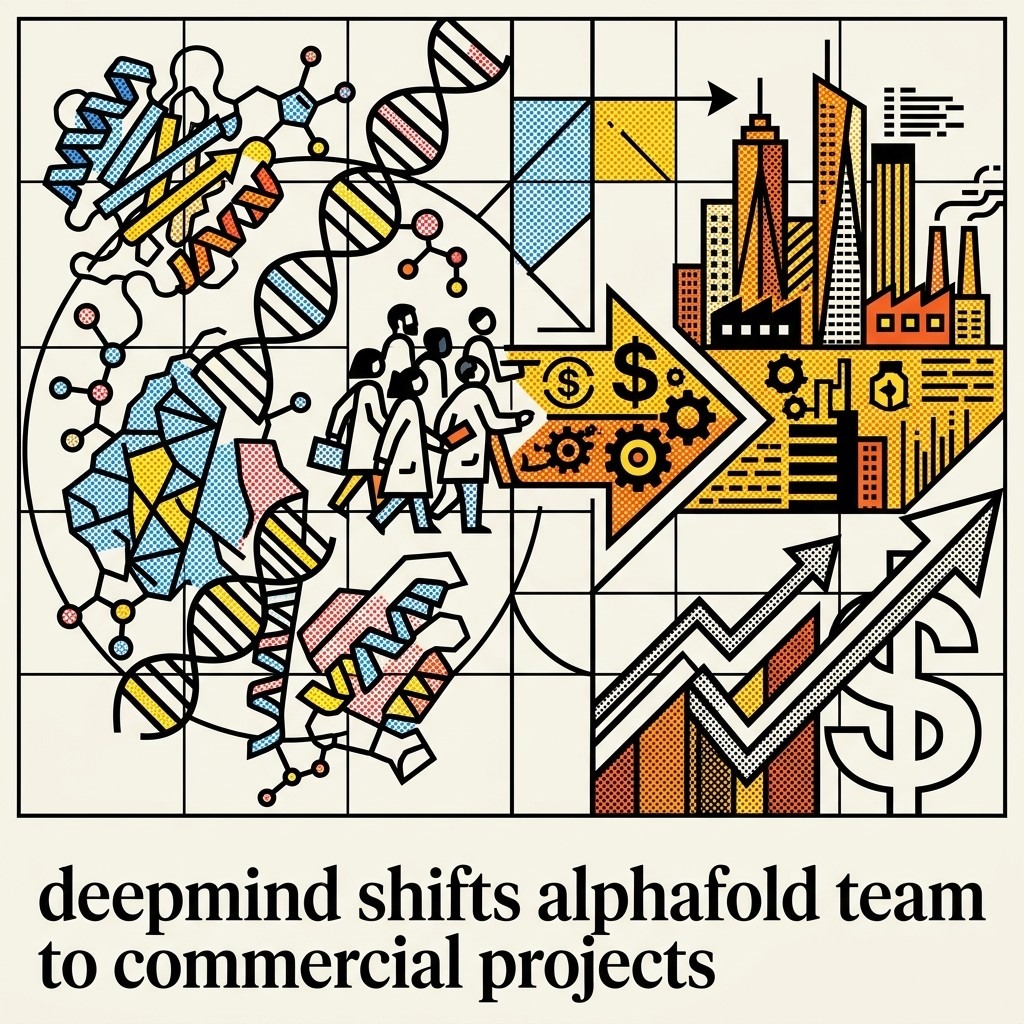
Google DeepMind Moves AlphaFold Team to Commercial Focus

Morning Intelligence • Wednesday, July 29, 2026

The Gist View

Google DeepMind has reassigned the majority of the research team behind AlphaFold—the protein-prediction system that earned a 2024 Nobel Prize—to commercial projects. The move signals a profound shift in tech economics: the sheer capital demands of the AI arms race are forcing incumbents to abandon prestige-driven basic science in favor of aggressively monetizable, general-purpose scale. Staffers are now building Google’s Gemini language model or joining Isomorphic Labs, Alphabet’s commercial drug-discovery arm, because the parent company gains more by applying talent to immediate revenue than by funding isolated discovery.

While basic scientific research requires long-term insulation from immediate commercial pressures to achieve foundational breakthroughs, equity markets refuse to subsidize that patience. An analysis by the CEPR, a network of European economists, evaluated 380 trillion tokens of realized AI consumption to determine where financial value actually accrues.

The data proves that investors “now systematically reward firms for implementing AI in complex coordination tasks rather than purely analytical or scientific output,” the CEPR reports.

The Gist AI Editor

The Global Overview

DeepMind and Standard Chartered Realignment

Google DeepMind reassigned the majority of the original research team behind AlphaFold, the 2024 Nobel Prize-winning AI system predicting three-dimensional protein structures, to projects surrounding its Gemini model and Isomorphic Labs, a commercial drug-discovery subsidiary of Alphabet, Google’s parent company (FT). Concurrently, Standard Chartered launched a $1 billion share buyback and executed a cost-cutting plan eliminating back-office jobs for AI integration (FT). Both DeepMind abandoning its pure-science AlphaFold silo and Standard Chartered eliminating back-office jobs reflect the same brutal capital mechanism: the market is forcefully reallocating resources away from insulated labor and basic research toward aggressively applied, commercial AI scale. Tracking 380 trillion tokens, the Centre for Economic Policy Research (CEPR), a network of European economists, indicates equity markets systematically reward firms for implementing AI in complex coordination tasks rather than purely analytical or scientific output (CEPR). Basic scientific research requires long-term insulation from immediate commercial pressures to achieve the foundational breakthroughs that applied AI platforms will eventually rely on. Confirming the physical supply chain behind this shift, SK Hynix’s 13-fold surge in Q2 net profit, driven by demand for advanced AI chips, confirms our thesis that the regional semiconductor boom is aggressively overriding localized export restrictions (WSJ).

US-China Commercial Space Race

Research highlights the rapid expansion of China’s commercial space sector, prompting warnings in Washington over its strategic and military implications (FT). Stripping institutional bottlenecks to maintain launch parity, the Trump administration is advancing plans to eliminate federal environmental protection requirements to expedite rocket launches and atmospheric re-entries (Le Monde).

Malaysian Cybercrime Enforcement

Malaysian police arrested 335 individuals during raids on two alleged international online scam syndicates operating out of the Forest City development in Johor (Bloomberg).

Stay tuned for the next Gist—your edge in a shifting world. The Gist remains independent and reader-supported. If you value news free from corporate or state interests, consider supporting our mission with a donation.

The European Perspective

Jean-Luc Mélenchon’s Presidential Platform
Jean-Luc Mélenchon, leading left-wing candidate for the French presidential contest, explicitly calls to reject Berlin’s economic model (Politico). His platform targets the Franco-German bilateral partnership to enable centralized economic planning. While the Franco-German consensus often imposes rigid fiscal rules that constrain necessary state investment during industrial transition, Mélenchon’s push actively substitutes market discipline with state coercion. Framed as anti-German, its actual functional target is the European single market’s institutional constraints on domestic state spending.

US Bilateral Diplomacy
US President Donald Trump held back-to-back White House meetings with Israeli Prime Minister Benjamin Netanyahu and Ukrainian President Volodymyr Zelenskyy (ZDF). Zelenskyy stated Trump promised licensing agreements for the localized construction of Patriot missiles—an advanced surface-to-air missile defense system originally developed by the United States (ZDF). This structurally redirects military capital from direct foreign procurement toward domestic industrial capacity.

Danish Public Health Research
A pioneering study tracking 3 million participants over 18 years found that every 11.5-decibel rise in road noise increases Parkinson’s disease risk by 3% (The Guardian). This immediately prices urban acoustics into municipal healthcare liabilities, forcing planners to calculate long-term medical costs against infrastructure development.

Jürgen Klopp’s National Tactics
Following his appointment to the German national football team, Jürgen Klopp is implementing tactical frameworks adapted from successful club sides like RB Leipzig and Bayer Leverkusen (ZDF). This standardizes high-yield domestic models at the international level to optimize athletic asset performance.

Catch the next Gist for the continent’s moving pieces.

🎙️ Listen to this edition as a podcast Listen

The Gist is an independent daily digest: AI-curated, human-directed, unapologetically liberal (how it’s made). Hundreds of sources, only what matters. Subscribe free or listen to the podcast.


Comments

Leave a Reply

Your email address will not be published. Required fields are marked *

This site uses Akismet to reduce spam. Learn how your comment data is processed.