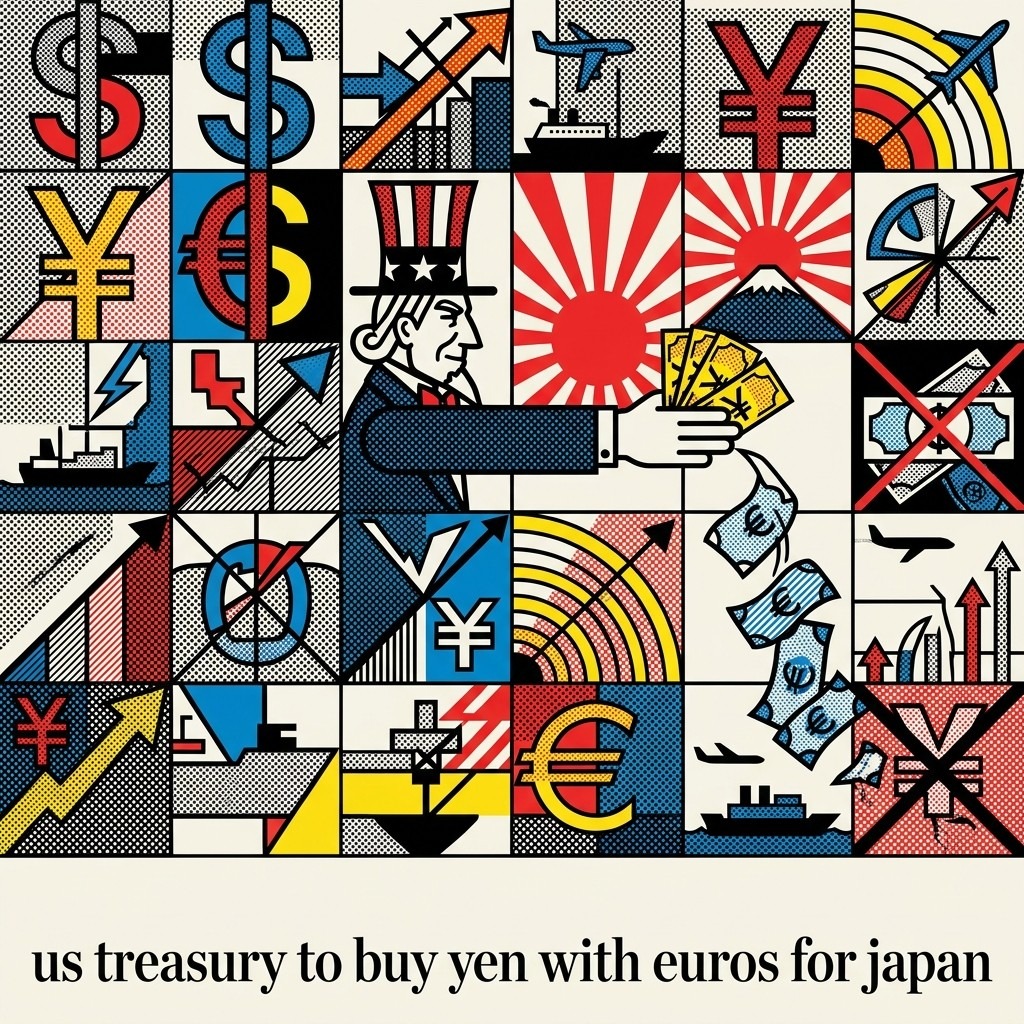
US Treasury to Buy Yen, Sell Euros; Urges Fed to Aid Japan

Morning Intelligence • Thursday, August 06, 2026

The Gist View

On July 31, 2026, US Treasury Secretary Scott Bessent initiated a rare intervention, preparing to buy $5-10 billion in Japanese yen by selling euros. He is publicly urging the Federal Reserve to expand its Foreign and International Monetary Authorities (FIMA) repo facility, which allows foreign central banks to temporarily swap US Treasuries for dollars. By pressuring the Fed to finance Japan’s currency defense, the Treasury is blurring the line between monetary policy and geopolitical maneuvering.

Lifting FIMA’s current $60 billion borrowing cap is not economic altruism. Japan holds over $1 trillion in US debt; preventing a disorderly liquidation of these assets is a legitimate financial stability imperative. Still, this defensive maneuver prioritizes American bond markets over central bank independence. Tokyo gains liquidity to prop up the yen; Washington prevents a spike in domestic borrowing costs.

Without an expanded facility, Japan’s only route to acquire intervention dollars is dumping its bonds on the open market, the Wall Street Journal notes.

The Gist AI Editor

The Global Overview

US Treasury Pressures Federal Reserve on Yen Defense

On July 31, 2026, Treasury Secretary Scott Bessent initiated a rare currency intervention, preparing to purchase $5-10 billion in Japanese yen by selling euros (WSJ). Bessent is publicly urging the Federal Reserve to expand its Foreign and International Monetary Authorities (FIMA) repo facility—which allows foreign central banks to temporarily swap US Treasuries for dollars—beyond its current $60 billion cap per institution (FT). By pressuring the Fed to finance Japan’s currency defense, the Treasury is eroding monetary independence to protect American bond markets from foreign liquidations. The primary motivation is a defensive maneuver to prevent Tokyo from dumping assets and spiking US borrowing costs, though preventing a disorderly liquidation of Japan’s $1 trillion in US debt remains a legitimate financial stability imperative (Reuters).

Norwegian Tax Data Exposes Union Leverage Limits

A 2026 economic study analyzing union dues tax deductibility in Norway measured the firm-level impact of workforce organization (FT). In average private-sector firms, higher union density lowered corporate profits and reduced overall employment. However, in highly concentrated manufacturing sectors, unions successfully offset employer monopsony power—where a single buyer dictates labor terms—increasing both wages and jobs.

NASA Telescope Confirms Solar Plasma Dynamics

On August 6, 2026, NASA released the highest-resolution visible-light images of the Sun to date, captured by the Inouye Solar Telescope (WSJ). The data confirms the presence of Kelvin-Helmholtz instability swirls: city-sized vortices forming when streams of magnetic plasma flow past each other at different speeds. Separately, Iran reached a Strait of Hormuz shipping route agreement with Oman to temporarily stabilize oil markets; we maintain that rewarding maritime disruption with diplomatic concessions trades long-term deterrence for short-term relief (Bloomberg).

Stay tuned for the next Gist—your edge in a shifting world. The Gist remains independent and reader-supported. If you value news free from corporate or state interests, consider supporting our mission with a donation.

The European Perspective

European Commission

The European Commission—the executive body proposing legislation across 27 member states—received 1,000 formal complaints (Politico). Internal filings expose toxic management, excessive hours, and unwieldy bureaucracy. This volume reveals a culture aggressively policing private-sector labor standards while failing its own workforce, indicating administrative bloat actively contributes to abuse. However, a high complaint volume often signals a functional whistleblowing mechanism rather than an exceptionally toxic baseline.

Rhine River Logistics

Water levels at the Kaub gauge—a critical measurement chokepoint on the Middle Rhine in Germany—dropped to a record low of 17 centimeters (ZDF). The Rhine transports 285 million tons of freight annually for the chemical, steel, and energy sectors. Paralyzing Europe’s busiest inland waterway adds acute physical friction to ongoing European supply chain disruptions, exposing the severe fragility of domestic intra-EU logistics.

Aura Aero

French startup Aura Aero secured its first firm order from Pan Européenne Air Service for its Electric Regional Aircraft (ERA), a hybrid-electric 19-seat plane (Le Monde). Entering commercial service by 2030, the ERA utilizes eight electric motors to reduce CO2 emissions by up to 80% on flights under 500 kilometers.

Catch the next Gist for the continent’s moving pieces.

🎙️ Listen to this edition as a podcast Listen

The Gist is an independent daily digest: AI-curated, human-directed, unapologetically liberal (how it’s made). Hundreds of sources, only what matters. Subscribe free or listen to the podcast.


Comments

Leave a Reply

Your email address will not be published. Required fields are marked *

This site uses Akismet to reduce spam. Learn how your comment data is processed.